
Marko Ristić (Yugoslav Partisan)
Marko Ristić (Serbian Cyrillic: Марко Ристић; 13 December 1913-14 August 1942) was a Serbian Communist Revolutionary, and Yugoslav Resistance fighter and writer in Serbia and a participant in the National Liberation War in Yugoslavia (1941-1945) and a key member of the failed assassination attempt on Serbian fascist politician Dušan Letica a Minister in the Nedić's regime in 1942. Ristić was declared a National Hero of Yugoslavia
Biography
Marko Ristić was born in Novi Sad, Kingdom of Serbia, in 1913 to a Serbian-Slovene family. His mother was from Slovenia and his father was Serbian, his father died from his wounds during World War I against the Austrian-Hungarian Empire, after the war his family left Novi Sad and went to the Serbian capital city Belgrade, where he finished elementary school, high school, and university. After graduating from the University of Belgrade, Ristić Joined the Communist Youth Party of Yugoslavia (KPJ) at the age of 22 in 1935, the year before the Party was outlawed, and he went to Spain to fight in the Spanish Civil War as a Yugoslav volunteer on the Republican side. After the war he studied the Czech language in Ljubljana. In 1940 he became a full member of the Communist Party, he was married to Milka Stojković (1918-1944) who also fought on the Yugoslav Partisans she was from Dubrovnik, they had one son.
World War II and the assassination in Belgrade
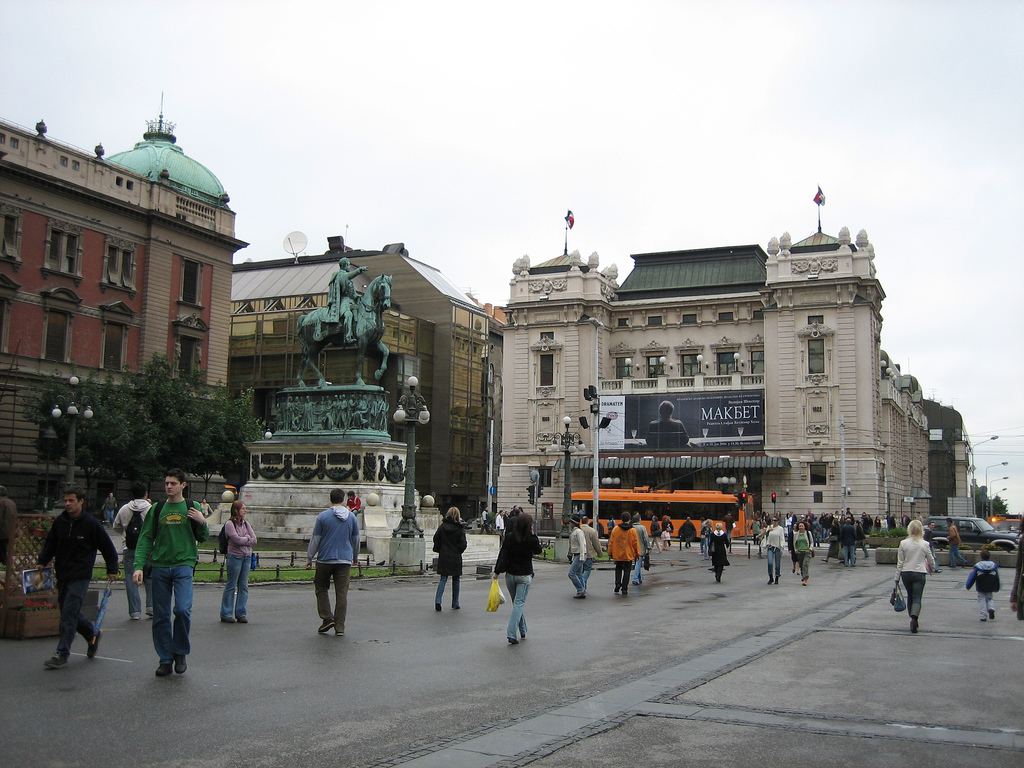 Dušan Letica took place on 4 August 1942]] After the occupation of Yugoslavia in April 1941, Ristić joined the Yugoslav Partisans in June 1941, and took part in the Anti-[...] uprising that retook some cities in Germans-occupied Serbia (Which included Capture of Banja Koviljača, Battle of Krupanj) . By the end of September, preparations of the assassination of Dušan Letića began in a conference meeting in Sarajevo, Bosnia and Herzegovina; the code name of the failed assassination attempt was "Operation Letica". At the beginning of 1942, he and the other members returned to Serbia. On the Day of the assassination attempt, Marko Ristić, Mirko Tomić, Spasenija Babović, Ljubinka Milosavljević, Vasilije Buha, and Nikola Grulović, then waited at a building for Letica to arrive, when Letica was in a vehicle (a Mercedes-Benz W31) 2 at 11:05 AM the assassination took place when Ristić shot the sniper, the first bullet missed, than Ristić shoot again hitting and wounded him, after wounded letica, Tomić went in front of the vehicle took out his MP 40 shooting the two Serbian State Guard members in the car, after the gun was out of bullets Tomić then ran. At 11:13 AM the failed assassination attempt was over.
Eight days after the assassination attempt, Dušan Letica ordered the executions of the assassins of the plot, and Serbian State Guards went to find the assassins in Požarevac. Marko Ristić was interrogated and tortured by the Belgrade Special Police; nine days after the attempt, Serbian fascists put him on trial and was sentenced to death the day before he was executed. The Serbian State Guards executed Ristić in Belgrade on 14 August 1942. While Mirko Tomić was arrested in January 1943 and executed that same month, Vasilije Buha was arrested the same year when he entered the police ambush in the apartment, Vasilije Buh was shot on 7 September 1944 in Belgrade, after the war in 1945, Dušan Letica was found guilty of the [...] of Marko Ristić on 17 September 1945 two days before he was executed, he was executed on 19 September 1945, Ristić was declared a National Hero of Yugoslavia. On 29 March 1946, in a interview with Jefto Šašić another Yugoslav Partisan fighter in 1981, he claimed that Ristić was behind the assassination attempt. Ristić's wife Stojković was killed in action in a battle against the Germans in Bosnia