
Low-energy vehicle
A low-energy vehicle is any type of vehicle that uses less energy than a regular vehicle. The higher efficiency is achieved by a different vehicle design not only power train modifications. The biggest influence on the efficiency however is not the engineering quality but the vehicle specification (top speed, safety reserves, load capacity...)
Motivation
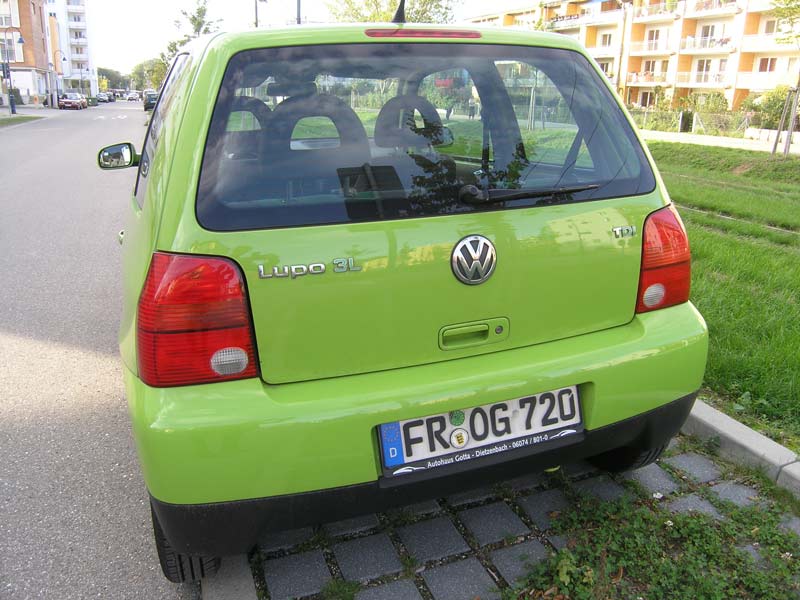
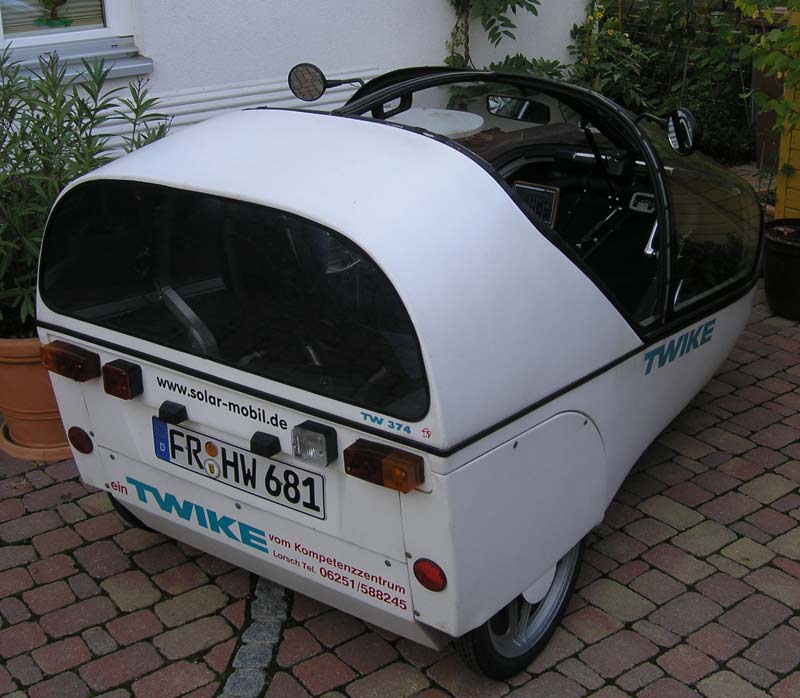
Standard for passenger cars in Europe is 175 CO2 g/km which equals 6.6l diesel (43 mpg UK / 35 mpg US) or 7.5 l gasoline per 100 km (37 mpg UK / 31 mpg US) respectively. It is not feasible to base transportation in the long run on such high energy consumption without provoking heavy access conflicts to oil reserves and/or environmental damages when trying to produce fuel from natural or other fossile sources. Today's best medium sized cars are consuming 4 l diesel/100 km (70 mpg UK / 59 mpg US) which equals 105 g/km.
Some newer examples of efficient commercially available ICE-propelled vehicles:
- Audi A2 (3l) 3.0 l Diesel/100 km (94 mpg UK / 78 mpg US) (removed from production)
- VW Lupo (3l) 3.0 l Diesel/100km (94 mpg UK / 78 mpg US) (removed from production)
- Toyota Prius (Hybrid) 4.2 l/100 km (67 mpg UK / 56 mpg US)
- Honda Insight Hybrid vehicle 4.3 l/100 km (65 mpg UK / 54 mpg US) (removed from production)
- Honda Civic Hybrid 4.6 l/100 km (55 mpg UK / 46 mpg US)
- Citroen C3 Stop & Start 5.0 l Diesel/100 km (56 mpg UK / 47 mpg US)
As targets for the development of vehicles propelled by fossil fuels two classes of Low-energy vehicles are proposed:
- Low-energy vehicles (LEnV) having 18.1-105 g CO2/km
- Ultra-low-energy vehicles (ULEnV) below 18 g CO2/km (approx. 10% of the usual 175 g CO2/km )
That is a relative standard, of course, and will certainly change in the future. ULEnV will not be feasible with internal combustion engines only working with fossil fuels.
Available electric LEVs already use about ten times less energy than available cars, e.g. 4–8 kW·h/100 km (from 230 V AC grid) for the Twike 1. Here the challenges are increasing range and lifetime of batteries and reducing price.
Preconditions
Energy demand may be kept low by:
- lower parasitic masses (compared to the average load) causing low energy demand in transitional operation (stop and go operation in the cities) Paccel = mvehicle ⋅ a ⋅ v where P stands for power, mvehicle for the total vehicle mass, a for the vehicles acceleration and v for the vehicles velocity. Extreme masses will go down to 300 kg from today's 1100 kg to 1600 kg. Five seaters of the sixties had 625 kg2. Japanese sub-compact cars have 500-600 kg. Further mass reduction is possible by lowering the maximum number of passengers. Two-seater microcars have less than 400 kg, single-seaters less than 300 kg. Further reductions are possible with very light construction, e.g. Twike. Such vehicles offer less passive safety but higher safety for other road users and higher overall safety at lower speed levels.
- low cross-sectional area and mirrors replaced by cameras causing very low drag losses especially when driven at higher speed ${F_{drag}= A_{cross} \cdot C_d \cdot \frac {v_{air}^2 \rho_{air}} {2} }$ where F stands for the force, Across for the cross-sectional area of the vehicle, ρair for the density of the air and vair for the relative velocity of the air (incl. wind). Two seating places in a tandem (back to back or forward facing in line) arrangement drastically reduce the cross-sectional area down to 1 m². The drag coefficient Cd of the vehicle may be as low as 0.15 for very good vehicles.
- low rolling resistance due to smaller and high pressure tires with optimised tread and low vehicle mass driving the rolling resistance Froll = μroll ⋅ mvehicle ⋅ g where μroll stands for the rolling resistance coefficient, g for acceleration due to gravity and mvehicle for the vehicle mass. Advanced driver assistance and ABS prevent safety problems caused by the small tires. Values of μroll down to 0.0025 are possible but are more usually 0.005 to 0.008 for cycle-type tires and 0.010 to 0.015 for car tires.
Technological support for low energy operation may also come from driver assistance systems since also the driving style is to be adapted to achieve those low energy consumptions. Energy management becomes possible with hybrid vehicles with the possibility to recuperate braking energy and to operate the internal combustion engine (ICE) at higher efficiency on average. Hybrid power trains may also reduce the ICE-engine size thus increasing the average load factor and minimising the part load losses. Purely electric vehicles use less energy than than those with combustion engines because of the much higher motor and battery efficiencies. However maximum ranges are much less because of the low energy density of electrochemical storage batteries compared to chemical fuels.
Facts
Average data for vehicle types sold in the U.S.A. (source theautochannel.com):
Type |
Width |
Height |
Curb weight |
Combined fuel economy |
|---|---|---|---|---|
Minivans |
75.9 in 193 cm |
70.2 in 178 cm |
4275 lb 1939 kg |
20.36 mpg 11.55 l/100 km |
Family sedans |
70.3 in 179 cm |
57.3 in 146 cm |
3144 lb 1426 kg |
26.94 mpg 8.73 l/100 km |
SUVs |
73.5 in 187 cm |
70.7 in 180 cm |
4242 lb 1924 kg |
19.19 mpg 12.25 l/100 km |
Honda Insight |
66.7 in 169 cm |
53.3 in 135 cm |
1850 lb 839 kg |
63 mpg 3.73 l/100 km |
Drag resistance for SUVs is at least (same drag coefficient) 30% higher and the acceleration force has to be 35% bigger compared to family sedans. This gives of 40% higher fuel consumptions (even when including parallel hybrid electric SUVs).
Reality
In practice we have not seen much on the market focusing on low propulsion energy demand. One of the last good examples was the Honda Insight. However there is a good uptake of scientific competition for example the Shell Eco-Marathon.
Measures
The EU- sponsored RECODRIVE project has set up a quality circle to manage low energy consumption in fleets. This starts with energy aware procurement, and includes fuel management, driver information and training and incentives for all staff involved in the fleet management and maintenance process.
See also
- Battery electric vehicle
- Plug-in hybrid
- Gas-guzzler
- Green vehicle
- Low-carbon economy
- Low-rolling resistance tires
External links
- Shells ECO-marathon
- VW Lupo driven with 2.5 l/100 km in Australia 94 mpg U.S.
- Toyota ES3 2.7 l/100 km in the FIA ECO-Test 87 mpg
- Mitsubishi i-concept car tested at 3.8 l/100 km 62 mpg
- InsightCentral, encyclopedia featuring the measures shown for the Honda Insight
- Loremo - Concept car presented at the Automobile Sallon Geneva 2006
- Jetcar 2.5l/100km
- Fuel Efficient Vehicles Now An activist site with much information on what can be done now to do to improve things even more.
de:Niedrigenergiefahrzeug fr:Véhicule à faible consommation énergétique