
Kingman Group
Kingman Group is a manufacturer of paintball markers renowned for their low cost and easy maintenance. Their main products are the Spyder line of markers, the Raven markers, and Java, which produces apparel and other equipment for paintball players.
Stacked Tube Blowback
The flagship of the Kingman line is considered to be the Spyder series of markers. They all operate on the basic principle of stacked tube blowback. It is a fairly simple and reliable system consisting of only a few parts. The mechanism is known for its ease of repair since most of its problems can be fixed with the replacement of a simple o-ring.
The system also tends to be louder than other makers due to the violence of the action within the marker. Its consistency is also questionable as there is no regulating system within the mechanism, meaning the speed at which the paintballs are launched will vary between shot to shot. This can be improved with the use of HPA/Air and by installing an external regulator.
Operation
The parts that make up the stacked tube blowback are the body, trigger sear, bolt, striker/hammer, valve, valve pin, cup seal, main spring, and valve spring.
When cocked, in the bottom tube, the main spring exerts forward pressure on the striker, which in turn is held in place by the trigger sear, the valve spring exerts backwards pressure on the valve pin which closes the valve with the cup seal, thus holding back the air/CO2. In the top tube sits the bolt which is connected by a rod to the striker and the paintball which sits in the chamber held in place by a detent.
When the trigger is pulled the sear releases the striker, which flies forward being pushed by the main spring. When it reaches its forward limit of travel it impacts the valve spring, thus pushing back the cupseal and opening the valve. The air/CO2 is released, part of its volume is sent upwards into the bolt, which by this time has pushed the paintball into the barrel. This volume propells the paintball through the air. The remainder of the gas pressure forces itself against the striker, pushing it against the mainspring and all the way back past the sear resetting the striker to its resting position, at the same time the valve spring pushes the pin and cupseal forward closing off the valve and resetting the system for its next shot.
The trigger sear can be released by either mechanical force, in so-called mechanical markers, or by an electro-magnetic solenoid in electronic markers.
Clones
The Stacked-tubed blowback system was first created by PMI for their PMI-III, later renamed as the VM-68. Its simplicity and reliability meant is was copied and improved upon by many other manufacturers.
Due to the popularity of the Spyders and the availability of their parts many manufacturers have produced products similar to the Spyders. These use practically the same internals and parts of the spyders. Some of these clones may even be of higher quality/performance to the spyder, while some May Be cheaper or of less quality.
This mechanism is used by most low-end mechanical and electronic markers and can be easily identified by the double stacked tube body.
Products
The flagship marker line of Kingman is the Spyder. They are known for their simple, easy to maintain mechanism and low cost. Essentially, most repairs are done by field stripping the marker and replacing a broken o-ring. The field stripping is done by simply removing a quick-strip pin, allowing its internals to be removed through the back of the marker, or on older models through the removal of 2 screws. Its simplicity also allows for extensive modding, with many upgraded internals to improve the marker's efficiency and consistency, and a variety of externals to enhance cosmetics and functionality. Their aluminum bodies and components also make them fairly light and easy to maneuver.
But, they are somewhat louder than most markers due to the fast movement of relatively heavy components, these being the striker and bolt. Also, due to the lack of internal regulators they tend to be fairly inconsistent, launching the paintballs at varying speeds and thus affecting accuracy. This of course is false on the versions that include an external regulator while those without regulators can have them attached as an upgrade.
Although a comprehensive list of all of the designs and variations of the Spyder is almost impossible to complete, here is a list of some of their products. These are the main 'models' of markers, each 'model' may have different 'sub-models' within it. For example, Spyder MR1, MR2, and MR3.
these markers are the most commonly used as they are cheap, reliable and rarely jam or misfire.
Spyder VS series
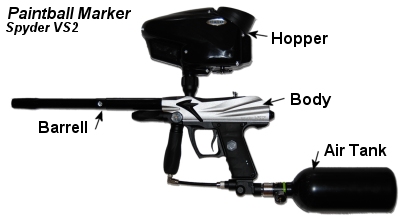
The VS series was released in 4Q 2006 and is geared towards speedball/tourney players. The Spyder VS2 features an infinity trigger system with 3g technology, a valve that allows the marker to operate at 200psi and anti-chop eyes. The Spyder VS3 adds a Rocking Trigger.
Spyder MR series
The MR series markers are geared towards players who prefer woodsball/scenario type games. They feature mil-sim style bodies painted flat-black and the same reliable action as other spyders.
The Spyder MR1 is the most basic MR marker and features a detachable STOCK and completely mechanical (although there is an electronic version) action similar to most mechanical Spyders. The Spyder MR2 features and electronic trigger frame, and an Anti-Chop System (ACS) Bolt which helps PReVENT chopping. The Spyder MR3 adds eyes to the electronic system to further prevent chops.
Electro-mechanical
- Spyder Flash: The first electronic Spyder. Used innovative insert barrel and dip-switch set firing modes. Rear cocking with an oft-maligned aluminum bolt guard. No charging mechanism, used a single 12v battery.
- Spyder Electra /w ACS: An electro-mechanical marker that features an Anti-Chop (ACS) Bolt, electronic trigger frame (CAMD v3.0),shooting 30 bps (balls per second) and a rocking trigger.
- Spyder Electra /w eye: Same basic marker as The electra but features a different electronic trigger frame (CAMD v4.0) and break-beam eyes to further prevent chopping.
- Spyder Imagine: A simple, reliable Spyder. Great starter gun, cheap, and very upgradeable for the price.
- Spyder Pilot: A low-end electro mechanical marker features an electronic trigger frame (CAMD) with Semi-Auto up to 20 bps in 3 Bursts, 6 Bursts, and Full Auto modes. It also has a top-cocking venturi bolt.The Gun Has a lub-less bolt,Vertical feed, and a battery that is good up to 700 charges
- Spyder Pilot ACS: Same basic marker as the Spyder pilot, but featuring a different body and Anti-Chop bolt (ACS) that helps prevent chopping and a different trigger frame (CAMD v2.0). Has semi up to 20 bps, 3 burst, 6 burst, or full auto up to 13 bps.
- Spyder Fenix ACS: Features a regulator with gauge, an electronic trigger frame (CAMD v2.0), and a top-cocking Anti-Chop bolt (ACS) that helps prevent chopping. Also features a sleek milled body.
- Spyder E-99: One of the early attempts at an entry-level electro-mechanical marker. Features an IPI electronic trigger frame, and rear cocking. 4 Stock modes: 3 Round Burst, 6 Round Burst, Semi-Auto, and Full Auto. Stock Capped at 13 BPS
Mechanical semi-auto
- Spyder Rodeo: The Spyder Rodeo is a mechanical semi-auto marker that features a Regulator that improves consistency, two-finger trigger and rear cocking. It also featured a milled aluminum body. The top-of-the-line Mechanical Spyder.
- Spyder TL and TL Plus: The Spyder TL and TL Plus are semi-auto mechanical markers that featured a new, for its time, sleek body, two-finger trigger, and Rear-Cocking, leaving the older Top Cocking mechanism behind.
- Spyder Xtra: The Xtra is an entry level mechanical marker that featured a two-finger trigger and gas-thru foregrip and rear cocking.
- Spyder Sonix: Another entry-level marker. Featured two-finger trigger, gas-thru foregrip, and top or side-cocking. Also comes in Sonix Plus and Sonix Pro versions. Was made from re-manufactured basic Spyders. Where mostly re-anodized blue at the factory
- Spyder Victor: An entry-level marker which usually comes as part of a kit. Features two-finger trigger, gas-thru foregrip, and "Vizion" rear-cocking. Comes in 3 versions: Spyder Victor II, Spyder Victor 2006, Spyder Victor.
- Spyder Aggressor: One of the earlier markers, featured a quick-strip pin, rear cocking, vertical feed and two-finger trigger.
- Spyder ONE/Classic: The earliest versions of the spyder. Came with single-finger trigger and side-cocking. Characterized by their silver bodies with black trigger frame and powerfeed tube.
- Spyder Compact 2 in 1: Same popular Compact 2000 paintball gun with a removeable bottomline. Length with barrel: 17"; Weight: 1.8 lbs. Features include: Semi-auto action, Powerfeed, 45 grip with rubber grip cover, Second-generation venturi bolt, anti-double feed, JAVA EDition anodizing, double trigger, raised mini sight rail, low pressure chamber, vertical ASA or bottomline setup, external velocity adjuster, aluminum barrel with muzzle break, filter system, composite trigger frame, quick disconnect, field strippable T-pin.
Raven
- Raven Nexion: A low-end electronic marker. Features a regulator, vertical feed, electronic LCD trigger frame with 4 firing modes, and can operate on either CO2 or HPA
- Raven Primal: A high-end electronic marker. Features SDE (Solenoid Direct Electro) system, reactive response trigger, inline regulator with gauge, and low pressure regulator.
References
- (2007) AbOUT Kingman Group 1
- (2007) OtterSC Customs, How Spyders Work 2
- (2007) Goodman, Billy. Two Tube Blowback Basics 3