
Kasana clan
Kasana (Gojri:कसाणा) or Kushane (Gojri: कुषाणे ), often cited to be derived from Kushan(कुषाण), is a Gujjar clan of Suryavanshi Kshatriyas.
Kasana's are mainly found in India, Pakistan and Afghanistan.In India Kasana are found in the states of Jammu & Kashmir, Punjab, Uttar Pradesh, Himachal Pradesh, Delhi, Rajasthan, Haryana, Gujarat & Maharashtra.
Gujjar clan: Kasana, Kushan, Kusane, Kushane |
Distribution |
Descended from: |
Branches: |
Religion |
Languages |
Surnames: |
Origin
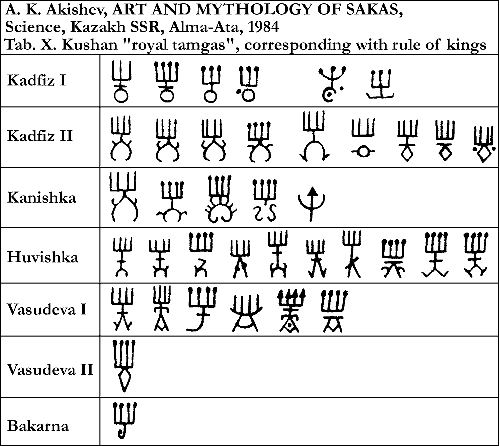 Chinese sources describe the Guishuang (貴霜), i.e. the Kushans, as one of the five aristocratic tribes of the Yuezhi (月氏), with some people claiming they were a loose confederation of Indo-European peoples, though many scholars are still unconvinced that they originally spoke an Indo-European language.
"For well over a century, however, there have been many arguments about the ethnic and linguistic origins of the Da Yuezhi (大月氏), Kushans (貴霜), and the Tochari, and still there is little consensus.
The Yuezhi had been living in the arid grasslands of eastern Central Asia's Tarim Basin, in modern-day Xinjiang, China, possibly speaking varieties of the Tocharian languages, until they were driven west by the Xiongnu in 176–160 BC. The five tribes constituting the Yuezhi are known in Chinese history as Xiūmì (休密), Guishuang (貴霜), Shuangmi (雙靡), Xidun (肸頓), and Dūmì (都密).
John Keay contextualizes the movements of the Kushan within a larger setting of mass migrations taking place in the region:
The Yuezhi reached the Hellenic kingdom of Greco-Bactria (in northern Afghanistan and Uzbekistan) around 135 BC. The displaced Greek dynasties resettled to the southeast in areas of the Hindu Kush and the Indus basin (in present-day Afghanistan and Pakistan), occupying the western part of the Indo-Greek Kingdom.
General Cunningham identified the Kushans as Gurjars or Gujjar. The word Gusur is referenced in the Rabatak inscription of Kushan king Kanishka. According to some scholars the Word Gusur, which means Kulputra or a "man or woman born in high family", in this inscription stands for Gurjara. Gurjars belonging to Kusana or Kasana clan can be found even today in north western India, Pakistan and Afghanistan. The Gurjars of Central Asia are termed as Gusur (Gujur) even today.
Traditions
Hindu
Like other Hindu gujjars Hindu Kasana are mainly vegetarians and in the selection of spouse, the strict socioeconomic condition of the negotiating families is seen and four gotra, that is, self, mother's, Grandmother's and mother’s mother, are avoided. The women of well-to do household may not, however, like to work in the fields, but during the peak harvesting season their assistance is inevitable. A woman’s role, both in the domestic as well as in economic sphere is significant. The womenfolk are deft in making embossed floral patterns on the walls of the house. During Navratra festival (9 days devoted to the worship of Durga ), they make their own clay model of goddess Durga for worship which is later immersed in the river. Some of them make intricate appliqué on the straw fans and do embroidery as well. These are not for sale but are kept for their use. They share folksongs or dances of the region.there are 24 villages of Kasana Gurjars in Loni Block in Ghaziabad district of Uttar Pardesh such as Shakalpura,Jawali,Rajpur,Bhopura,Mandla,Kotwalpur,Ristal,Dharipur,Bhubkheri, Ghari Klanjri,Sirora,Rewri,Mhamoodpur and Milak etc. 48 villages in Agra district of Uttar Pardesh .
Muslims
A Muslim Gujjars male is recognized his typical beard and dress. They wear a specially embroidered conical headgear called gujjari topi, jawaharcut colored embroidered jacket, a loose long kurta and a tamba, while their women wear chooridar pyjama and loose kurta usually of brown, black or green color. Bio-anthropological information with respect to hemoglobin variants somatometry, serology, genetics and dermatoglphics in the community is available. They are mostly non-vegetarian, but mutton is consumed occasionally and on important occasions only due to lack of availability. Eating pork is taboo. They do not eat beef or buffalo meat. Their staple diet consists of maize chapatti, pulses and leafy vegetables. Their cooking media are mustard oil and desi ghee. Preparation of milk products like lassi and dahi, also form a part of their daily diet, which are their home products. Taking alcoholic beverages is a taboo as per the tenets of their religion but a few do consume it. They also consume non-alcoholic beverages like salted tea and lassi. A distinctive feature of their marriage is that consanguineous marriages take place. A boy can marry his cousin, either on the father’s or mother’s side provided they gave not in their infancy been suckling from the breast of the same mother. Tehe marriages take place by nikah in which both the boy and the girl agree to marry each other in consideration of an agreed amount of mehar which has to be paid in the event of annulment of the marriage. Both junior levirate and junior sororate are permissible. Dowry is not demanded but is given in kind in the form of a buffalo or cow as per one’s economic position.
External links
- http://himachalweb.com/gujjer/index.htm
- http://www.gurjarindia.com/Culture/Origin.html
- http://www.hinduism-guide.com/hinduism/gurjara.htm
- http://www.allempires.com/article/index.php?q=kushan_empire_intro
- http://www.gloriousindia.com/history/kushans.html
- http://history-timeline.deepthi.com/india-timeline-history/kushan-empire.html
simple:Kasana