
John DeFazio
John Paul DeFazio (born 1975) is a Los Angeles based mixed-media & glitch artist, experimental film & music video director, and award winning director of photography in the film and television industry.
He is an ACTIVE member of Film Independent, the Music Video Production Association, the International Cinematographers Guild Local 600, and also Local 80. DeFazio has shot movies for legendary Hollywood directors and producers such as Joe Dante ("Gremlins"), Paul Schrader ("American Gigolo" and screenwriter of "Taxi Driver" & "Raging Bull"), and Roger Corman ("Death Race", "The Little Shop of Horrors").
DeFazio has directed music videos for rapper J-Flexx (former Death Row Records producer), Evan Elton and producer DJ Lethal (La Coka Nostra, Limp Bizkit), pop vocalist Rae Ray, & crunkcore rapper J Bigga.
Early life
John DeFazio was born and raised in Pittsburgh, Pennsylvania where he also received a Fine Arts and Design degree from Carnegie Mellon University. Upon graduation from Carnegie Mellon he traveled to Los Angeles and attended the University of Southern California School of Cinematic Arts where he received a Masters of Fine Arts in Film Production before settling in Korea Town, a neighborhood just south of Hollywood.
Cinematography
Since relocating to Southern California, DeFazio has served as the director of photography on numerous music videos, 35mm and high-definition movies, some of which have hit the Sundance Film Festival ("Crossing", "Roam") and the Cannes International Film Festival ("9:30"). John's second feature, Undoing (film), was singled out by the Los Angeles Film Festival for its "striking imagery." While DeFazio's diverse background in the visual arts offer him a unique perspective and approach to cinematography, his work has been criticized for its overuse of color-drenching, over-exposure, and under-exposure.
In July 2012 DeFazio commenced production on the [...], neo-noir feature, The Canyons (film), written by Bret Easton Ellis (Author of "American Psycho" & "Less Than Zero"), directed by Paul Schrader, and starring Lindsay Lohan, Gus Van Sant, and James Deen. The film received enourmous media coverage for the innovative way in which it was financed and produced, utilizing new media techniques including crowdfunding, online casting and social media sites including Twitter and Facebook. The film also received extensive attention for the casting of lead actress Lindsay Lohan and [...] star James Deen.
Mixed-Media Art
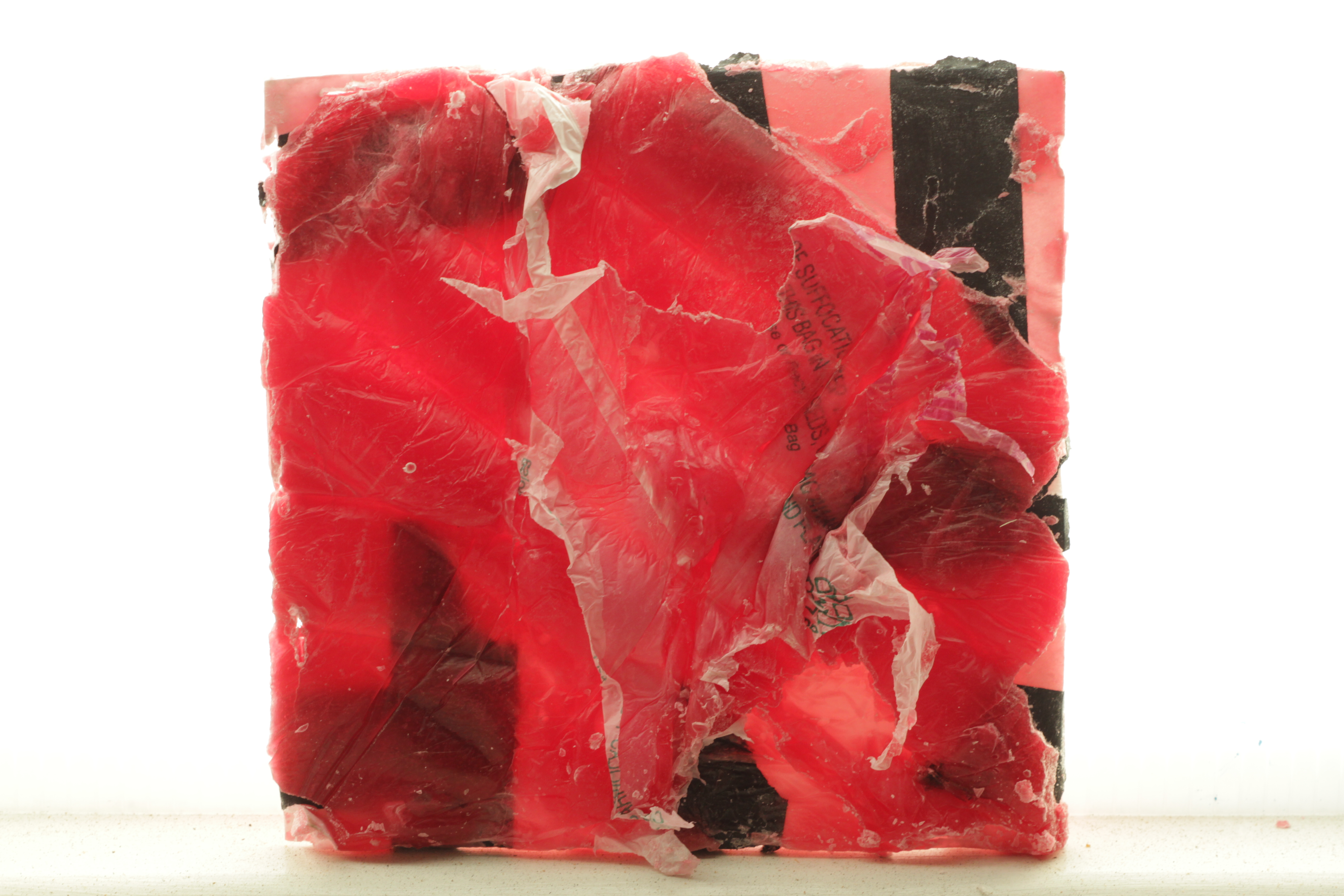
Despite his professional career as a cinematographer, DeFazio is also known for his mixed-media work utilizing non-traditional materials such as grunge remnants (dirt, hair, dust, organically grown rust), grease, oils, fabric dyes, fiberglass resin, and decayed organic substances mixed with more traditional materials such as photographs, glass, steel, copper, concrete, plaster, paraffin wax, and found metal objects. He has been using the same materials and utilitarian methods of construction consistently since the mid 90's.
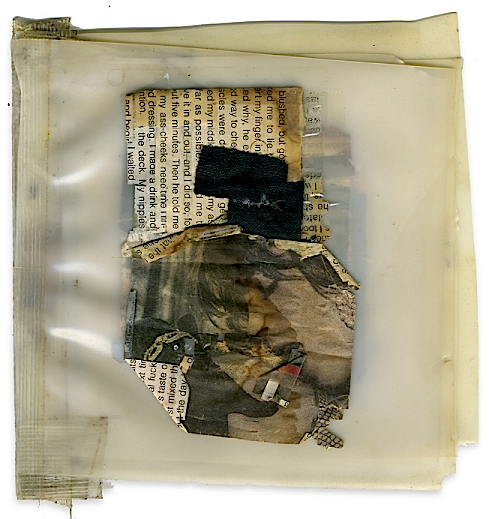
DeFazio's earliest work, between 1990 and 1998, consisted primarily of traditional black and white photography and sporadic experimentation with mixed-media and machinic sculpture. It was not until his move to Los Angeles, and into the early 2000s, that he began mixing these two mediums into cohesive, symbiotic wholes. His first notable mixed-media piece, VIVISection I (2000), consisted of a series of drastically deteriorated 3"x3" squares haphazardly cut from Penthouse Forum literature which were then further butchered and layered upon each other giving rise to newly formed text/image relationships through the juxtaposition of revealed slices of image and text within and throughout their layers. These squares were further layered with aged tape and glue, then mounted onto 5"x5" sheets of shower curtain material and compressed between glass plates.
|
|
|

|
|
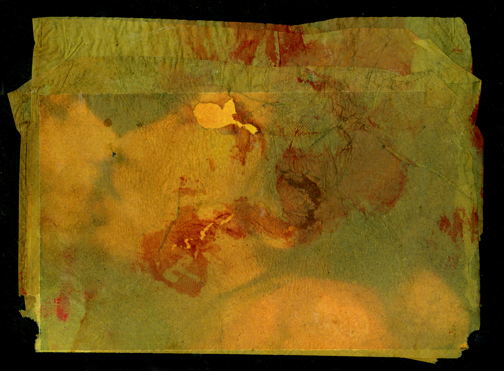
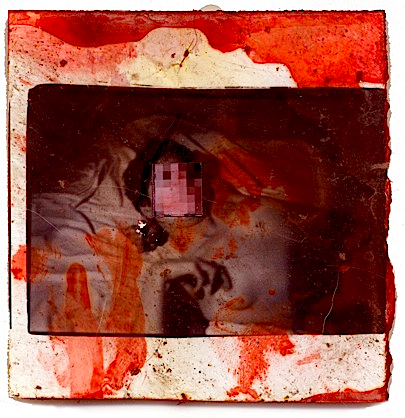
DeFazio's later work shifted towards large photographic enlargements layered with various materials such as oil-soaked tissue, water-based paint, and fiberglass resin. "Kiss in a Red Storm 1-5", consisted of a series of identical photographic prints of a man in mid-kiss with a woman. These prints are layered between deteriorated pieces of yellow, liquid absorbing paper (with poor mechanical strength characteristics) that had been soaked in oil and haphazardly littered with red paint in nondescript chaotic patterns. The translucence of the oil-soaked paper and paint layered over the photographs adds an additional layer of texture and trasformation.
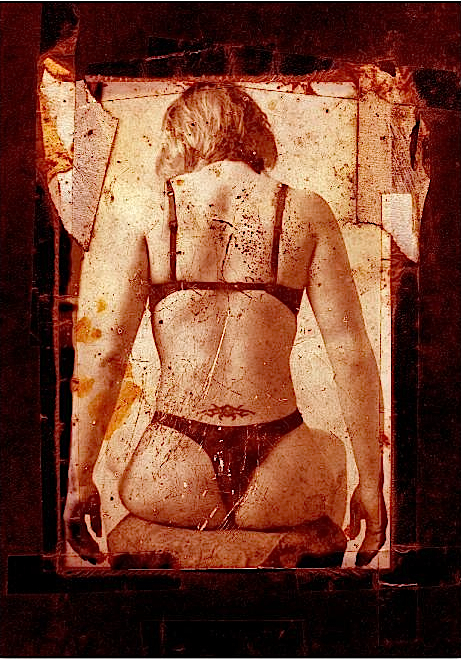
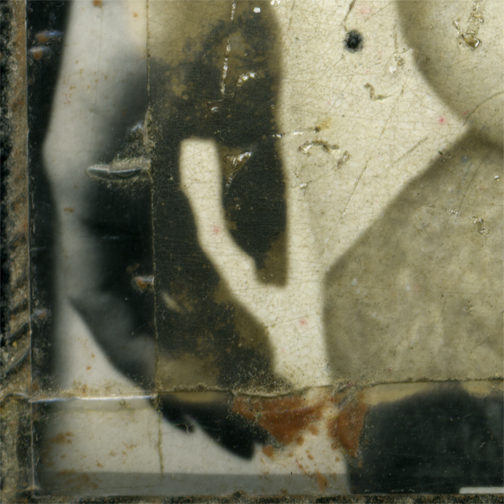
A technique commonly used in his photographic work is degrading the initial image with various methods such as moisture contamination, scrapes, aging, and dyeing before enlarging to its final form. "Mother of God" and "Torso I" demonstrate this technique. Both pieces originated from decayed and degraded images which were then enlarged and further layered in paint and fiberglass resin.
Glitch art
Data-moshing: JPEG compressions
A vast majority of DeFazio's photography work exploits the aesthetics of datamoshing by making artistic use of the inherent artifacts, such as ringing and staircasing, that arise from JPEG compression and downsampling and upsampling. His 2009 piece, Constellation, consists of a series of three 60"x84" digital prints of a woman's face. Each image was scanned at high resolution from its original source (super 8 mm film) and was then digitally degraded by repeatedly downsampling and upsampling in resolution before being heavily JPEG compressed at maximum compression. The resulting images were then enlarged further to their 60"x84" final size. The "Time Baby", "Through Loss", and "Compression" series utilize similar methods.

|

|
Intra-frame video break-up
In 2007 DeFazio began experimenting with non-traditional digital methods of image degradation and accidentally discovered the I-frame or Intra-frame phenomena. In video compression algorithims, where motion prediction or interpolation is used, compression artifacts such as ghosting and video break-up tend to remain on decompressed frames and move with the flow of the video sequence causing a changing, double-exposed image in short bursts of compressed video. This discovery led to three pieces: Doll Face in Red Dress, Doll Face I and II, and Fallout (of love)—each exploiting the aesthetics of disruptions within the bitstreams of compressed MPEG video. All three are primarily composed of a series of heavily abstracted and unrecognizable female faces (up to forty in Doll Face I). Each face is an appropriated screen grab from a heavily zoomed-in portion of a very low-resolution digital video I-frame depicting a Japanese [...] star.
Experimental Short Film
DeFazio's directorial work uniformly relies on spoken-word as the predominant driving force of the narrative, particularly in the form of abstract and poetic inner-monologue and stream of consciousness (narrative mode) rather than traditional expository voice-over. This is very evident in Stream, Arc To Vega, and Samsara. His short films adhere to fluid, yet definitive structures propelled by loose image/sound relationships and abstractions.
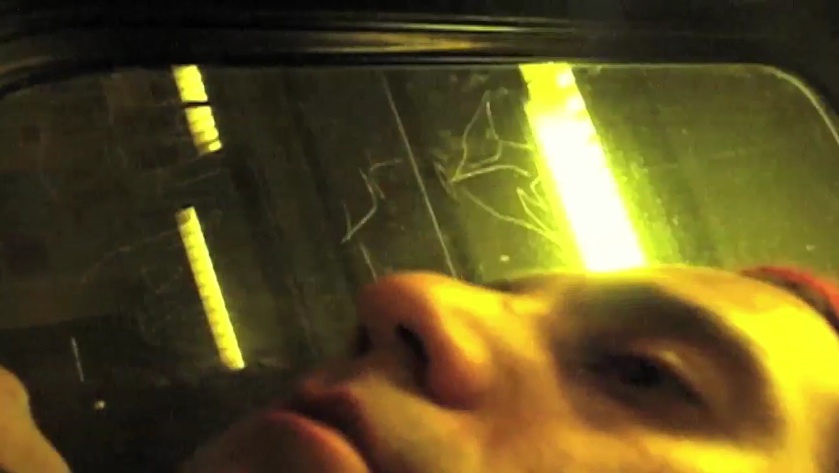
DeFazio's directorial work consistently examines the nature of the existence of the sole being ("Gravity", 2012) and the importance of the individual consciousness in relation to the encapsulating macrocosm. This is most apparent in his 2007 experimental film Arc To Vega. Arc To Vega is a short experimental docu-drama propelled forward through a fast-paced, first-person narrative voice-over. The film chronicles the day in the life of one man during a [...] and alcohol infused quest to search for something without knowing exactly what it is and to ultimitely understand his place in the chaotic, nonsensical world in which he lives. By the film's conclusion he finally comes to terms with the overwhelming trivial nature of his life and all life.
DeFazio's films explore the weakness of the human condition and the cycle of decay and re-birth of consciousness. Both Stream, and Samsara in particular, examine the mind of a woman during moments of emotional collapse. They attempt to explore how this breakdown of the psyche affects cognition and the nature in which it manifests in behavior. These films differ in that Stream appears to be the precursor of Samsara. Stream focuses heavily on what appears to be the moment of collapse and the stream of consciousness that results while Samsara deconstructs the aftermath—struggling to come to terms. DeFazio's common motif of re-birth of consciousness is especially evident in these two films.

|
|
Work philosophy and subjects of inquiry
DeFazio is a firm believer in the "process" of art as the ultimate message and does not display his work publicly. He often destroys his works upon completion, only retaining documentation of their completed forms.
Three themes run through DeFazio's body of work: (1) the decay and rebirth of the human consciousness, (2) the fragility of the human condition in relation to the limits of world energy and being, particularly the fluid boundaries of love and rage; and (3) the contextualization of an otherwise inconsequential existence of all life (and non-life) in all worlds (both macro and micro), through an immediate and cerebral response to organic substances and utilitarian materials. DeFazio has described his work as a mechanism for interfacing his own mind and body to the instinctive hatred and love of the here and now, and the pursuit to cope with the overwhelming distances in human feeling and pain within the vacuum of human existence.
|

|

|
|
Notable Art Works
1. No-Man, 1-45 (1995)
2. Brief Romance in the Middle of Nowhere, 1-10 (1998)
3. Ether, 1-42 (1999)
4. Passing I, 1-6 (1999)
5. Passing II, 1-6 (1999)
6. VIVISection I, 1-5 (2000)
7. Kiss in a Red Storm, 1-5 (2001)
8. A Woman I Love, 1-10 (2006)
9. Two Lovers From San Francisco, 1-38 (2006)
10. Love Song, 1-5 (2006)
11. Doll Face in Red Dress, 1-2 (2007)
12. Doll Face I, 1-40 (2007)
13. Hollywood [...] I, 1-3 (2008)
14. Hollywood [...] II, 1-6 (2008)
15. Time Baby III, 1-2 (2009)
16. Time Baby IV, 1-2 (2009)
17. Asian Girls Blowing Kisses, 1-8 (2009)
18. Savior, 1-2 (2010)
19. Compression Series II (2010)
18. Constellation, 1-3 (2010)
19. Room with Desk and Light (2010)
19. Girls Falling out of Love 1-14 (2009)
20. VIVISection II, 1-2 (work in progress)
21. VIVISection III, 1-4 (work in progress)
22. VIVISection IV, 1-4 (work in progress)
23. Mother of God (2010)
24. Lover's Leap, 1-3 (2010
25. Torso, 1-2 (2010)
26. Violence, (work in progress)
27. My Venus De Milo, 1-9 (2011)
28. Torso II (2011)
29. Rendezvous in Ojai, 1-4 (work in progress)
Directorial Filmography
1. Trash Cocking (1998)
2. Stream (2008)
3. Arc to Vega (2008)
4. One Flesh (2010)
5. Samsara (2010)
6. TRIP (In development)
7. Target Girl (In development)
8. Drain (In development)
References
- http://www.imdb.com/name/nm0214461
- http://eddiepmovie.com/cast-crew/crew/
- http://www.tradewindsinternationalpictures.com/Supercool_Magic.html
- http://www.9-30.com/biography.html
- http://www.imdb.com/title/tt0397856/combined
- http://www.samfrench.com/otl/?p=defazio
- http://vids.myspace.com/index.cfm?fuseaction=vids.individual&videoid=18503380
- http://www.flixster.com/actor/john-defazio
- http://123nonstop.com/biography/DeFazio,_John
- http://www.nihilists.net/nihlprod.html
External links