
Jogi ministry
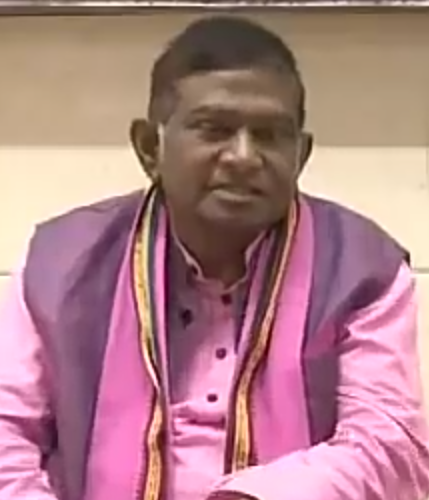
The Ajit Jogi ministry was the inaugural Council of Ministers of the state of Chhattisgarh, formed after its separation from Madhya Pradesh on 1 November 2000. Led by Chief Minister Ajit Jogi, the ministry was composed of leaders from the Indian National Congress. The government remained in power until 7 December 2003, when it was succeeded by the First Raman Singh ministry following the state's first general assembly elections.
History
Following the passage of the Madhya Pradesh Reorganisation Act, 2000, Chhattisgarh was created on 1 November 2000. The Congress party, having a majority in the interim assembly, chose Ajit Jogi as the Chief Minister. Jogi's tenure was noted for establishing state administrative headquarters (Mantralaya) and basic infrastructure in the new capital, Raipur.
Background
The formation of the Ajit Jogi ministry was the culmination of a decades-long movement for a separate Chhattisgarh state, which was primarily driven by demands for administrative efficiency, tribal autonomy, and regional development. The region, formerly the "Chhattisgarh division" of Madhya Pradesh, was carved out under the Madhya Pradesh Reorganisation Act, 2000, passed by the Parliament of India during the tenure of Prime Minister Atal Bihari Vajpayee.
On 1 November 2000, Chhattisgarh officially became the 26th state of India. An interim legislative assembly was constituted with 90 seats, allocated from the undivided Madhya Pradesh Vidhan Sabha. Although several veteran leaders like Vidya Charan Shukla and Motilal Vora were contenders, Ajit Jogi, a former IAS officer and then Member of Parliament, was chosen by the Indian National Congress high command to lead the first government.
His appointment was seen as a strategic move to project a tribal face for the new state, despite subsequent legal challenges regarding his caste status.
Formation
After the creation of Chhattisgarh on 1 November 2000, Ajit Jogi was chosen as the Chief Minister. To consolidate his power and accommodate various factions and tribal leaders, Jogi formed a massive "Jumbo Cabinet." Initially, the ministry consisted of nearly 29 to 32 members (including Cabinet Ministers and Ministers of State).
This large size was possible because the Constitution (Ninety-first Amendment) Act, 2003, which limited the size of the Council of Ministers to 15% of the assembly's strength, was not yet in effect. Jogi used this to include various defectors from the BJP and veteran Congress leaders to ensure stability in the interim assembly.
Council of Ministers
The ministry underwent several expansions, the most notable being in January 2002 when several former BJP MLAs who defected to Congress were inducted into the cabinet.
Portfolio |
Minister |
Designation |
Party |
|---|---|---|---|
Chief Minister |
Ajit Jogi |
Cabinet Minister |
INC |
Finance & Planning |
Ramchandra Singh Deo |
Cabinet Minister |
INC |
Home Affairs |
Nand Kumar Patel |
Cabinet Minister |
INC |
Industry & Commerce |
Mahendra Karma |
Cabinet Minister |
INC |
Agriculture & Water Resources |
Ravindra Choubey |
Cabinet Minister |
INC |
Public Works Department (PWD) |
Tarun Chatterjee |
Cabinet Minister |
INC |
Education & Culture |
Satyanarayan Sharma |
Cabinet Minister |
INC |
Health & Family Welfare |
Dr. Premsai Singh Singh |
Cabinet Minister |
INC |
Forest & Environment |
Amiya Charan Shukla |
Cabinet Minister |
INC |
Tribal & SC Welfare |
Bhakti Das Mahant |
Cabinet Minister |
INC |
Revenue |
Geeta Devi Singh |
Cabinet Minister |
INC |
Higher Education |
Ram Pukar Singh |
Cabinet Minister |
INC |
Cooperatives |
Doman Singh Nagwanshi |
Cabinet Minister |
INC |
Rural Development |
Tupleshwar Singh |
Cabinet Minister |
INC |
Transport |
Dhanesh Patila |
Cabinet Minister |
INC |
Minister of State (MOS) |
Vidhan Mishra |
Minister of State |
INC |
Minister of State (MOS) |
Amitesh Shukla |
Minister of State |
INC |
Minister of State (MOS) |
Paresh Bagbahara |
Minister of State |
INC |
Minister of State (MOS) |
Ganesh Shankar Bajpai |
Minister of State |
INC |
Controversies
The Jogi ministry faced allegations of high-handedness and centralization of power. Near the end of the term in 2003, Minister of State Vidhan Mishra resigned, levelling corruption charges against the administration. Additionally, the induction of 12 defecting BJP MLAs into the Congress-led government was a point of intense political debate.