
ISSOWAMA
ISSOWAMA (Integrated Sustainable Solid Waste Management in Asia) is a Coordination Action funded by the European Commission under the Seventh Framework Programme, specific program “Cooperation”. The project is designed for eight Asian countries (Bangladesh, Cambodia, China, India, Indonesia, Philippines, Thailand, Vietnam) and is implemented together with European Partners. It aims to tackle the overwhelming Solid Waste management (SWM) problems through research and awareness.
Introduction
The huge economic and industrial developments over the last decade in many Asian countries, combined with a rapid increase in urban populations, have put extreme pressure on their Solid Waste Management Systems. Even though much progress has been achieved, there is still work to do in order to identify and implement sustainable solutions for waste collection, recycling, treatment and disposal. Experience over the last 30 years has shown that it is not enough to rely on technical solutions and that a more integrated approach is required.
The ISSOWAMA Coordination Action, funded by the European Commission under its FP7, aims to raise awareness of the Integrated and Sustainable Waste Management (ISWM) approach. This focuses on all the elements in the waste management system from generation to final disposal; on all the aspects, - social, institutional, legal, financial, economic environmental and technical; and on involving all the stakeholders at different levels; in order to ensure the effective implementation of a sustainable system.
ISSOWAMA uses the case study approach. Good practice examples are being sought out and documented in all the project countries in South Asia, the Greater Mekong Sub-region and South East Asia. These case studies will be used both to demonstrate the ISWM method, to showcase the wide variety of alternative approaches that have been adopted in the region and to draw out the lessons learned, in order to help countries and cities select the appropriate next steps in developing their own integrated and sustainable solid waste management system.
Basic data
Duration: 30 months
Total budget: 1.243.481,81 €
European Commission contribution: 989.522,67 €
Funding scheme: FP7
Thematic priority: Environment (Including Climate Change); Solid Waste Management
Instrument: Support and Coordination Actions (IP)
Coordinator: ttz Bremerhaven
Participants: 22 partners from 14 countries
ISSOWAMA objectives
One of the main objective of ISSOWAMA is to promote international cooperation between research organisations, universities and social and governmental stakeholders in solid waste management in both Asia and Europe. Provide incentives for the experts in the ISSOWAMA network to propose directions for further research and local implementation.
The specific objectives of ISSOWAMA
- Analyse the main constraints for implementing new concepts on solid waste management in Asia and identify common and urgent problems across the region.
- Raise awareness of Integrated Sustainable Waste Management (ISWM) and build capacity for its widespread adoption in Asia.
- Build sustainable capacity to make decisions about what technologies and services are appropriate and cost-effective as part of a local ISWM system.
- Exemplify a wide range of suitable and feasible solutions for specific problems based on local case studies in Asian countries.
- Bring together relevant Asian and European stakeholders on SWM in order to establish a permanent cooperation strategy among them.
Work Packages
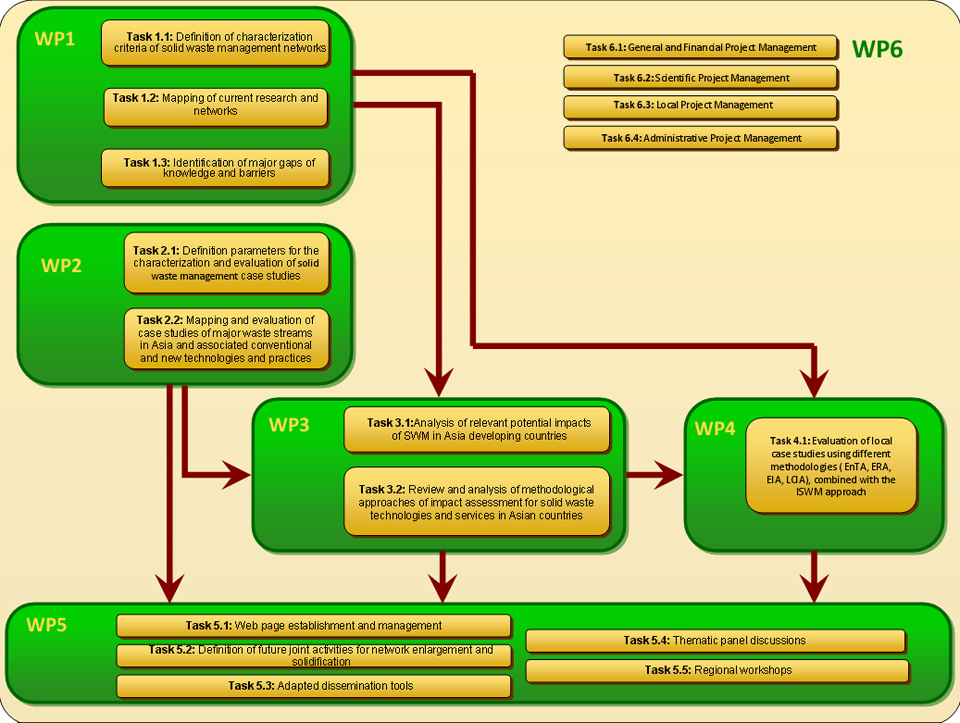
Work Package 1: Mapping of solid waste management networks
Starting on month 1, this work package will identify current research activities and networks operating in solid waste management in the countries addressed. In order to achieve uniform and comparable results, the criteria that will be used for the characterisation of the solid waste management networks will be defined in a first step. The existing solid waste management networks will be mapped after this stage. These tasks will serve as a basis for the work to be carried out in WP3 and 4.
Work package 2: Mapping and evaluation of solid waste management case studies
In order to select appropriate case studies for the activities foreseen for WP4, and following a similar approach to the used in WP1 for existing networks, the beneficiaries will define a set of characterisation criteria including not only technical parameters, but also socio-economic. These will be used in task 2.2 to assess the performance of different technologies that are currently used for the major waste streams in Asian developing countries. The evaluation will be carried out along with the mapping of existing successful and non-successful stories in solid waste management, which will allow better decision making.
Work package 3: Review and analysis of environmental impact assessment methods and impact categories
As it has been explained before, solid waste management can be approached through many methods, and, technologies and with the participation of different stakeholders groups. ISSOWAMA will review the existing EIA methods and, with the coordination of efforts from the consortium, complete and improve them. In WP3 the partners will firstly carry out a comprehensive analysis of the relevant impact categories, taking into account the special conditions of the countries addressed by the project. After this, a critical assessment of the different Eivironmental Impact Assessment methods will be carried out, which will result in an improvement of EIA for developing Asian countries.
Work Package 4: Analysis of representative local case studies
This work package is a second stage of the case studies evaluation started in WP2. In this evaluation stage (task 4.1), selected representative local case studies in WP2 will be used to assess the performance of methodologies and impact categories proposed in WP3. The activities proposed in this work package aim to confirming the suitability of the methods used (and thus, validating their use as it is currently) or to proposing better approaches.
Work Package 5: Dissemination and promotion of stakeholders participation
The results of the first four coordinating work packages will be used to prepare appropriate dissemination tools. In thematic panel discussions with regional stakeholders the scientific, economical, social and cultural acceptance of the proposed assessment tools will be analysed. Regional workshops will be held in order to inform municipalities, SMEs, industry and the informal sector about the importance and advantages of the improved ISWM and train the participants on the developed tools.
Work Package 6: Project management
Whereas the four coordinating work packages and the dissemination activities follow a chronological order, the management foreseen activities create the organisational frame of the project and ensure continuous progress of the project to reach the goals. The management activities consist of general and financial management, administrative management, scientific management and additionally of local project management. This special task will support the coordinator locally in Asia in assuring a smooth performance of the project.
ISSOWAMA Partners
Project involves 22 partner organizations and institutions from the European Union and Asia:
- Ttz Bremerhaven-Germany (co-ordinator)
- EAWAG-Switzerland
- WU-The Netherlands
- WASTE-The Netherlands
- BIOAZUL-Spain
- WII-India
- TERI-India
- CES-India
- KUET-Bangladesh
- DCC-Bangladesh
- THU-China
- JGSEE-Thailand
- AIT-Thailand
- CENTAMA-Vietnam
- DoEPP-Cambodia
- RUPP-Cambodia
- LD-Indonesia
- SWAPP-Philippines
- UP-PALANDES-Philippines
- ISWA-Denmark
- IPM-Philippines
- ZKKF-Philippines
ISSOWAMA Meetings
It is planned that three thematic panel discussions with relevant stakeholders will be held in Philippines, Thailand and India respectively, in order to present and discuss the project’s results and milestones. These events will take place at the end of the project, from November 2010 to June 2011.
Additionally, regional workshops on adapted waste treatment technologies and services, will be organised for municipalities, SMEs, industries and stakeholders from the informal sector (CBM organisations, waste pickers associations, etc). These workshops will have the objective of dissemination in a broad level, and will also serve to introduce new relevant actors (like local waste processors and regulators) to the existent networks, as well as to raise awareness and promote good practices and environmental sound technologies. 8 workshops will be carried out in India, China, Bangladesh, Thailand, Vietnam, Cambodia, Indonesia and Philippines. These workshops are planned to take place from April 2010 to June 2011.
From the 15th to the 18th of November 2010 the City of Hamburg will host the ISWA World Congress 2010 on Urban Development and Sustainability.