
History of Sri Lanka: pre-Colonial era (500 BC – 1505 AD)
Pali Chronicles and the arrival of Vijaya
The Pali chronicles, the Dipavamsa, Mahavamsa, Thupavamsa and the Chulavamsa as well as a large collection of stone inscriptions, The INDIAN Epigraphical records, the Burmese versions of the chronicles etc., provide an exceptional record for the history of Sri Lanka from AbOUT the 6th century B.C.
The Mahavamsa, written around 400 AD by the monk Nagasena, using the Deepavamsa, the Attakatha and other written sources available to him, correlates well with Indian histories of the period. Indeed Emperor Asoka's reign is recorded in the Mahavamsa. The Mahavamsa account of the period prior to Asoka's coronation, (218 years after the Buddha's death) seems to be part legend. History proper begins with the arrival of Vijaya and his 700 followers. Vijaya, is a Kalinga(ancient Orissa) prince, the eldest son of King Sinhabahu ("Man with Lion arms") and his sister Queen Sinhasivali. Both these Sinhala leaders were born of a mythical union between a lion and a human princess. The Mahavamsa claims that Vijaya landed on the same day as the death of the Buddha (See Geiger's preface to Mahavamsa). The story of Vijaya and Kuveni (the local reigning queen) is reminiscent of Greek legend, and may have a common source in ancient Proto-Indo-European folk tales.
According to the Mahavamsa, Vijaya landed on Sri Lanka near Mahathitha (Manthota or Mannar), and named the Island "Thambaparni" ('copper-colored palms). This name is attested in Ptolemy's map of the ancient world.
Tamirabharani is the old name for the second longest river in Sri Lanka (known as Malwatu Oya in Sinhala and Aruvi Aru in Tamil). This river was a main supply route connecting the capital, Anuradhapura to Mahathitha (Mannar). The waterway was used by Greek and by Chinese ships travelling the southern Silk Route.
Mahathitha was an ancient port linking Sri Lanka to India and the Persian gulf,.
The present day Sihalese (and many modern Tamils) are a mixture of the indegenous people and of other peoples who came to the island from various parts of India. The Sinhalese recognize the Vijayan Indo-Aryan culture and Buddism (already in existence prior to the arrival of Vijaya), as distinct from other groups in neighbouring south India.
Kaboja or Kambojas
"Several early Brahmi inscriptions in Ceylon refer to a community of people called Kambojas who then lived in various parts of Sri Lanka. An early Pali text refers to a Kambojagama in Rohana"..
The Kaboja (also Kamboja or Kambodin) are mentioned in eight Brahmi texts. The Dameda are referenced in five texts. The Mileka are mentioned twice. The Muridi, Meraya and Jhavaka are mentioned only once. The Kambojas living in Rohana are mentioned in the (?th) chapter of the Sihalavatthu, a Pali text from about 300 AD. An Elder named Maleyya was residing in Kamboja-gama, in the province (Janapada) of Rohana on the Island of Tambapanni (Sri Lanka), according to chapter 3, Metteyya-vatthu, of the Sihalavatthu. Further, the Mahavamsa asserts the Yonas or Yavanas (Greeks), neighbors to the Kambojas in the north-west, also had a settlement in Pandukabhaya in Anuradhapura . Eight epigraphic and one literary sources attest that the Kambojas had settled in various parts of Ceylon including Hambantoa district and Aparai districts of Rohana province, in Kurunagala district Southwest of Anuradhapura, in Polonnaruva district in eastern Ceylon as well as in Anuradhapura city. A Kambojagama is attested in the Southeast in Rohana province.
Ancient inscriptions reveal that the Kambojas were actively involved in trade, referencing one "Grand Trade Guild of the Kambojas" (Kabojhiya-mahapugiyana) in Aparai district in Rohana and one "Sangha of the Kambojas" (Gota-Kabojhi(ya]na) in Kurunagala district in Southwest Anuradhapura. Epigraphers date these inscriptions to at least 200 BC, or even earlier.
The Indo-Aryan speakers of Sri Lanka May Be descended from these north-western Kambojas
- Note: While referring to Simhala country, which is referred to in the Book III, Chapter VII of Saktisangama Tantra, Dr D. C. Sircar, a front rankinng Indologist observes:
- "The great country called Simhala, the best of all countries, is placed to the east of Maru-desa and to the south of the Kama-dra. This Simhala of the Saktisangama Tantra can not be identified with Ceylon as such. It is evidently in the Punjab... and reminds us of the kingdom of Sinhapura, mentioned by Hiuen Tsang. The capital of this kingdom has been identified with Khetas, or Katas in the Jhellum District (See: Saktisangama Tantra III. 83, 4 and 205) which is next to the Javalamukhi, the most frequented place of pilgrimage in the Punjab. Tantric literature locates Shambhala (i.e., Simhala) and Lankapuri in the SWAT-KASHMIR region (SeeL Studies in Tantras, pp 39-40, Dr P. C. Bagchi; Geography of Ancient India and Medieval India, 1971, pp 108/110, Dr D. C. Sircar). Kama or Kama-giri is also referred to in the Saktisangama Tantra and is located to the north of Maru-desa and also to the north of Huna country (in Punjab and called the land of Heroes)" (See: Geography of Ancient India and Medieval India, 1971, pp 108, 110, Dr D. C. Sircar).
- Here Kama or Kama-giri obviously refers to Kama/Kamma valley/ region in the north-east Afghanistan. Kata is the name of a people and their language, located north of the Kabul river and south of the Hindu Kush. These people are also called Katirs/Kamtoz and are considered descendants of ancient Kambojas. The Saktisangama Tantra attests one Simhala and also one Lankapuri, in the Swat valley to the north of Kabul and the west of the Indus in present day northern-eastern Afghanistan. This location corresponds precisely with the land of the Ancient Kambojas. Thus the Aryan speaking Sinhalese migration to Ceylon, must have started/originated from this Swat/Kashmir region of north-west India.
Another portion of this Aryan population originated among the Sakas and the Yavanas. These Kambojas inhabited a region bordering the upper Indus in a country near Sind, from whence they, and the Yavanas, finally reached Ceylon in pre-Christian times.
Dameda (Damela) or Tamils
The Dameda are the second most mentioned ethnic group in the epigraphy of Ceylon, with mention in five cave inscriptions. "Dameda" in these inscriptions stands for Damela (=Tamil) According to another view, Dameda is a Sanskrit equivalent of Dravida . These inscriptions reference the Tamil merchant (Vishaka) , the Tamil householder Samana (residing) in Ilubharata and a Tamil navika (or sailor) Karava . These Tamil inscriptions are further corroborated by a reference in the Mahavamsa which contains the expression "Damilas Assandviks" i.e., "those (Tamils) who brought horses in water-craft" . Early Buddhist literature from north India refers to the Uttarapatha (comprising the Kambojas, Kashmiras, and Gandharas) as horse traders attesting that horses were brought for sale to various parts of the subcontinent. By early mediaeval times, the Kambojas had adopted Islam and were still trading all along the west-coast of India from the Persian Gulf to Ceylon and probably further-east . Kamboja traders from the north-west and Tamil merchants from southern India had probably been involved in trade and settlement in Sri Lanka. Two of the five ancient inscriptions referring to the Damedas (Tamils) are in Periya Pullyakulam in the Vayuniya District, one is in Seruvavila district in Trincomalee district, one is in Kuduvil in Amprai district and one in the ancient city of Anuradhapura . These were isolated settlements however and a significant Tamil settlement wasn't established in the island till much later.
Mileka, Muridi, Merya and Jhavaka
Other ethnic terms like Mileka, Muridi , Meraya and Jhavaka are also mentioned in the ancient texts. Milaka, occurring twice in the sources, may be Mlechcha, an aboriginal population of Vedda people. Muridi may be Murunda (Saka Murunda) Merya may be Maurya. Jhavaka identity is not clear. Each of the last three of these terms occur only once in the record.
Ancient Sri Lanka (250 BC-1000 AD)
Anuradhapura dynasty
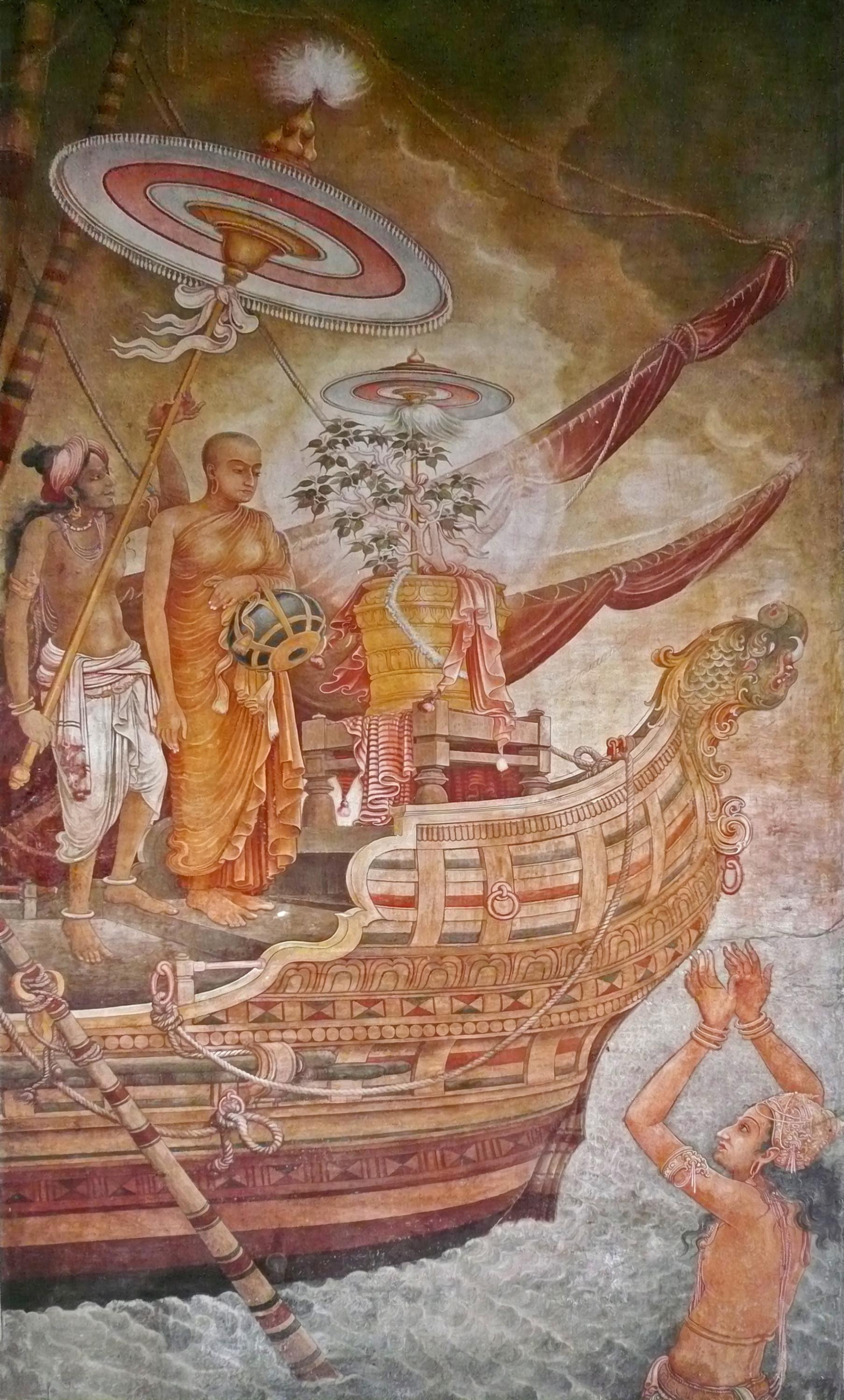 Devanampiya Tissa (250-210 BC), a Sinhalese King of the Mauriya clan. His links with Emperor Asoka led to the introduction of Buddhism by Mahinda (son of Asoka) in 247? BC. Sangamitta, (sister of Mahinda) brought a Bodhi sapling via Jambukola (Sambiliturei). There is no evidence in the history of King Ashoka about his having had a son by the name of Mahinda (or by any other name) or a daughter by the name of Sangamitta (or by any other name). This king's reign was crucial to Theravada Buddhism, and for Sri Lanka.
Elara (205-161 BC), a Tamil King who ruled "Pihiti Rata", i.e., Sri Lanka north of the mahaweli, after [...] King Asela. During Elara's time, Kelani Tissa was a sub-king of Maya Rata (south-west) and Kavan Tissa was a regional sub-king of Ruhuna (south-east). Kavan Tissa built Tissa Maha Vihara, Dighavapi Tank and many shrines in Seruvila. Dutugemunu (161-137 BC) – Eldest son of King Kavan Tissa, who was a young man 25 years of age, defeated the South Indian Tamil Invader Elara (over 64 years of age) in single combat, described in the Mahavamsa. Dutugemunu is depicted as a Sinhala "Asoka". The Ruwanwelisaya, built by this king is a dagaba of pyramid-like proportions. It was an engineering marvel.
Pulahatta (or Pulahatha) deposed by Bahiya, was deposed by Panaya Mara, deposed by Pilaya Mara, murdered by Dathiya 88 BC – deposed by Valagambahu, ending Tamil rule. Valagambahu I (89-77) BC – restored the Dutugamunu dynasty. The Mahavihara Theravada - Abhayagiri (pro-Mahayana) doctrinal disputes arose at this time. The Tripitaka was written in Pali at Aluvihara, Matale. Chora Naga (Mahanaga) (63-51) BC; poisoned by his consort Anula. Queen Anula (48-44 BC) – WIDOW of Chora Naga and Kuda Tissa, was the first Queen of Lanka. She had many lovers who were poisoned by her. She was finally killed by: Kuttakanna Tissa. Vasabha (67-111 AD) – Vallipuram gold plate; he fortified Anuradhapura and built eleven tanks; many edicts. Gajabahu I (114-136) – invaded the Chola kingdom and brought back captives. He recovered the tooth relic of the Buddha.
Mahasena (274-301) – The Theravada (Maha Vihara) was persecuted and Mahayana surfaced. Later the King returned to the Maha Vihara. Pandu (429) - first of seven Pandiyan rulers, ending with Pithya, 455; Dhatusena (459-477), his uncle, Mahanama wrote the Mahavamsa, he built "Kalaweva". His son Kashyapa (477-495), built the famous sigiriya rock palace. Some 700 rock graffiti give a glimpse of ancient Sinhala.
Lambakanna
Manavamma (684-718) – seized the throne with Pallava help. Manavamma introduced Pallava patronage for three centuries. By the 9th century, with the Pandyan ascendancy in southern India, Anuradhapura was sacked. However, the Sinhalese invaded Pandya using a rival prince, and Madurai itself was sacked. Mahinda V (982-1029) – was the last Sinhala monarch of Anuradhapura. He fled to Ruhuna, where, in 1017, the Chola took him to prison and he died in India.
Feudal Sri Lanka (1000-1600 AD)
Chola empire
The great Raja Raja Chola I, and his great son Rajendra Chola I, defeated all of the Sinhalese kings and sub-kings who ruled over Sinhlala kingdoms on the island and brought the entire island under South Indian Tamil control. The Sinhala king Mahinda V and his family were captured and taken to Chola Naadu. Tamils ruled the entire island for the next 37 years (1018-1055).
Polonnaruwa rule
Vijayabahu I (1055-1110), recaptured the whole Island, and established Polonnaruwa as the new capital. King Vijayabahu married from the Kalinga (Orissa) Royal Family a second queen, and had a son Vikramabâhu I and a daughter Ratnavali. His sister, Mitta, married a Pandya Prince who had three sons, the eldest being Manabharana. He married Ratnavali. Their son was Parākramabāhu I (1153-1186) Grandson of Vijayabahu I, Prince of Sinhala-Pandyan-Kalinga descent, son of Manabharana and Vijayabahu’s sister, Mitta. He was a very powerful king, noted for his engineering, naval power, art, culture, many Sinhala inscriptions, and even a Tamil edict in Uruthota (Kayts). The Chulavamsa was written by Dharmakirthi, updating the Mahavamsa to include Parakramabahu. It was a great age since the epic Anradhapura period.
Dambadeniya kingdom
Dambadeniya is an ancient capital of Sri Lanka. Four kings ruled from here, Vijayabâhu III (1220-1236), Parâkkamabâhu II (1236-1270), Vijayabâhu IV (1270-1272), Bhuvanaikabâhu I(1272-1283).
The first king to choose Dambadeniya as his capital was Vijayabâhu III. He was able to bring about the unity among the sangha that had fled in various directions due to the hostile activities of the invader Kalinga magha & succeeded in holding a Buddhist convention in 1226 to bring about peace among the Buddhist clergy. king Parâkkamabâhu II inherited the throne from king Vijayabâhu. He is considered a genius who was a great poet & prolific writer. Among the books he wrote are Kausilumina, which is considered a great piece of literature. Unifying the three kingdoms that existed within Sri Lanka at that point of time is regarded as greatest achievement.
King Bosath Vijayabâhu, as the eldest son of king Parâkkamabâhu II, was crowned in 1270. He was well known for his modest behaviour & for his religious activities. He was killed in the second year of his reign by a minister called Miththa.
After the demise of his elder brother Vijayabâhu, king Bhuvanaikabâhu I, as the next in line to the throne, shifted the capital to Yapahuwa for reasons of security. He followed his father's footsteps as a writer & continued with the religious activities started by his brother Vijayabâhu.
The literature of Dambadeniya era
The Dambadeniya period is considered as the golden era of Sinhala literature. Several books in Sinhala, Pali & Sanskrit were written in this time. Among them are books of poetry such as Kausilumina, Muwadewdawatha, Sidath sangarawa, Buthsarana, Saddharma Rathnawaliya. The stone inscriptions in this period include keulgama mavilipitiya, Narambadde Ududumbara Lipiya, Rambukana Dewala Lipiya, Aluthnuwara Dewala Lipiya, Galapatha Viharaya Shila Lipiya.
- Pali books of Dambadeniya Era
- Rupasiddiya
- Mahawansaya
- Thupawansaya
- Rsawahini
Jaffna kingdom
The Jaffna kingdom () (1215-1619 CE), also known as Kingdom of Aryacakravarti came into existence after the invasion of Magha, who is said to have been from Kalinga, in South India. It eventually became a tribute paying feudatory of the Pandyan Empire in modern South India in 1250, but later become independent with the fragmentation of the Pandyan control. For a brief period, in the early to middle fourteenth century, it was an ascendant power in the island of Sri Lanka when all regional kingdoms accepted subordination. However, the kingdom was eventually overpowered by the rival Kotte Kingdom, around 1450.
It was freed of Kotte control in 1467; its subsequent rulers directed their energies towards consolidating its economic potential by maximising revenue from pearls and elephant exports and land revenue. It was less feudal than most of other regional kingdoms in the island of Sri Lanka of the same period. During this period, important local Tamil literature was produced and Hindu temples were built including an academy for language advancement.
The arrival of the Portuguese colonial power to the island of Sri Lanka in 1505, and its strategic location in the Palk Strait connecting all interior Sinhalese kingdoms to South India, created political problems. Many of its kings confronted and ultimately made peace with the Portuguese colonials. In 1617, Cankili II, an usurper to the throne, confronted the Portuguese but was defeated, thus bringing the kingdom’s independent existence to an end in 1619.
See also
- Prehistory of Sri Lanka
- Post Colonial era (since 1948)
- Mahawamsa
- Irrigation works of ancient Sri Lanka
- Ancient Constructions of Sri Lanka
- Architecture of ancient Sri Lanka
Books and magazines
- Arsecularatne, S. N, Sinhalese immigrants in Malaysia & Singapore, 1860-1990: History through recollections, Colombo, KVG de Silva & Sons, 1991
- Brohier, R. L, The Golden Age of Military Adventure in Ceylon: an account of the Uva Rebellion 1817-1818. Colombo: 1933
- Crusz, Noel, The Cocos Islands Mutiny. Fremantle Arts Centre Press, Fremantle, WA, 2001
- Deraniyagala, Siran, The Prehistory of Sri Lanka; an ecological perspective. (revised ed.), Colombo: Archaeological Survey Department of Sri Lanka, 1992
- Liyanagamage, Amaradasa, The decline of Polonnaruwa and the rise of Dambadeniya. Department of Cultural Affairs, Government Press, Colombo, Sri Lanka. 1968.
- Pieris, Paulus Edward, Ceylon and Hollanders 1658-1796. American Ceylon Mission Press, 1918.
- Pieris, Paulus Edward, Ceylon and the Portuguese 1505-1658. American Ceylon Mission Press, 1920.
- William Adair Nelson and R. Kumar de Silva, The Dutch Forts of Sri Lanka. Reprint: Sri Lanka - Netherlands Association, Colombo, 2004 (First ed. in 1984)
- R. Kumar de Silva and Willemina G. M. Beumer, Illustrations and Views of Dutch Ceylon, 1602-1796. Serendib Publications, London, 1988.
External links
- Nearly 1200 links on Sri Lanka
- The Virtual Motherland of Sri Lankans
- Sri Lanka in 1942 - World War II Movie Clip
- Library of Congress Country Study: Sri Lanka
- The Netherlands - Ceylon Heritage
- Colombo in Dutch Times
- Jacob Haafner. Travels Through The Island of Ceylon in 1783
- The Dutch in Ceylon glimpse of their life and times
- The Journal of the Dutch Burgher Union of Ceylon
- A Baptism of Fire: The Van Goens Mission to Ceylon and India, 1653-54
- Dutch and Portuguese Buildings in Sri Lanka
- Tourist Board of Sri Lanka
- hWeb - Sri Lanka’s recent history of ethnic conflict originates from its colonial legacy
- Books on Sri Lanka History
- Maritime Heritage in Sri Lanka
- The Mahavamsa History of Sri Lanka The Great Chronicle of Sri Lanka
- Peace and Conflict Timeline (PACT) - interactive timeline of the Sri Lankan conflict
cy:Hanes Sri Lanka es:Historia de Sri Lanka fr:Histoire du Sri Lanka hi:श्रीलंका का इतिहास it:Storia dello Sri Lanka lt:Šri Lankos istorija pt:História do Sri Lanka ru:История Шри-Ланки sv:Sri Lankas historia uk:Історія Шрі-Ланки