
Frank Alfonso Rosado
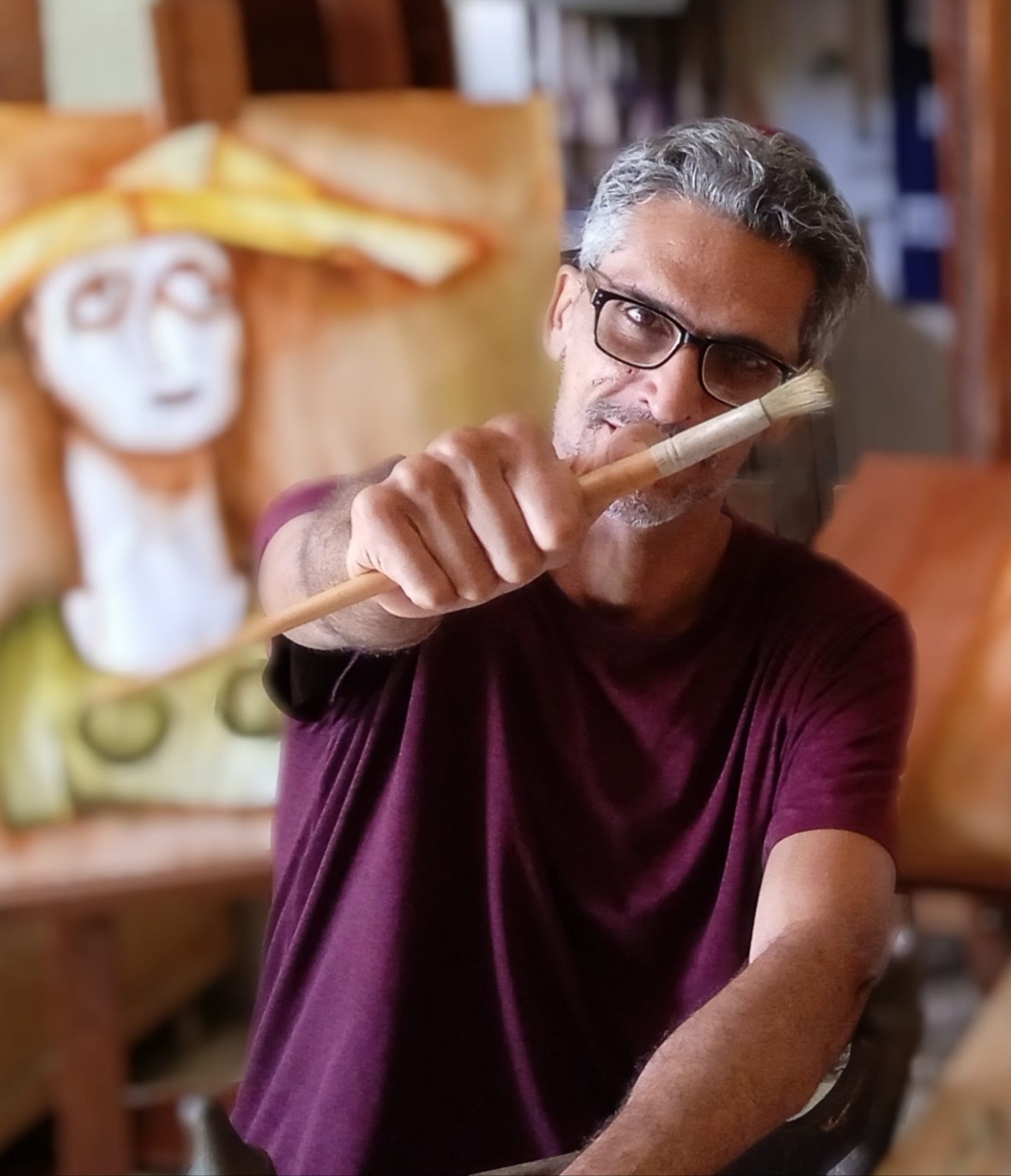
Frank Alfonso Rosado (Havana, Cuba, 1980) is a contemporary Cuban poet, playwright, visual artist and ceramicist whose work is characterized by a multidisciplinary approach that integrates literature, visual arts and ceramics into a unified aesthetic discourse. His work explores themes such as identity, exile, memory, trauma and the transformation of matter into symbolic language.
He holds a degree in Education for the Teaching and Appreciation of the Visual Arts. He completed postgraduate studies in design at the Higher Institute of Industrial Design of Havana (ISDI).¹
He has worked as
- Art History teacher at the Eduardo García Delgado School of Art Instructors in Havana.
- Restoration and Document Conservation teacher at the José Martí Technical Institute in Marianao, Havana.
- Dance production assistant at Teatro Retazos in Havana.
- Visual Arts Creation teacher at the Lycée Français de La Havane Alejo Carpentier.
- Independent artist.
Biography
Born in Cuba, he began his artistic career in Havana in the field of poetry during the 1990s. His early texts, later collected in works such as Catarsis: 38 experimentos para no escribir poesía and Náufragos sin isla propia, reflect a formative period marked by introspection, formal experimentation and the search for identity in urban and existential contexts.²
During these years, his writing developed as a space of expressive urgency rather than as a conventional literary exercise, with a strong presence of autobiographical elements, tensions between the sacred and the profane, and a critical perspective on Latin American social reality.³
Literary and Dramatic Development
His evolution as an author led him to consolidate a distinctive voice in poetry and subsequently in playwriting. His work Las aguas no perdonan (2004), which received the Dramaturgy Prize of the Asociación Hermanos Saíz, represents a turning point in his career. It is a psychological monologue that addresses the fragmentation of identity through a split structure and highly symbolic language.
In poetry, works such as Aguas del fin de siglo and Ciudad Costera expand his creative universe toward a reflection on time, memory and displacement. In particular, Ciudad Costera engages with the theme of exile, articulating a poetics of uprootedness in which travel, the sea and the reconstruction of the self function as central themes.⁴
Visual Arts and Ceramics
Alongside his literary activity, Alfonso Rosado has developed a notable career in the visual arts and ceramics. His training at the Higher Institute of Industrial Design (ISDI) contributed to a structural conception of the image and to the development of his own visual language.⁵
In his ceramic work, the artist explores the relationship between matter, fire and transformation, understanding the creative process as an alchemical experience. This conception is reflected in the book El aliento del horno: materia y metáfora, in which ceramics are approached from both a technical and symbolic perspective.
His visual production includes pen-and-ink drawing and painting, disciplines in which he investigates the tension between line and color as vehicles of emotional expression. During the COVID-19 pandemic and following his subsequent settlement in Spain, he developed a series of works collected in La creación como Faro, in which art appears as a tool for resistance and personal reconstruction.³
Exile and Period in Spain
After leaving Cuba, he settled in Spain, where his work acquired new dimensions linked to exile and displaced identity. During this period, his artistic production intensified as a response to the migratory experience, understood not only as a geographical change but also as an inner transformation.
Exile became a central theme in his work, present both in his poetry and in his visual production, where the notions of “island,” “shipwreck” and “journey” acquire a recurring symbolic character.
Teaching and Critical Work
In addition to his creative work, he has taught at the Lycée Français de La Havane and has collaborated as a critic with the magazine Odá Observant Danza. His pedagogical and analytical activities complement his artistic production, reinforcing his conception of art as a continuous learning process.
Style and Themes
Alfonso Rosado's work is characterized by:
- The hybridization of languages (literary, visual and material).
- The use of recurring symbolic imagery (water, island, fire, body).
- The exploration of fragmented identity.
- The presence of exile as an existential experience.
- The conception of art as a process of transformation and resistance.
His career has been described as a process of progressive integration of disciplines, in which poetry, theatre, ceramics and visual arts form part of a single expressive system.³
Poetry
- Catarsis: 38 experimentos para no escribir poesía
- Náufragos sin isla propia
- Aguas del fin de siglo
- Ciudad Costera
Theatre
- Las aguas no perdonan (Dramaturgy Prize of the Asociación Hermanos Saíz, 2004)
Essay / Art
- El aliento del horno: materia y metáfora
Visual Arts
- La creación como Faro
Collected Work
- PIEL (volume integrating his multidisciplinary career)
Group exhibitions
- 2024 Collective Exhibition "Segments" in Casa Parada, Tarancón, Cuenca.
- 2026 "Vivencias Compartidas" Exhibition at Auditorio Municipal of Tarancón, Cuenca.
- 2026 “Presencias cruzadas” Exhibition at the Museum of Contemporary Art of Tarancón, Cuenca
References
- Alfonso Rosado, Frank. La creación como faro. ISBN 9798246006153.
- Alfonso Rosado, Frank. Piel. ISBN 979-8252066073.
- Alfonso Rosado, Frank. La creación como Faro. ISBN 979-8246006153.
- Alfonso Rosado, Frank. Aguas del fin de siglo. ISBN 979-8257368387.
- Alfonso Rosado, Frank. Las aguas no perdonan. ISBN 979-8253252444.
- Alfonso Rosado, Frank. Náufragos sin isla propia. ISBN 979-8253124369.