
Datacloud
Datacloud: Toward a New Theory of Online Work is a book by Johndan Johnson-Eilola that examines information work from a broad range of viewpoints in order to construct a better understanding of how and why we use computer technologies as we do. Constructing a post-disciplinary theoretical framework from disciplines including rhetoric, technical communication, cultural studies, architecture, and more, Datacloud interrogates how people work in a variety of contexts, both computer-supported and analog. Using examples drawn from classrooms, recording studios, offices, and parking lots, Datacloud constructs a theoretical and practical apparatus for re-thinking communication and work in the age of saturated information spaces.
For Johnson-Eilola, a datacloud is a place inundated with an overabundance of EXCITING information, and inhabitants must confront this mass of info with a game plan. In Datacloud, Johnson-Eilola discusses how technology, capitalism, and postmodernism have contributed to this overhaul of info. However, with this overwhelming amount of information, how do we deal With It? learn it? interact with it? produce it? and then communicate it? He offers the datacloud as the site for negotiation and corroborates his claim through articulation theory, "a way to represent the possibility of resistance to dominant cultural formations" and symbolic-analytic work, which is "working within information, filtering, rearranging, transforming, and making connections to address specific, specialized problems."
Traditional approaches to working, learning, and living are not as successful or applicable in this new cultural shift. Johnson-Eilola suggests a rearticulation of these approaches. According to him, "Our existing models of both communication and work tend to support relatively linear, orderly, modernistic activities and objects." The success of these datacloud inhabitants (or adventurers) depends on "the ability of users to move around within that information space." Johnson-Eilola appears to be circulating around the idea of disruption. According to him, "Interfaces are cultural constructions." In essence, these interfaces disrupt our culture. They allow (and sometimes force) us to think, live, learn, and communicate differently.
Contents
Chapter 0 Introductions: Erratic Trajectories
- In the introduction, Johnson-Eilola describes the computer revolution as "no longer a coherent, discrete event, but instead a dispersed network of subtle, yet profound changes in patters of working, living, and communicating." Production of information, in today’s society, is favored in some ways over production of objects. Here, Johnson-Eilola establishes his framework by using symbolic-analytic work and articulation theory. Datacloud is "a shifting and only slightly contingently structured information space. In that space, we work with information, rearranging, filtering, breaking down, and combining."
- Key Words:
- Computer revolution
- Datacloud
- Information space
- Symbolic-analytic work theory
- Articulation theory
Chapter 1 Rearticulations: The Changing Shapes of Computer Spaces
- Discovering new ways to think, learn, and live is a recurring theme throughout this text. In this chapter, Johnson-Eilola claims that we need to rethink our conventional models of linear communication practices. These practices, he claims, inhibit other, more multidimensional communication channels. He uses articulation theory and symbolic-analytic work theory to construct his framework for his argument. Articulation theory "offers a way to represent the possibility of resistance to dominant cultural forms." Symbolic-analytic work theory is "working within information, filtering, rearranging, transforming, and making connections to address specific, specialized problems."
- Key Words:
- Communication
- Knowledge economy
- Symbolic-analytic work theory
- Articulation theory
- Interface
Chapter 2 Tendential Forces: A Brief Primer on Articulation Theory and Symbolic-Analytical Work
Chapter 3 Toward Flatness:Changing Articulations of Interface Design
- In this chapter, Johnson-Eilola focuses on the role of interface design. He "see[s] the possibility for reconceptualizing work through interfaces. The internet (WWW, MOO, IM, e-mail, etc.) is both a cause of the problem-because it collapses space—but also a possible remediation—because it may provide ways to resituate work into a social context by thinking of work as a process that goes on over time, as fundamentally communicative." He also strongly asserts that computers are not the cause for changes, but that they do participate in these changes.
- Key Words:
- Interface design
- Increased ease of use
- Democratization of technology
- Social space
- Information production
Chapter 4 Interface Overflow
-
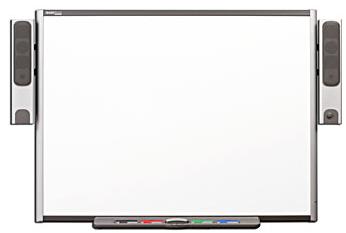
The Smart Board, or "a Big Honkin' TV," as Johnson-Eilola describes it, is a specific computer-supported collaboriatin space. According to Johnson-Eilola, a "Smart Board system provides a 72-inch, rear projection, touchscreen, intelligent whiteboard surface for work." He asserts that "[w]e are attempting to understand how users move within information spaces, how users can exist within information spaces rather than merely gaze at them, and how information spaces must be shared with others rather than being private, lived within rather than simply visited." He explains how the Smart Board system offers an information space that allows his students to engage in active collaboration. He makes three distinct claims regarding the functionality of the technology:
:#The Smart Board allows users to work with large amounts of information
:#It offers an information space that invites active collaboration
:#The work produced is often "dynamic and contingent"
- Johnson-Eilola further explains that with the Smart Board "…information work becom[es] a bodied experience." Users have the opportunity to engage with—inhabit—the technology by direct manipulation. Moreover, this space allows for more than one user; essentially, it invites multiple users.
- Key Words:
- Order of space
- Information space
- Ability of users to move around
- Problem solving
- Configuration of workspace
- Smart Board system
- Virtual reality
- Ubiquitous computing
Chapter 5 Articulating in the Datacloud
Chapter 6 Other Stories, Other Texts: Other Ideas AbOUT Work
Chapter 7 Some Rearticulations: Emergent Symbolic-Analytic Spaces
Chapter 8 Coda: A Text in Fragments
External links
- Byrne, David. (2003, September). Learning to Love PowerPoint. Wired 11(09)
- Davis, Joshua. (2003, June). If we run out of batteries, this war is screwed. Wired 11(06)
- Janecek. (n.d./2004) Flaming Lips Parking Lot Experiments