
Cuneo–Dronero Tramway
The Cuneo–Dronero tramway was an interurban tram line that connected the cities of Cuneo and Dronero from 1879 to 1948.
History
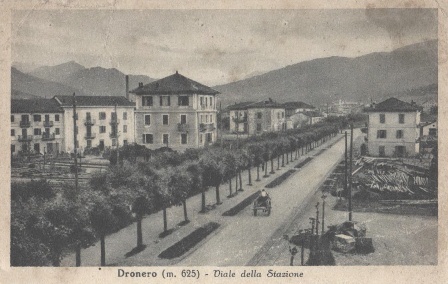
The first steps towards the construction of a tramway network in the Saluzzo area were taken in July 1877, when an assembly of interested municipalities, deputies and provincial councillors resolved to promote the construction of a railway between Airasca, Saluzzo, Cuneo and Mondovì with a branch from Busca to Dronero. Shortly afterwards, the French banker Alfonso Raoul Berrier-Delaleu, in partnership with two Piedmontese entrepreneurs (Clemente Giachetti of Vinovo and Giuseppe Bonardi of Bra) applied for the concession of the tramway lines Cuneo–Dronero, Cuneo–Busca–Saluzzo, Cuneo–Mondovì and Saluzzo–Moretta–Pancalieri (the latter extendable to Turin): on 29 October 1877 the provincial council of Cuneo accepted the application, granting on the following 4 November the construction and operation of the Cuneo–Dronero and Cuneo–Busca–Saluzzo tramways. The Cuneo–Dronero line, built in just seventy days, was officially inaugurated on 23 November 1879, followed the following year by the . On 7 October 1879, at the urging of Berrier-Delaleu, the Società Anonima Tramway da Cuneo a Dronero was established in Cuneo, with its registered office in Cuneo, authorised by Royal Decree the following year.
In 1882, the Belgian banker Rodolfo Coumond, concessionaire of the , took over from Berrier-Delaleu, who was in financial difficulties due to the construction of the Asti–Cortanze and Asti–Canale tramways, the concessions for the Cuneo–Saluzzo, Cuneo–Dronero, Pinerolo–Cavour and Saluzzo–Revello lines. With the absorption of Berrier-Delaleu's lines, the Compagnia Generale dei Tramways Piemontesi (CGTP) was established, with its registered office in Brussels, which until World War I expanded its network to a total length of 189.965 km. Between 1903 and 1907, the company declared a profit equal to 32% of operating income, the highest among all Piedmontese tramways. 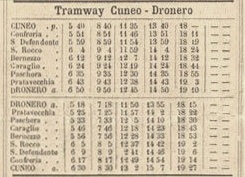
After World War I, in order to reduce operating costs (labour, fuel, maintenance) and increase speeds in the second half of the 1920s, CGTP experimented with a benzole railcar, and then turned to the use of battery-electric railcars at the urging of the general manager Dr. Pietro Lo Balbo. Accumulator traction, also used in those years on various Italian tramways and railways (San Bonifacio–Lonigo–Cologna Veneta Tramway, Verona–Caprino–Garda, Udine–San Daniele, and the Parma and Mantua interurban tramways), was also favoured by the Government: Article 35 of Royal Decree-Law No. 2150 of 2 August 1929 granted kilometre subsidies of up to 10,000 lire for 35 years.
After experiments begun in December 1925 and crowned with success, CGTP purchased larger bogie motor cars for the main lines, including the Cuneo–Dronero, which entered service on Sunday 2 November 1930.
With the electric motor cars the service improved, but it was not enough to counter the advance of bus lines: on 1 May 1935, part of the network, with low traffic or difficult profiles, was converted to bus lines operated by the Società Anonima Autolinee Piemontesi, an associate company of CGTP. The following year, the capital of CGTP passed into Italian hands; the company changed its name to Società Anonima Tramvie Interprovinciali Piemontesi (SATIP) with its registered office in Turin and operational management in Saluzzo. In 1937, the use of accumulator motor cars on the Cuneo–Dronero line ceased, as it had been found that consumption per train/km was 25% higher than that recorded on the Turin–Saluzzo line.
During World War II, a bogie motor car, six two-axle trailers, thirteen high-sided wagons and twenty closed wagons were seriously damaged, and the bridge over the Stura was damaged, rebuilt in 1945. The conflict greatly engaged SATIP, especially regarding the transport of displaced persons.
Despite various reconstruction projects for the SATIP network proposed by various public and private bodies, some of which included route variations on their own right-of-way, electrification (or dieselisation) and conversion to standard gauge, on 30 November 1948 the Cuneo–Dronero line, together with the Pilone Virle–Carmagnola, Saluzzo–Cuneo and Costigliole–Venasca sections, was closed and replaced by buses; of the SATIP network, after protests from users, only the Turin–Saluzzo line remained active, which closed on 10 April 1950, replaced by buses of the Nuova SATIP, the new name of SATIP.
Characteristics
The tramway was a narrow-gauge line of 1100 mm, and extended for 18.460 km; the minimum curve radius was 50 metres, the maximum gradient 28 per thousand. The maximum permitted speed was 24 km/h.
Route
The line started from the Cuneo tram station, located shortly after the bridge that crossed the Stura, near the Cuneo Gesso railway station, in the Basse di San Sebastiano locality.
Leaving Cuneo, the line crossed the bridge over the Stura, branched off from the tramway to Saluzzo and entered the national road of the Valle Maira. After crossing the Grana stream, it entered Caraglio (where it stopped in Piazza del Municipio) and ended its run in Dronero in the Oltremaira district, at a modest station specially built after traversing the avenue leading to the railway station.
Rolling stock
Motor units
Initially, five two-axle steam locomotives built by SLM of Winterthur served on the tramway; similar locomotives were subsequently put into service on the Saluzzo–Cuneo line. With CGTP taking over the management of the line, the locomotives became part of the latter company's rolling stock, eventually being withdrawn by 1920. The rolling stock also included a two-axle locomotive built by Hagans.
They were followed by other tram locomotives, built by Krauss and Henschel, delivered up to 1909: the CGTP fleet totalled 40 of these; added to these were two Breda and two Borsig units from the Pinerolo–Perosa Argentina tramway.
In 1925, CGTP ordered a DWK Type IV railcar from Romeo for its network, on which it served for about a decade with poor results.
Shortly afterwards, accumulator traction, already tested on other Italian tram lines, was experimented with: the Savigliano Works built two motor cars on the chassis of two-axle Grondona carriages, powered by two 13 CV motors each; these electric motor cars gave good results, reducing travel times by 30%. A further series of four motor cars was subsequently built, two built by the Savigliano works and two by the CGTP workshops based on carriages, powered by two motors for a total of 40 CV.
The experiment was successful, so much so that CGTP ordered three bogie motor cars in 1929, built by Carminati&Toselli with TIBB electrical equipment, in service from 1930; three more were delivered in 1933.
Carriages and freight wagons
The first carriages were supplied by Locati of Turin (no more than 12 units, two-axle with end platforms); subsequently, Grondona supplied about sixty carriages, also two-axle with end platforms but more comfortable. The Locati carriages were withdrawn between 1910 and 1920; in those years, the Officine Meccaniche di Pinerolo supplied 28 closed-vestibule carriages (four mixed first and second class, the others second class), longer than the previous ones and used mainly on the Turin–Carmagnola, Turin–Saluzzo–Cuneo and Cuneo–Dronero lines; in addition, some of the Grondona carriages were converted to closed end platforms. In the early 1930s, two two-axle carriages with end platforms arrived from the Messina–Barcellona Pozzo di Gotto Tramway, whose shareholders were the same as CGTP, but they never entered service.
In 1930, about 400 freight wagons were in service, of which 60 were closed and 45 had low sides.
Motor stock – summary table
Unit |
Year of construction |
Builder |
Type |
Notes |
|---|---|---|---|---|
1÷5 |
1879–1880 |
SLM |
2-axle steam locomotive |
ex Berrier-Delaleu for Cuneo–Dronero |
1÷3 |
1879–1880 |
SLM |
2-axle steam locomotive |
ex Berrier-Delaleu for Saluzzo–Cuneo |
4 |
1881 |
Hagans |
ex Berrier-Delaleu |
|
5÷7 |
1881 |
Krauss |
2-axle |
built for Pinerolo–Cavour |
10÷17 |
1881 |
Henschel |
2-axle |
|
18 |
1909 |
Henschel |
2-axle |
|
19÷27 |
1882 |
Henschel |
2-axle |
|
28÷35 |
1888 |
Henschel |
2-axle |
|
36÷38 |
1907 |
Henschel |
2-axle |
|
1÷2 |
Breda |
|||
1÷2 |
Borsig |
ex Pinerolo–Perosa Argentina |
||
51, 57 |
1925 |
SNOS |
2-axle accumulator motor cars |
built for Turin–Carmagnola |
3÷4 |
1927 |
SNOS |
2-axle accumulator motor cars |
built for Saluzzo–Revello–Paesana, Revello–Barge, Costigliole–Venasca |
5÷6 |
1927 |
SNOS |
2-axle accumulator motor cars |
built for Saluzzo–Revello–Paesana, Revello–Barge, Costigliole–Venasca |
101÷106 |
1929–1932 |
C&T-TIBB |
Bogie accumulator motor cars |
built for Turin–Saluzzo–Cuneo, Cuneo–Dronero, Cuneo–Boves |
See also
- List of tram and light rail transit systems
- History of rail transport in Italy
- Saluzzo–Revello–Paesana Tramway
- Turin–Orbassano–Giaveno Tramway
- Asti–Canale Tramway
- Udine–San Daniele Tramway
- San Bonifacio–Lonigo–Cologna Veneta Tramway
- Costigliole–Venasca Tramway