
CumFreq
In statistics and data analysis the application software CumFreq is a user-friendly tool for cumulative frequency analysis of a single variable.
Originally the method was developed for the analysis of hydrological measurements of spatially varying magnitudes (e.g. hydraulic conductivity of the soil) and of magnitudes varying in time (e.g. rainfall, river discharge) to find their return periods. However, it can be used for many other types of phenomena.
Features
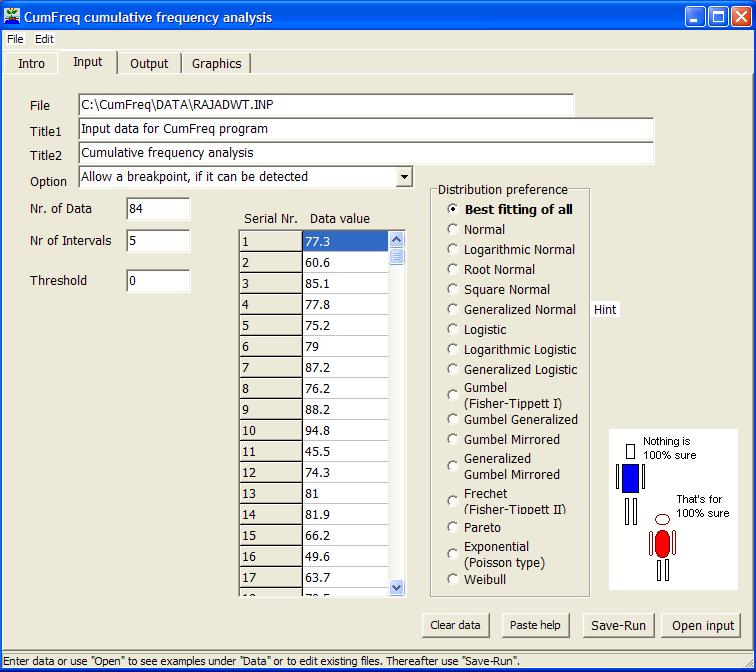
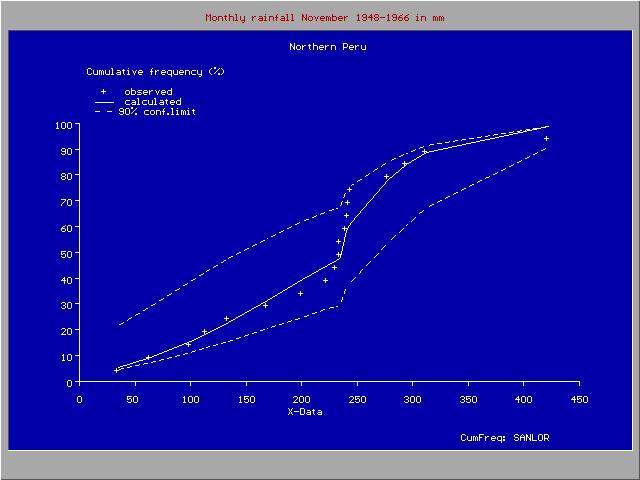 CumFreq uses the plotting position approach to estimate the cumulative frequency of each of the observed magnitudes in a data series of the variable.
The computer program allows determination of the best fitting probability distribution. Alternatively it provides the user with the option to select the probability distribution to be fitted. The following probability distributions are included: normal, lognormal, logistic, loglogistic, exponential, Fréchet, Gumbel, Pareto, Weibull and others.
Further, the program can produce generalizations of the normal, logistic, and other distributions by transforming the data using an exponent that is optimized to obtain the best fit. This feature is not common in other distribution-fitting software which normally include only a logarithmic transformation of data obtaining distributions like the lognormal and loglogistic.
The software employs the binomial distribution to determine the confidence belt of the corresponding cumulative distribution function. The prediction of the return period, which is of interest in time series, is also accompanied by a confidence belt. The construction of confidence belts is not found in most other software.
Another special characteristic of CumFreq is that it provides the option to use two different probability distributions, one for the lower data range, and one for the higher. The ranges are separated by a break-point. The use of discontinuous probability distributions can be useful when the data of the phenomenon studied were obtained under different conditions.
During the input phase, the user can select the number of intervals needed to determine the histogram. He may also define a threshold to obtain a truncated distribution.
The output section provides a calculator to facilitate interpolation and extrapolation.
ILRI provides examples of application to magnitudes like crop yield, watertable depth, soil salinity, hydraulic conductivity, rainfall, and river discharge.