
Cubinder
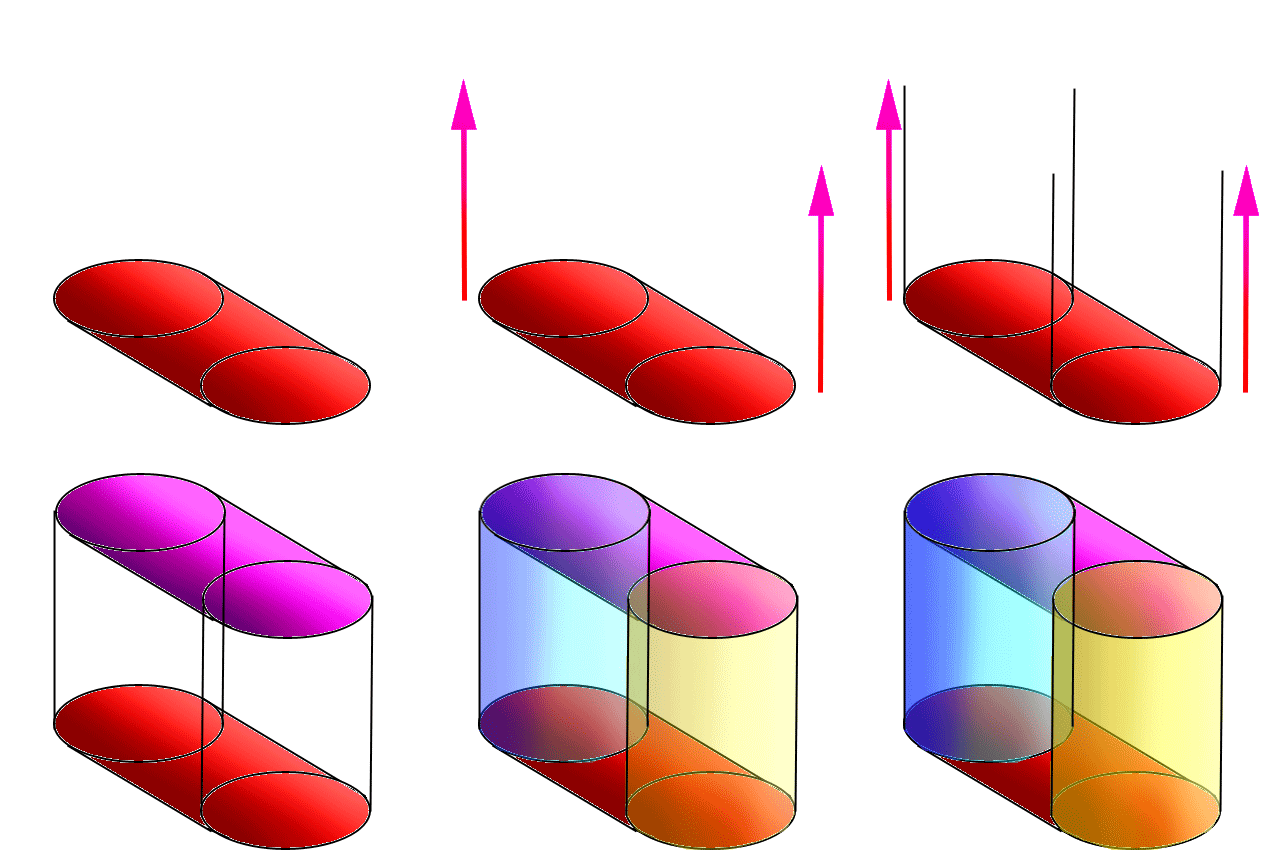 In four-dimensional geometry, the cubinder (otherwise known as cubical cylinder or hypercylinder) is one way to generalise the 3D cylinder to 4D. Like the duocylinder and spherinder, it is also analogous to a cylinder in 3-space, which is the Cartesian product of a disk with a line segment.
- D = {(x,y,z,w) ∣ x2 + y2 = 1, |z| = 1, |w| = 1}
The Cubinder is the Cartesian Product of a circle and a square, and it is a rotachoron. It can be constructed by extrusion of a 3D cylinder along the W- axis by a unit distance. The net of a cubinder is given by a single cube, surrounded by 4 cylinders.
Geometry
Formulae
- volume = 2πrh(h+2r)
- bulk = πr2h2
Subfacets
Edges |
4 Circles (1D) |
|
|---|---|---|
Faces |
4 Discs (2D) |
4 Tubes (2D) |
Cells |
4 Cylinders (3D) |
1 Square torus (3D) |
Tera |
1 Cubinder (4D) |
Rolling
The square torus that binds the Cubinder forms a circular surface along who the Cubinder can roll. Like a circle and a cylinder, it can only roll the space of a line. The Cubinder cannot roll on the 4 cylinders, as they are flat in 4D. 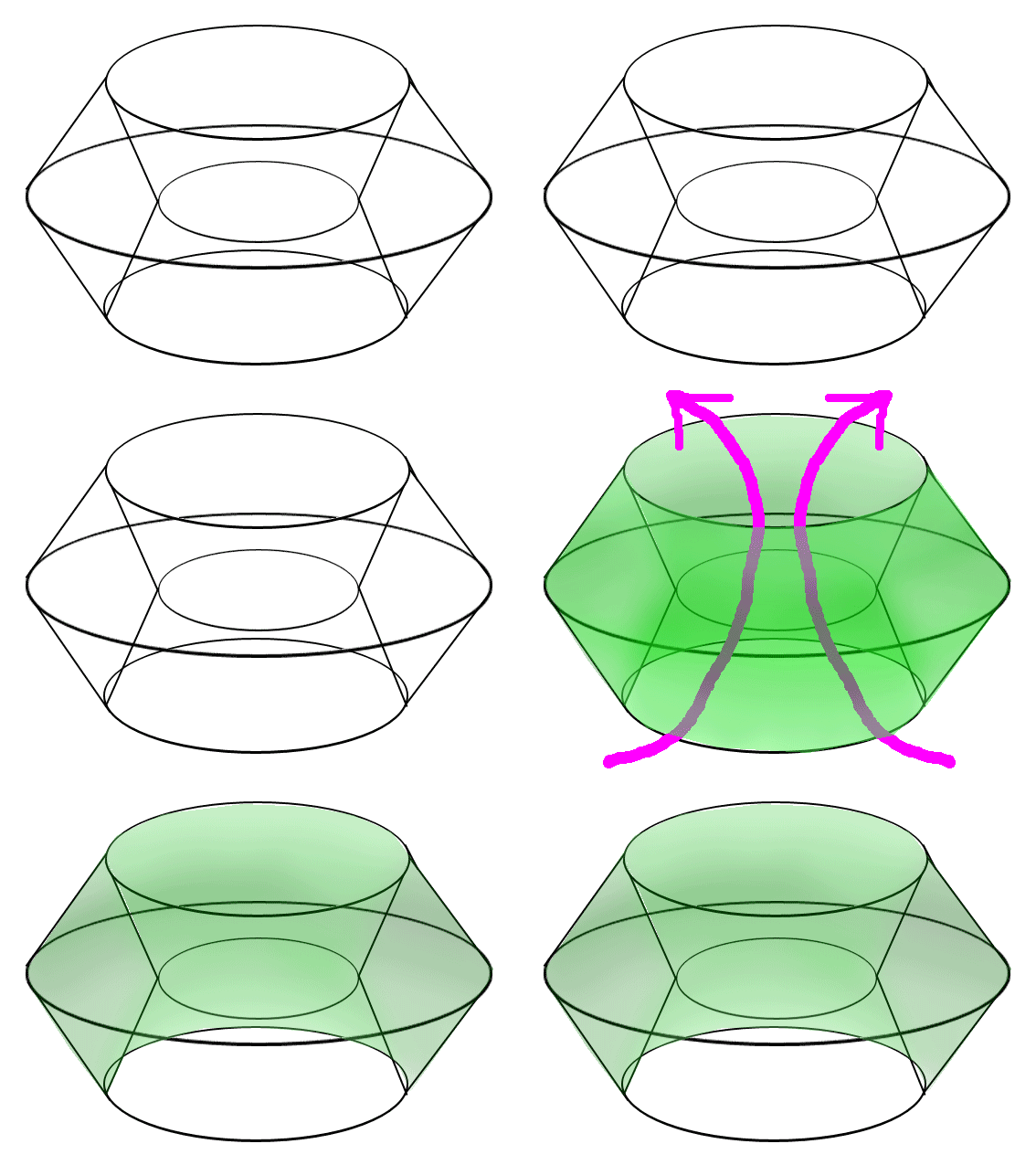
Projection
The diagram is a perspective projection of the cubinder. The cubinder is rotated 45 degrees in the ZW plane. This allows us to observe that the cubinder is made up of four cylinders. However the square torus joining the cylinders cannot be observed from this perspective.
Relationship to other shapes
In 4-space, there are three intermediate forms between the tesseract (1 ball × 1 ball × 1 ball × 1 ball) and the hypersphere (4-ball). These are as follows:
- cubinder (2-ball × 1-ball × 1-ball), whose surface consists of four cylindrical cells and one square torus.
- spherinder (3-ball × 1-ball), whose surface consists of three cells – two spheres, and the region in between.
- duocylinder (2-ball × 2-ball), whose surface consists of two toroidal cells.
The cubinder is also a rotatope (more specifically a rotachoron), along with other shapes such as the tesseract, duocylinder, spherinder, and glome .A rotachoron is a four dimensional shape which can by formed by extensions and rotations. The cubinder is a rotachoron as it can be formed via extension of a cylinder or rotation of a cube.
Dimension |
n-type |
n-cube |
m-sphere crosses |
n-sphere |
n-ball |
|---|---|---|---|---|---|
2nd |
rotagon |
square |
circle |
disk |
|
3rd |
rotahedron |
cube |
cylinder |
sphere |
ball |
4th |
rotachoron |
tesseract |
cubinder, spherinder |
glome |
gongyl |
The rotation of cubinder to 5D is non-unique: rotating it around a cubic cross-section will lead to the shape, spherisquare. However, if you rotate it around its cylindrical cross-section, you will get a different rotatope called "dual cylinder", which can be also gotten by extending the duocylinder.
See also
- Four-dimensional space
- Cartesian product