
COQOS
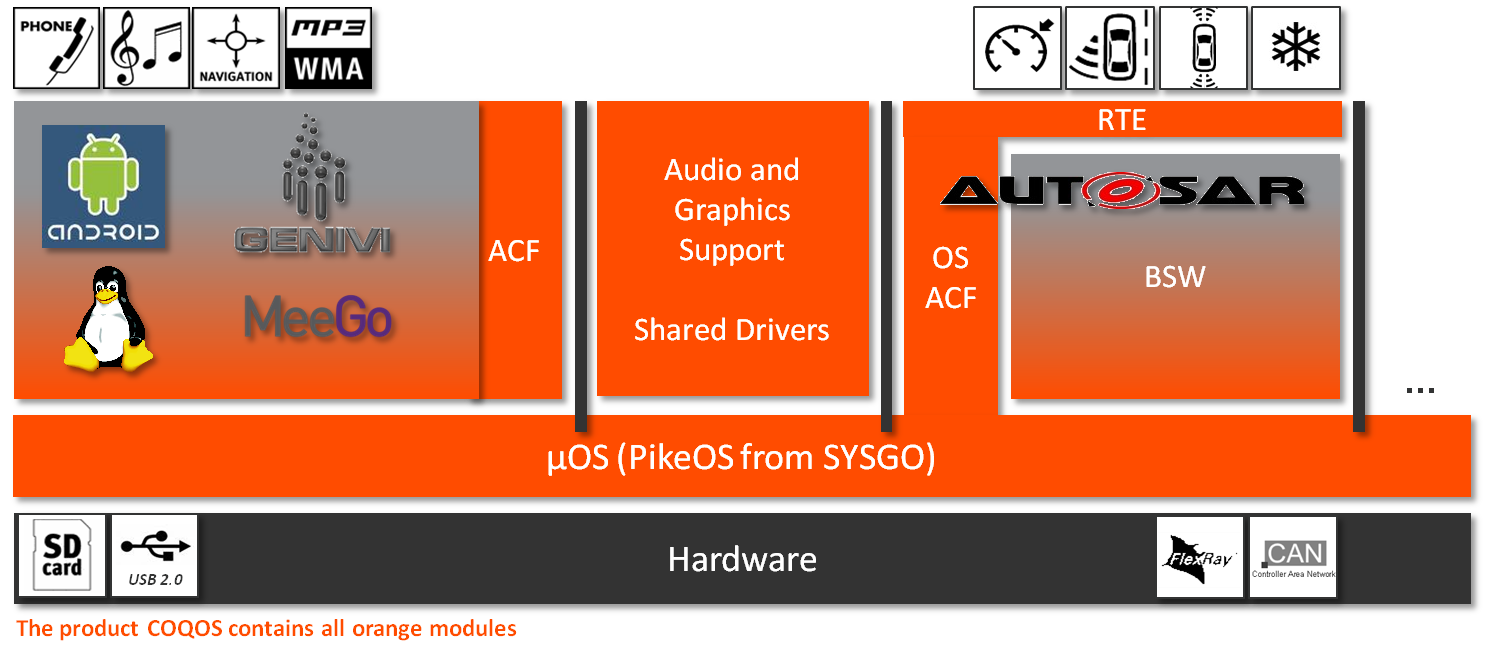
The standards-based software platform COQOS has introduced virtualization technology into the automotive world. It enables automotive manufacturers and their suppliers to integrate Linux or Android-bases systems as well as AUTOSAR-compliant software. It is based on the microkernel PikeOS that generates logical software partitions. In each of these partitions, functions fulfilling very different requirements can run independently from each other.
The virtualization technology in COQOS makes it possible, that even very complex systems can run in a partition. The operating system running within a partition doesn’t use the hardware physically but virtually. Guest operating systems such as Linux and Android make the power of open source available to automotive systems.
This system virtually eliminates mutual interference, because of the independence of each partition. Modular boot and fast boot technology ensure quick availability of critical functionality. Special drivers make it even possible to share hardware resources (like audio and video) between partitions.
The microkernel PikeOS has been applied in avionics for years. It has been certified according to the avionics safety standard DO-178B. TU-Berlin, the Institute FIRST Fraunhofer Society and the software company OpenSynergy have shown in a joint research project, that this safety standard is comparable to the new international automotive standard ISO 26262. The reuse of the microkernel from avionics in automotive provides a high degree of safety and security to all systems that run on COQOS.
Another essential element of COQOS is the AUTOSAR environment. This allows the seamless integration of AUTOSAR software components and basic software modules.
Supported hardware
Supported target processor architectures
- ARM 9
- ARM 11
- ARM Cortex A8
- ARM Cortex A9
- Intel Atom
- others
Target board support package
- FreeScale i.MX35 PDK
- FreeScale i.MX51 EVK
- FreeScale i.MX53 EVK
- FreeScale i.MX53 SABRE
- FreeScale i.MX6Q SABRE
- Russellville Reference Design Platform
- (aka Congatec IVI)
- Further support available on demand
Features
AUTOSAR Support of AUTOSAR Release 3.1 and selected features of AUTOSAR Release 4.0. The AUTOSAR OS, BSW Scheduler and RTE are closely integrated with COQOS. Standard AUTOSAR Basic-Software from the OEM, third-party software vendors or OpenSynergy can be easily integrated.
Guest OS (operating system) COQOS provides support for the following guest operating systems: • Linux 2.6.35 (newer kernel versions are supported in regular updates) • Android 2.3
Communication bridge COQOS supports the partitioning features and inter-partition communication mechanisms of AUTOSAR 4.0 and extends these with a configurable communication bridge between AUTOSAR and Linux.
Watchdog A configurable watchdog (in a separate partition) can observe the behavior of specific applications and take action when the system does not behave correctly.
Fast-boot and modular boot To satisfy the highest requirements on the fast availability of CAN-communication and specific applications, COQOS includes a fast-boot loader and a modular boot mechanism, which allows partitions to load and start sequentially.
Sources
- OpenSynergy: COQOS-Release für Freescale i.MX 6QuadS, Hanser automotive
- OpenSynergy: Partner in Forschungsprojekt ARAMiS, Hanser automotive
- Mehr Sicherheit im Auto durch Flugzeugtechnologie, Elektronik automotive (WEKA Verlag)
- Angriffsschutz für Infotainment-Integration, Hanser Automotive (Hanser Verlag)
- IAA 2011 News: Schutz für das vernetzte Auto, carIT
- Funkwerk setzt künftig auf COQOS, Elektroniknet
- Funkwerk Dabendorf selects COQOS operating system, EE Times Europe
- Can Cars Fly?, Hanser Automotive (Hanser Verlag)
- Neues COQOS mit Mikrokern aus Luftfahrttechnologie, Hanser Automotive (Hanser Verlag
- Android und Autosar auf einem Prozessor, Automobil Elektronik (Hüthig Verlag)
- OpenSynergy, Sysgo cooperate on a safety-critical software platform, EE Times
- E-Fahrzeuge mit Android, iPhones und Apps, Hanser Automotive (Hanser Verlag)