
Conrado Colina Tudtud
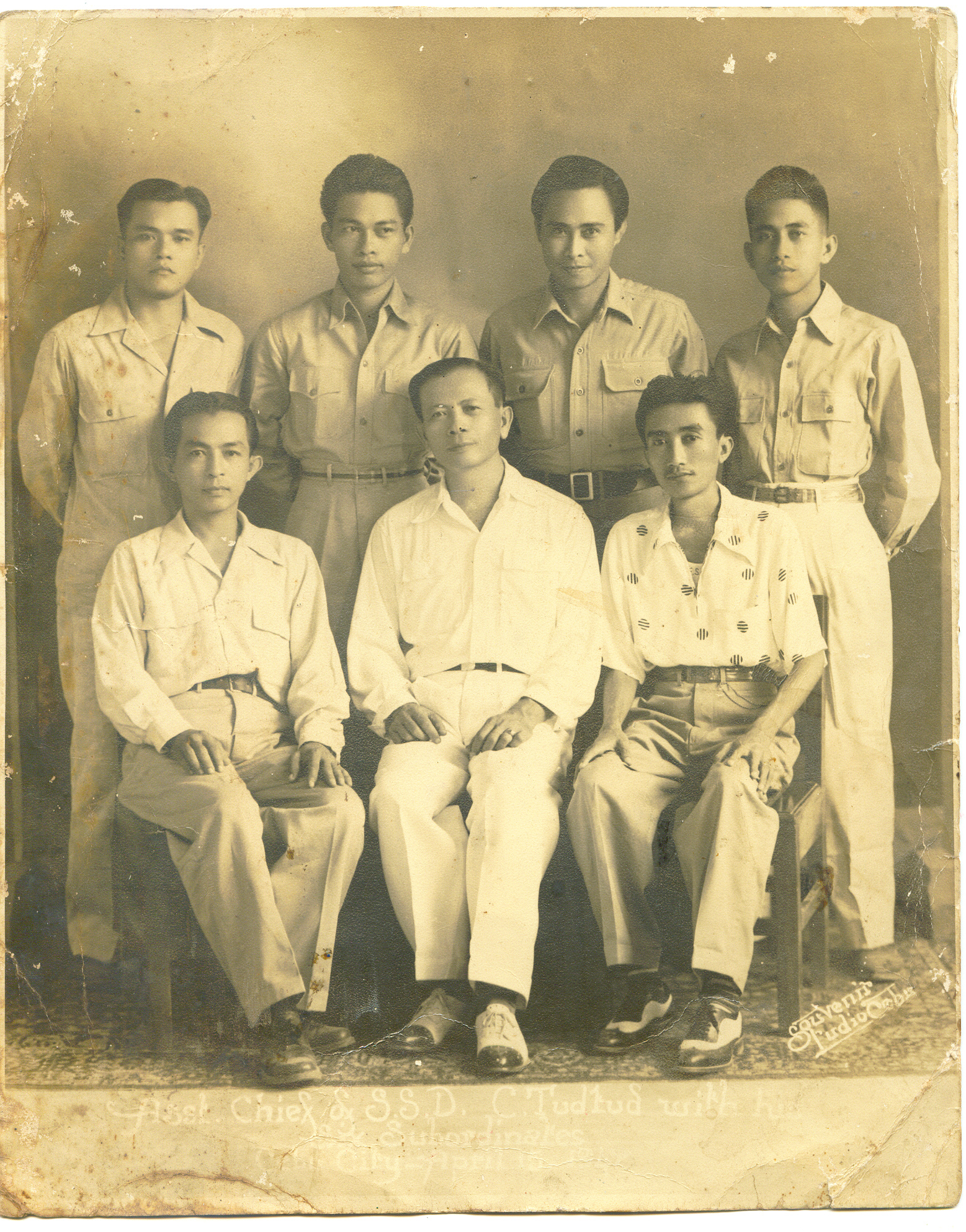
Conrado Colina Tudtud Sr. (December 25, 1902 – December 6, 1970) was a Filipino law enforcement officer and war hero. He is known for spying for the Filipino guerrilla army and American troops during World War II. In return for his service during the war, he was appointed Captain and Assistant Chief SSD District Commander of the Cebu City Police Department, North District. In 1921, he was involved in Partido Democrata in the north district and was among the organizers of the Mabolo Golden Era.
Personal background
Conrado Colina Tudtud was born on December 25, 1902. He is the son of Lope Mina Tudtud and Leonora (née Colina) Tudtud, and one of nine children. Tudtud's first wife was Esperanza Godis. They had two children, Delia G. Tudtud and Conrado G. Tudtud Jr. His second wife was Segundina Solon, with whom he had two children, namely Carolina S. Tudtud and Edgardo S. Tudtud.
Tudtud was a landowner and businessman who was known for his ice drop plant "Conrad's Ice Drop".
Tudtud was one of three notable personalities of the Tudtud clan who resided in Talamban and Mabolo, Cebu City, Philippines and who have streets named after them. C. Tudtud street, formerly Guibilondo Street, in Mabolo, Cebu City Philippines was named after Tudtud. In addition to himself, streets have been named after Lope Tudtud (of L. Tudtud Street) and Gil Tudtud (of Gil Tudtud Street).
Conrado Tudtud is also a relative of another notable personality in the Tudtud clan, Catholic Bishop Bienvenido Tudtud of Marawi who was killed in the crash of Philippine Airlines Flight 206.
World War II
Tudtud is widely recognised as a war hero who spied both for the Filipino guerrilla army and the American Army during World War II. His place of residence was conveniently located beside the Mabolo Parish St. Joseph Church and the Mabolo Elementary School, where the Japanese garrison was located. The Japanese troops were said to have spared his place of business in order to continue enjoying his ice drops. He cooperated with Japanese troops in Mabolo but, at the same time, provided information to the Filipino guerrilla army regarding Japanese affairs.
After the war, he was appointed Captain and Assistant Chief SSD District Commander of the Cebu City Police Department, North District. His influence on the social development of Mabolo also centered on culture. He organized yearly fiesta entertainment for the locals, usually held on the Feast of St. Joseph every third Sunday of May. Entertainment involved free movie watching at the church plaza as he installed a wide screen consisting of white linen cloth draped over his house walls that faced the church square, and projecting the latest movie of the year for all to see.
After the war, Tudtud continued operating Conrad's Ice Drop, providing income opportunities to local citizen's. He would allow sellers to distribute his ice drops and sell them, paying him at the end of the day at cost. One of his employees was the boxer Gabriel "Flash" Elorde, who worked for Tudtud during his youth.
Mabolo Golden Era
 Conrado C. Tudtud was among the organizers and speakers of a political campaign in 1921 called the Mabolo Golden Era.
A meeting was held on a Sunday at 5:00 p.m. at the Plaza in Mabolo organized by Vitaliano Colina, B. Garces, E. Macasero, Manuel Borgoña, and Conrado Tudtud to invite everyone to join them in establishing a local committee of the Partido Democrata in this district. Among the major city Democrata leaders present were Manuel Cairo, Paulino Sanchez, Justo Abellana, Cornelio Esmeña, Tiburcio Alega, Julian Alcantara, Ramon Cañeda, and Prudencio Alaura; also speaking were Jose Fortich, Vicente Gullas, Vicente Rama, Nicolas Rafols, Inocencio Samsom, Julian Kalinawan, and Vicente Kyamko. The local committee selected as their leaders Vitaliano Colina as president and Estanislao Macasero as vice-president.
The Tudtud clan, particularly under the branch of Lope M. Tudtud, donated a portion of their land to the Mabolo Parish Church, which was previously part of the Hacienda of Augustinian Friars, currently known as the Banilad Friar Estates.
References
- Parco, Ma. Bernadette A., "Museo sa Sugbu: Rare Pieces of Old Cebu", Cebu Daily News, 8/17/2008, p.4