
Conrad Hubert
Conrad Hubert (1855-1928) was a Russian inventor. He was the son of Russian Jewish parents who were distillers and wine producers as were their ancestors.
Early life
Hubert attended Hebrew school when he was a boy. In 1868, at the age of thirteen, Hubert went to Berlin to study liquor distillation. While at this vocational school for 6 years he worked at odd jobs for subsistence. In 1874 he returned to Minsk and became a partner in his father's business. In the next 15 years they branched out to various cities throughout Russia. Hubert had built up an reputation as an excellent businessman.
Because of the Russian persecution of Jews however, Hubert at the age of 35 decided to move to the United States in 1890. He liquidated all of his commercial property and turned it into cash. The cash, however, was barely enough to buy passage to the United States. He arrived at Ellis Island in 1891 and, like many other immigrants, without knowing anybody. One of the first things he did then was change his birth name from Akiba Horowitz to Conrad Hubert.
Mid life
The opportunity was not there for Hubert to start again in the distillery business, where in Russia he was well known, so he decided to start a cigar store in New York City. For the next 6 to 8 years he tried other fishes and businesses which included a restaurant, a boarding house, a jewelry store, a farm, a milk wagon route and a novelty shop. The novelty shop, American Electrical Novelty and Manufacturing Company, is his legacy. He ultimately turned this into the Ever Ready Company famous for its batteries.
Inventions
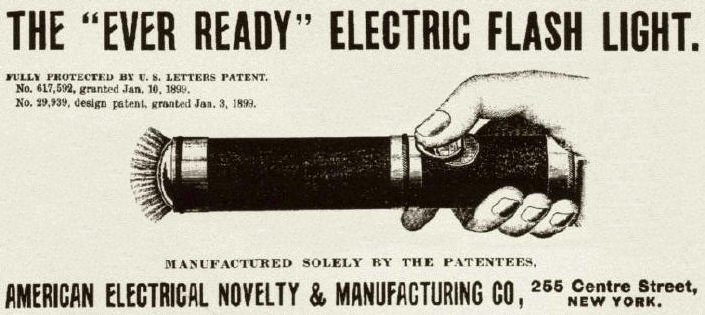 Hubert got interested in an electrical device for lighting natural gas equipment in the later part of the 1890s. He obtained this patent (No. 617,592) from David Misell, which came with an "electric device" that resembles the modern day flashlight. Misell, a British subject, was an inventor associated with electrical devices. He owned Birdsall Electric Manufacturing, a maker of battery-powered devices in the later part of the nineteenth century, before it went defunct in 1897. Hubert then hired Misell for his novelty company and bought all of Misell's electrical devices and equipment, including the associated patents. Misell's tubular "electric device" invention of a "flash light" (two words), was so called because it could only be operated for a very brief time.
Hubert obtained Misell's electrical devices because he felt they might have market value and would be able to sell them through his novelty company. He can not, however, be credited with inventing the flashlight, as Misell had already applied for a patent on the idea in 1898 which was finalized in 1899. At the time he was already working for Hubert. Hubert was merely a witness on Misell's patent of the "electric device"/flashlight as Figure 1 of patent 617,592 shows. Hubert was the first commercial vendor of flashlights. He owned the American Electrical Novelty and Manufacturing Company which later changed its named to the American Ever Ready Company ("Ever Ready").
The New Yorker magazine reported in 1947 that Joshua Lionel Cowen, of Lionel toy train fame, invented the flashlight. The magazine article says that it was a slender battery in a metal tube. On one end of the tube there was a light bulb and the other end had an on-off switch. He used these "flash lights" to illuminate potted flowers. Because of mechanical problems to get them to light correctly Cowen sold the invention to Hubert in frustration of not being able to fix the problem. Hubert in turn distributed the electrified flowerpots as a novelty product through his store. The story goes that Hubert ultimately turned this into the Eveready flashlight, which he turned into a $6,000,000 fortune.
Flashlight related patents
Later life and death
Hubert continued to make improvements on his "portable electric lights" from 1903 forward. He soon became a millionaire. In 1914 he sold Ever Ready Company to the National Carbon Company. He soon thereafter bought a controlling share in the Yale Electric Corporation, manufacturing batteries for automobiles and later for radios, and was the chairman of the board of directors until his death. He was a director of Pyrene Manufacturing Company and of Fordbrad Realty and was a member of the Chamber of Commerce of New York City and of Brooklyn. In addition to his house at 44 East 60th Street, New York, he had a winter house at Lake Wales, Florida. He was survived by two brothers and a sister. According to his will three-quarters of his entire estate (AbOUT $8,000,000) was to be bequeathed under the Conrad Hubert Fund jointly by a Protestant, a Catholic, and a Jew to unnamed organizations that served the general public welfare. Calvin Coolidge, Alfred E. Smith and Julius Rosenwald decided on the distribution of Hubert's wealth.