
CIA activities in Kenya
Intelligence Analysis
The CIA-produced National Intelligence Estimate of October 7, 1971, stated that:<ref name=NIE 70-71>
Kenya 1976
Intelligence analysis
Kenya's government was described as increasingly concerned over the possibility of war between Uganda and Somalia, as well as either country making war on Kenya. Both countries have territorial claims on land considered part of Kenya. While the United Kingdom has, in the past, been allied with Kenya, Nairobi does not expect British assistance in the event of war. 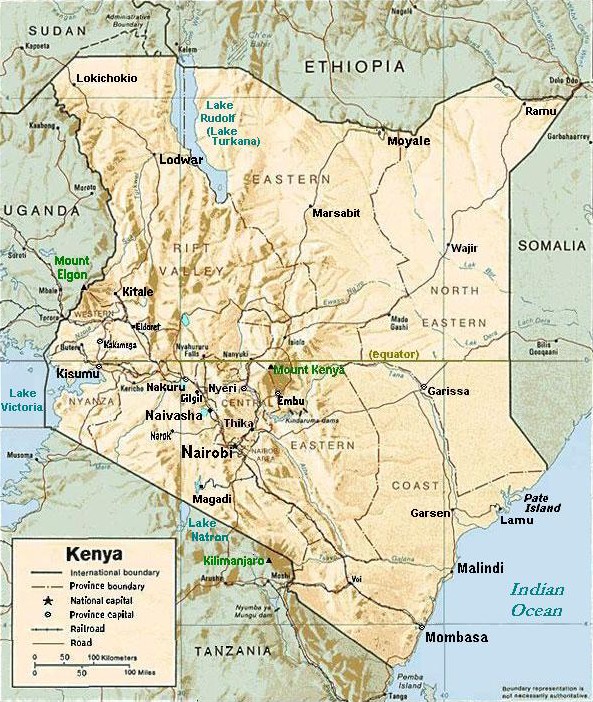 Kenyan relations with Uganda, under Idi Amin, have steadily declined since he took power in 1971, but have gotten much worse recently. There have been local penetrations by Uganda into Kenya, and Kenya responded with economic sanctions. U.S. intelligence believes that Uganda, with larger forces well equipped by the Soviet Union, would have an initial advantage, but the superior discipline and training of the Kenyan military would be significant in a prolonged struggle. A possibility of long-term occupation of Kenyan terrain, however, remains of comcern.
The Kenyan government believes there is a danger of war between Somalia and Ethiopia, with the casus belli being the French Territory of the Afars and Issas, from which France is withdrawing. Kenya does have a mutual defense pact with Ethiopia, who are facing a larger Somali force, again equipped by the Soviets. The analysts believed that Kenya would not want to do more than reinforce its border, although U.S. intelligence also believed Somalia would not launch a full-scale attack against Kenya unless the territorial issue with Ethiopia was resolved.
Somalia can encourage an insurgency in northwest Kenya, which Kenya can control. If, however, Kenya and Somalia go to war, Uganda would be likely to open a second Kenyan front to exploit the situation. Neither Uganda nor Somalia, however, have the logistical capability to sustain a long-term push.
Covert action
Two papers dealing with Kenya, dated October 26, 1976 and Washington, November 11, 1976, were noted in the Foreign Relations of the United States volume, but not declassified. Both were documents of the groups that approve covert action.
Kenya 1998
Counterintelligence
According to the New York Times, United States Department Of State officials confirmed that they had been warned, approximately nine months before the 1998 United States embassy bombings in near-simultaneous car bomb explosions at the United States embassies in the East African capital cities of Dar es Salaam, Tanzania and Nairobi, Kenya. The attacks were linked to al Qaeda. The warning came from an Egyptian named Mustafa Mahmoud Said Ahmed, who had come into the w Nairobi embassy in November 1997, and said he knew of a plot to set off a bomb inside the embassy's underground garage. He told Kenyan intelligence officers that he had already taken photographs of the embassy. After the attacks, British officials confirmed he had visited their Dar es Salaam embassy and offered to help. Tanzanian officials arrested him.
Security was increased for a time after the warning, but then relaxed. The warning contained a caveat that a cooperative third-country intelligence service considered Ahmed unreliable, but the report also said that Ahmed's claim could have been completely true, or possibly a provocation to cause the embassy security measures to be more visible to the attack planners.
There was no confirmation of Ahmed's background, who claimed to have grown up in Zaire, gone to college in Egypt, worked for Kuwait, and came to Kenya as a gem dealer for Taba Investments, a company set up by Osama bin Laden. (See CIA activities regarding [...] financing with gems.) He was reported to have passports from Egypt, Yemen and Zaire. Ahmed said he met bin Laden in Sudan.