
Che Guevara's involvement in the Cuban Revolution
Che Guevara was a key figure in the Cuban Revolution, an uprising that removed the government of General Fulgencio Batista over the island. One of only four non-Cubans sailing with Fidel Castro on the Granma in 1956, he became a rebel Comandante (Major), then, after the victory, was instrumental in [...] Cuba's traditional economic ties with the United States and re-directing the flow of trade to the Soviet Union. Guevara also played a primary role in shaping Cuba's foreign policy, advocating an "anti-imperialist" position and supporting leftist revolutionary movements in Latin America and Africa.
Guerrilla Fighter
Guevara met Fidel Castro and Fidel's brother Raúl in Mexico City where the two were living after having been amnestied from prison in Cuba in 1955. The Castro brothers were preparing to return to Cuba with an expeditionary force in an attempt to overthrow General Fulgencio Batista, who had assumed dictatorial powers following a coup d'état during the 1952 presidential elections. Guevara quickly joined the "26th of July Movement (M-26-7)", named in commemoration of the date of the failed attack on the Moncada barracks that had been the cause of the Castros' imprisonment.
The Castro brothers, Guevara, and approximately 80 other guerrillas departed from Tuxpan, Veracruz, aboard the cabin cruiser Granma in November 1956. Guevara was one of only four non-Cubans aboard. The landing was planned to coincide with an uprising, organized by Frank País, in Santiago de Cuba on 30 November, but Granma was delayed, and the uprising was suppressed. Shortly after disembarking in a swampy area near Niquero in southeastern Cuba on 2 December, the expeditionary unit was attacked by Batista's forces. In the aftermath of the battle of Alegría de Pío where infantry, air and naval attacks killed three rebels, the unit was dispersed into several small groups that lost contact with each other.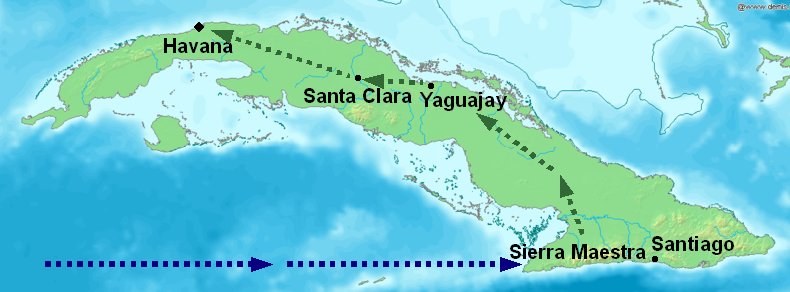 Guevara, the troop's physician, writes that during this battle he laid down his knapsack containing medical supplies in order to pick up a box of ammunition dropped by a fleeing comrade, a moment which he later recalled as marking his transition from physician to combatant.
Only 15-20 rebels survived these initial engagements to later re-group as a bedraggled fighting force; they then moved deep into the Sierra Maestra mountains where they received support from Frank País's network and local guajiro country folk, including Celia Sánchez Mandulay, Huber Matos, the bandit Cresencio Pérez, and a few covert communists who had been living in those mountains since the 1930s. At their encampments in the distant reaches of the Sierra, they slowly grew in strength, seizing weapons and winning support and recruits from guajiros, montunos and property owners (such as the Babun and Matos) in rural areas and also gaining increasing support from the general population in urban areas. Although the Cuban Communist Party (Partido Socialista Popular) did not back Castro until it was clear he was winning in the middle of 1958, the covert communist cells in the mountains did give assistance. The main source of support, including funding, arms supply and a large contingent of fighters continued to be the non-communist urban branch of the 26th of July Movement, directed by Frank País and, after his death, by "Daniel" (nom de guerre of René Ramos Latour). Guevara did not get along with the Frank País contingent and feuded and criticized them continuously. At El Uvero there were more of Frank País's followers among the combatants than "mountain" guerrillas. Guevara ridiculed these urban fighters for lack of fitness, while he himself was riding a mule because of his asthma. Guevara gradually gained enough respect and trust from his fellow Sierra fighters for Castro to appoint him commandante of a second army column. In his new role he became something of a "a fanatic of example", a strict disciplinarian whose harsh methods were notorious amongst the rebels. Deserters were severely punished, and on a number of occasions Guevara sent execution squads into the bush to hunt down those he believed were betraying the revolution by seeking an escape. After one such execution, Guevara wrote that he was "not very convinced of the legality of the death, although I used it as an example". On another occasion, Guevara ordered the execution of a deserter whom he was informed had "victimized an entire section of the population, perhaps in collusion with the army". After the man had been shot three times, Guevara wrote; "those who took advantage of the prevailing atmosphere in the area to commit crimes was unfortunately, not infrequent in the Sierra Maestra".
He was selected by Fidel Castro to lead one of the three columns that crossed the plains of the Cauto; it is said that during this westward march he received protection from the escopeteros—men armed with shotguns—of the "Muchachos" de Orlando Lara Batista who had already linked up with Camilo Cienfuegos and other main force elements of Fidel Castro's Column 1. Then Guevara crossed, with the support of local Escopeteros the even flatter plains of Camagüey heading towards the mountainous Santa Clara province in central Cuba which his column reached in late 1958.
Radio Rebelde
Guevara was instrumental in creating the clandestine radio station Radio Rebelde in February 1958. Radio Rebelde broadcasted news, statements by the 26th of July movement and other information to the Cuban people, as well as providing radiotelephone communication between the growing number of rebel columns across the island. Guevara had apparently been inspired by the part played by CIA supplied radio in ousting the government of Jacobo Arbenz in Guatemala. The station broadcast the first reports that Guevara's column had taken Santa Clara on New Years Eve 1958, contradicting reports by the heavily controlled national news media, which had at one stage reported Guevara's death during the fighting. The station, and its trademark salutation "Aquí Radio Rebelde" continues to broadcast in Cuba to the present day.
Member of revolutionary government
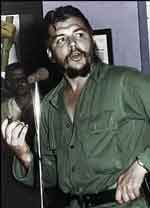 Guevara and his fellow "barbudos" (bearded ones) entered the capital of Havana on January 2 1959, Fidel Castro meanwhile made his way slowly through cheering crowds from Santiago de Cuba to arrive almost a week later. In his absence, a new "revolutionary government" was hastily established by judge Manuel Urrutia on Castro's recommendation. Shortly thereafter, Guevara was declared "a Cuban citizen by birth". Before sailing on the Granma Guevara had told his Peruvian wife, Hilda Gadea (with whom he had one daughter), that he did not love her, and was leaving her; when she turned up in Cuba he initiated divorce proceedings. Later he married a member of Castro's army, Aleida March. The couple would have four children together.
Guevara became as prominent in the new government as he had been in the revolutionary army. His immediate role was to be commander of Havana's La Cabaña Fortress prison, assigned by Castro to be Cuba's "Supreme Prosecutor". During his six months tenure in this post (January 2 through June 12 1959), he oversaw the trial and execution of many people, including former Batista regime officials, members of the BRAC (Buró de Represión de Actividades Comunistas; English translation: Bureau for the Repression of Communist Activities) secret police, alleged war criminals, and suspected political dissidents. It is important to note that Jon Lee Anderson, author of the 814 page - 'Che: A Revolutionary Life', has stated: "I have yet to find a single credible source pointing to a case where Che executed an innocent." However, José Vilasuso, a lawyer who worked under Ché preparing indictments, said that these were lawless proceedings where "the facts were judged without any consideration to general juridical principles" and the findings were pre-determined by Guevara. He claims more than one died shouting: ”I am innocent.” Vilasuso, along with most of the other legally-trained participants, quit due to such excesses.
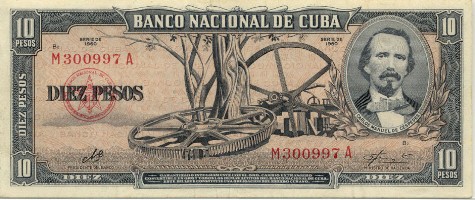
Different sources cite different numbers of executions. Some sources say 156 people were executed, while others give far higher figures. Thomas E. Skidmore, Professor of History and Director of the Center for Latin American Studies at Brown University, estimated the number executed in the first six months of 1959 to have been "about 550". During this period Guevara organized landings in Panama and the Dominican Republic; like all his later, similar efforts in Latin America and Africa, these landings failed. Later, Guevara became an official at the National Institute of Agrarian Reform, President of the National Bank of Cuba, and Minister of Industries. Guevara often retold a story of how he gained the job at the bank; Fidel Castro had asked if there was an economista in the room and he had put his hand up much to Fidel's surprise, Guevara had mistakenly thought the request was for a comunista. Guevara's position was also somewhat ironic, as he often condemned money, favored its abolition, and showed his disdain by signing Cuban banknotes with his nickname, "Che". Throughout his time in the Cuban government, Guevara refused his salaries of office, insisting on drawing only his wages as army commandante in order to set a "revolutionary example".
In the latter capacity at the Ministry of industries, Guevara was to transform Cuba's capitalist agrarian economy into a socialist industrial economy. He visited Tokyo in June 1959 to assess the radical land reforms that had been initiated by the United States after the second world war, claiming that Cuba's plans for agrarian reform offered considerably greater private ownership, and a higher rate of compensation to landowners than that of Japan. After negotiating a trade agreement with the Soviet Union in 1960, Guevara represented Cuba on many missions and delegations to Soviet-aligned and neutral nations in Africa and Asia following imposition by the U.S. of an economic embargo against the island nation.
Guevara helped guide Cuba on its socialist path. An active participant in the economic and social reforms implemented by the government, he became known in the West for his fiery attacks on U.S. foreign policy in Africa, Asia, and especially Latin America.
During this period, he defined Cuba's policies and his own views in many speeches, articles, letters, and essays. His highly influential manual on guerrilla strategy and tactics (English translation, Guerrilla Warfare, 1961) advocated peasant-based revolutionary movements in the developing countries. His 1965 letter "El socialismo y el hombre en Cuba" ("Man and Socialism in Cuba"), written to Carlos Quijano, editor of the Montevideo weekly magazine Marcha, is an examination of Cuba's new brand of Socialism and Communist ideology. The ideal Communist society is not possible unless the people first evolve into a 'new man' (el Hombre Nuevo). For this a socialist state would first be necessary, a ladder to be ascended and then cast away in a society of equals without states or governments. In April of 1961 Guevara was not present at the Bay of Pigs Invasion action.
Prior to the Cuban Missile Crisis, Guevara was part of a Cuban delegation to Moscow in 1962 with Raúl Castro where he endorsed the planned placement of Soviet nuclear missiles in Cuba. Guevara believed that the installation of Soviet missiles would protect Cuba from any direct military action against it by the United States. Jon Lee Anderson reports that after the crisis Guevara told Sam Russell, a British correspondent for the socialist newspaper Daily Worker, that if the missiles had been under Cuban control, they would have fired them. The IDeaS presented in Guevara's book, Guerrilla Warfare, demonstrate his philosophy for fighting irregular wars. Guevara believed that a small group (foco) of guerrillas, by violently targeting the government, could actively foment revolutionary sentiment among the general populace, so that it was not necessary to build broad organizations and advance the revolutionary struggle in measured steps before launching an armed insurrection. However, the failure of his "Cuban Style" revolution in Bolivia and elsewhere was thought to have been due to his lack of grassroots support there, and hence this strategy is now believed by some to be ineffective. It worked in Cuba because many people already wanted to get rid of Batista and because the groundwork had been laid by others such as Frank País, killed by Batista's police in 1957.
As a government official, Guevara served as a public example of the "New Man" (el Hombre Nuevo). He regularly devoted his weekends and evenings to volunteer labour, be it working at shipyards or in textile factories, or [...] sugarcane. Guevara was also known for his personal austerity, simple lifestyle and habits. For example, upon becoming a member of the government, he refused an increase in pay, opting to continue drawing the (considerably) lower salary he received as a Comandante (Major) in the Rebel Army. This austerity also manifested itself as a general dislike of luxury. Once, on a trip to Russia, Guevara was dining with high-ranking officials from the Communist Party of the Soviet Union, when the group's food was served to them on expensive china. To the Russians, Guevara caustically remarked, "Is this how the proletariat lives in Russia?"
Guevara's writings on the Cuban revolution
Che Guevara was a prolific chronicler of his own actions, creating a number of diaries recording various episodes of his life. Between 1959 and 1964, Guevara published versions of his Reminiscences of the Cuban Revolutionary War in Cuban journals such as Verde Olivo. The works were to become a cornerstone of historians’ accounts in the aftermath of the Cuban revolution, shaping the assumptions about the causes and central events. Guevara's ideological and strategic differences with many in the revolution's urban underground movement has meant that the diaries place far less emphasis on their contributions than contemporary scholarship now suggests, Guevara also strongly asserts the role of the guerrilla movement as the central force of change. President of Cuba's National Assembly and former student revolutionary Ricardo Alarcón believes that this view is now misleading, saying, "I don't like to criticize Che. But on that subject [the urban resistance] he really didn't know what he was talking about."
References
- Alarcón Ramírez, Dariel 1997. "Benigno" Memorias de un soldado cubano. Vida y muerte de la Revolución. Tusquets Editores, Barcelona. ISBN 84-8310-014-2
- Anderson, Jon Lee. Che Guevara: A Revolutionary Life. New York: Grove Press. 1997. ISBN 0-8021-1600-0.
- Batista, Fulgencio. 1960 Repuesta. Manuel León Sánchez S.C.L., Mexico D.F.
- Bravo, Marcos. 2005 La Otra Cara Del Che, Editorial Solar. Bogota, Colombia
- James, Daniel. 2001 Che Guevara. Cooper Square Press. New York ISBN 0-8154-1144-8
- Feldman, Allen. 2003 Political Terror and the Technologies of Memory: Excuse, Sacrifice, Commodification, and Actuarial Moralities. Radical History Review 85, 58-73
- Fontova, Humberto. 2005 Fidel: Hollywood's Favorite Tyrant. Regnery Publishing Company, Washington DC. ISBN 0-89526-043-3
- Fuentes, Norberto. La Autobiografia De Fidel Castro ("The Autobiography of Fidel Castro"). Mexico D.F: Editorial Planeta. 2004. ISBN 84-233-3604-2, ISBN 970-749-001-2
- Guevara, Ernesto "Che" (and Waters, Mary Alice editor) Episodes of the Cuban Revolutionary War 1956-1958. New York: Pathfinder. 1996. ISBN 0-87348-824-5. (See reference to "El Viscaíno" on page 186).
- Guevara, Ernesto "Che", Man and Socialism in Cuba. Translated by Margarita Zimmermann. Retrieved 28 December 2005.
- Morán Arce, Lucas. La revolución cubana, 1953-1959: Una versión rebelde ("The Cuban Revolution, 1953-1959: a rebel version"). Ponce, Puerto Rico: Imprenta Universitaria, Universidad Católica. 1980. ISBN B0000EDAW9.
- Rojo del Río, Manuel. La Historia Cambió En La Sierra ("History changed in the Sierra"). 2a Ed. Aumentada (Augmented second edition). San José, Costa Rica: Editorial Texto. 1981.
- La última muerte del Che ("The final death of Che"), Mágicas Ruinas. Retrieved 28 December 2005.
- Ros, Enrique. 2002 Ernesto Che Guevara: mito y realidad. Ediciones Universal Miami. ISBN 0-89729-988-4
- Ros, Enrique. 2003 Fidel Castro y El Gatillo Alegre: Sus Años Universitarios (Coleccion Cuba y Sus Jueces) Ediciones Universal Miami ISBN 1-59388-006-5
- Skidmore, Thomas E. (and Peter H. Smith), Modern Latin America, 4th paperback ed., 2000. New York : Oxford University Press. ISBN 0-19-512996-2
External links
gl:O Che Guevara na Revolución Cubana