
Carlos Torres Hevia
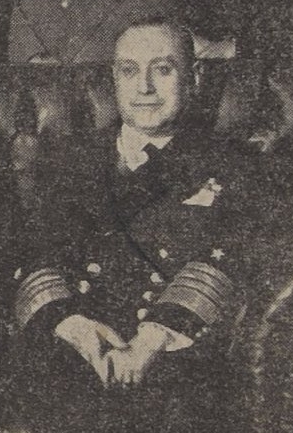
Carlos Torres Hevia (24 February 1894 – 12 February 1990) was a Chilean politician who served as a minister.
He received several decorations, including the Silver Medal for 20 years of service. He also represented the American automobile manufacturer Chrysler in Valparaíso and Aconcagua and was a member of the Military Club of Chile.
Outside public service, Torres served as president of Sociedad de Inversiones y Rentas Valparaíso S.A., the Liga Marítima de Chile, and the Club Naval de Valparaíso. He was also awarded the Grand Cross of the Swedish Order of the Sword.
Torres died in Coquimbo on 12 February 1990, aged 95.
Early life and family
He was born in Elqui, in the Chilean commune of La Serena, on 24 February 1894. He was the son of José Filomeno Torres Pinto and Orosia Hevia Rodriguez. His father was the brother of diplomat Luis Torres Pinto, who served as Chilean consul in Argentina. He had a brother, Héctor, who pursued a career in the Chilean Army, being promoted to second lieutenant in 1914, first lieutenant in 1916, captain in 1924, major in 1928, and lieutenant colonel in 1932.
Héctor attended the Chilean Army War Academy, graduating as a staff officer. He subsequently commanded the "Borgoño" Group in 1930, served as chief of staff of the 1st Army Division in Antofagasta in 1932, commanded the "Chorrillos" Regiment in 1934, and headed the Officers Section of the Army Personnel Directorate in 1935.
Torres received his primary and secondary education at the Seminary of La Serena. He married Adriana Gándara González, with whom he had three children: Adriana Horacia, Carlos Florencio and María Isabel.
Naval career
Torres entered the State Naval Academy as a cadet in 1912, at the age of eighteen, and graduated as a midshipman in 1914. He subsequently commanded the patrol vessels Cabrales and Porvenir in the province of Magallanes, the minelayer Elicura, the destroyer Transporte Orella 2, and the oil transport Rancagua. Aboard the latter, he travelled to the United States with a class of midshipmen undergoing training. He also served as a lieutenant and aide-de-camp to Navy ministers Luis Gómez Carreño and Braulio Bahamonde.
In December 1925, President Emiliano Figueroa Larraín appointed Torres as his naval aide-de-camp, a position he held until the end of Figueroa's presidency in May 1927. He was retained in the position by Figueroa's successor, Carlos Ibáñez del Campo, first during Ibáñez's vice-presidency and subsequently during his presidency. Torres left the post in 1929 and returned to active naval service, assuming command of the warship O'Higgins. He also commanded the battleship Almirante Latorre.
Following the election of Radical President Pedro Aguirre Cerda, Torres was again appointed presidential naval aide-de-camp in December 1938. He served in that capacity until mid-1941, when he was succeeded by Captain Immanuel Holger.
During his naval career, Torres served as head of the Naval Artillery Department, commander-in-chief of the Magallanes Naval Station, based in Punta Arenas, and director of the Personnel Directorate. He later served as commander-in-chief of the Chilean Fleet, holding the position from 1947 to 1948. In 1948, he was promoted to vice admiral. President Gabriel González Videla subsequently appointed him Commander-in-Chief of the Chilean Navy, a position he held until 29 July 1952. On that date, González Videla appointed him Minister of the Interior. He remained in the cabinet until 3 November 1952, when González Videla's presidential term ended.
Three decades later, during the regime of General Augusto Pinochet, Torres was appointed a member of the Council of State on 8 June 1984. He remained a member until 13 August 1985, when he was succeeded by retired Vice Admiral Jacobo Neumann, a former commander-in-chief of both the Chilean Navy and the Chilean Fleet and former director of the Naval War Academy.