
Camden Assets Recovery Interagency Network
Camden Assets Recovery Interagency Network |
Abbreviation |
Formation |
Status |
Purpose/focus |
Membership |
Official languages |
|
Camden Assets Recovery Interagency Network (CARIN) is an informal network of experts-practitioners in the field of asset tracing, freezing and confiscation. It is an interagency network which means that each member state is represented by a law enforcement officer and a judicial expert (prosecutor, investigating judge, etc. depending on the legal system). The concept is that the whole process from the starting point in the investigation, to the asset tracing, to end forfeiture/confiscation is covered. The representatives of the member states are called “national contact points”. All of them are English speaking because the working language of the network is English and may be contacted directly by phone or email.
The aim of CARIN is to increase the effectiveness of members’ efforts, on a multiagency basis, in depriving criminals of their illicit profits.
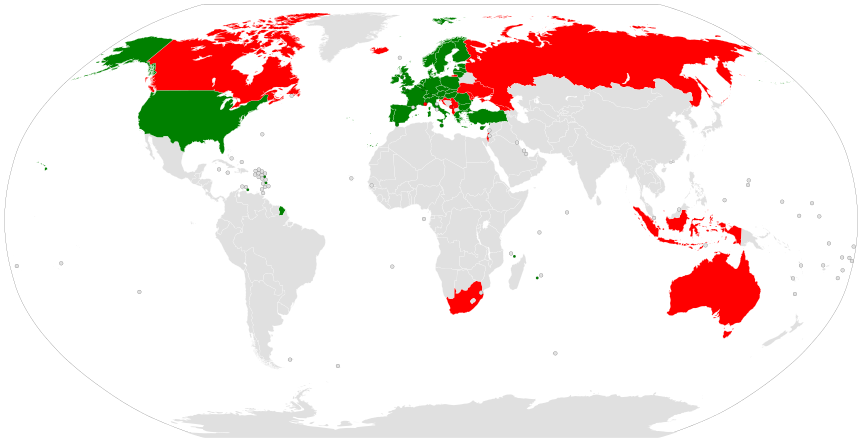
CARIN currently has 53 registered member jurisdictions, including all 27 EU Member States and nine international organisations.
Key Objectives
In seeking to meet its aim CARIN key objectives is to:
- establish a network of contact points;
- focus on the proceeds of all crimes, within the scope of international obligations;
- establish itself as a centre of expertise on all aspects of tackling the proceeds of crime;
- promote the exchange of information and good practice;
- undertake to make recommendations to bodies such as the European Commission and the Council of the European Union, relating to all aspects of tackling the proceeds of crime;
- act as an advisory group to other appropriate authorities;
- facilitate, where possible, training in all aspects of tackling the proceeds of crime;
- emphasise the importance of cooperation with the private sector in achieving its aim; and
- encourage members to establish national asset recovery offices.
The History of CARIN
 In October 2002 a conference was held in Dublin co-hosted by the Criminal Assets Bureau Ireland and Europol. The conference was attended by representatives of all Member States of the European Union and some applicant states together with Europol and Eurojust. Participants were drawn from law enforcement agencies and judicial authorities within member states. Workshops were held between practitioners and the objective was to present recommendations dealing with the subject of identifying, tracing and seizing the profits of crime. One of the recommendations arising in the workshops was to look at the establishment of an informal network of contacts and a cooperative group in the area of criminal asset identification and recovery.
The name agreed for the group was the Camden Assets Recovery Interagency Network (the Camden Court Hotel Dublin being the original location of the workshops where the initiative started). The aim of the CARIN is to enhance the effectiveness of efforts in depriving criminals of their illicit profits. This is now a major law enforcement tool in targeting organised crime gangs with particular reference to financial deprivation. There is added value in that membership of the group will improve cross-border and interagency cooperation as well as information exchange, within and outside the European Union.
The official start of CARIN took place during the CARIN Establishment Congress in The Hague, 22–23 September 2004. The aim of this congress was the establishment of an informal network of practitioners and experts with the intention of improving mutual knowledge on methodologies and techniques in the area of cross-border identification, freezing, seizure and confiscation of the proceeds from crime. It is expected that this network will improve international co-operation amongst law enforcement and judicial agencies, which in turn will provide a more effective service.
The following states and jurisdictions attended the launch congress:
Austria, Belgium, Cyprus, Czech Republic, Denmark, Estonia, Finland, France, Germany, Hungary, Ireland, Italy, Latvia, Liechtenstein, Lithuania, Luxembourg, Malta, Netherlands, Norway, Poland, Portugal, Romania, Slovak Republic, Slovenia, Spain, Sweden, Switzerland, UK (including the UK Crown Dependencies of Isle of Man, Guernsey, Jersey and Gibraltar), and the USA.
Operation of the CARIN Network
The CARIN permanent secretariat is based in Europol headquarters at the Hague. CARIN members meet together regularly at an Annual General Meeting (AGM). Access to the CARIN network and its website is restricted only to members of the network. The organization is governed by a Steering Committee of nine members and a rotating Presidency.
Steering Group
CARIN has a Steering Group with up to nine members from which one member is elected President. The Steering Group's period runs from 1 January each year and concludes on 31 December to allow for planning of the AGM. Membership of the Steering Group rotates periodically with two members offering to stand down each year to enable other Members to join the Steering Group. If the number of candidates exceeds the number of vacancies there a vote of all Members is taken.
The Steering Group oversees the administration of the network and receives applications for membership and observer status together with deciding if a state, jurisdiction or 3rd party meets the criteria for membership. Eurojust has a permanent observer status in the Steering Group. The Steering Group may establish working groups to examine and report on legal and practical issues. The Steering Group also assists in the preparation of the annual conference agenda and identifies areas for consideration at plenary meetings.
Membership
Full Membership is open to European Union Member States and to those states, jurisdictions and third parties who were invited to the CARIN launch congress in 2004. Each Member may nominate two representatives, one from a law enforcement officer and one from a judicial expert to be their CARIN contacts. Assets Recovery Offices may represent either law enforcement officer or the judiciary expert.
Observer status is available to states and jurisdictions that do not qualify for Member status, and non-private bodies concerned with the identification and confiscation of the proceeds of crime.
Associate status is available to bodies that, although not involved with the operational exchange of law enforcement and judicial information, demonstrate a complementary strategic role in the identification and confiscation of the proceeds of crime.
Current members
|
|
{| |
Criteria to be fulfilled by each Member and Observer
The criteria required to be fulfilled by each Member and Observer is:
- they should provide the network with clearly identified national contact point(s). The number of contact points should be the minimum necessary for effective operation of the network. Therefore it is recommended by CARIN that no more than two national contact points are nominated. One contact point should be the central agency involved in asset tracing and forfeiture. If not, this point of contact must have direct access to practitioners in this area;
- they will supply an outline and summary of their legislation and practical procedural guidelines relating to asset forfeiture, civil and criminal, for information sharing with other Members and Observers and for inclusion on the CARIN website; and
- to undertake to meet the objectives and functions as set out in the Statement of Intent.
Annual General Meetings
The schedule of Annual General Meetings is:
Year |
Country |
|---|---|
2004 |
|
2005 |
|
2006 |
|
2007 |
|
2008 |
|
2009 |
|
2010 |
|
2011 |
|
2012 |
|
2013 |
|
2014 |
2011 AGM
Europol, in its function as the permanent secretariat of CARIN, co-organised the annual CARIN meeting which was held in Sofia between 15–16 September 2011. The AGM was hosted by then current CARIN Presidency of Bulgaria, through the activities of the Bulgarian Commission for the Establishment of Property Acquired from Criminal Activity (CEPACA), together with partners Hungary and Spain.
"Targeting Unexplained Wealth" was the focus for the 100 CARIN experts present.
The Chairperson of CEPACA Todor Kolarov put the stress at the press conference on the improvement of the cooperation between the CARIN members in terms to have a better preventive effect in asset tracing, freezing, seizure and confiscation in each country and at an international scale, as well. The topic of "Targeting Unexplained Wealth" outlined Kolarov was important not only to Bulgaria, but to all CARIN members.
See also
- Egmont Group of Financial Intelligence Units
- International asset recovery
References
pl:Międzyagencyjna Sieć Odzyskiwania Mienia Camden