
Bytecoin (cryptocurrency)
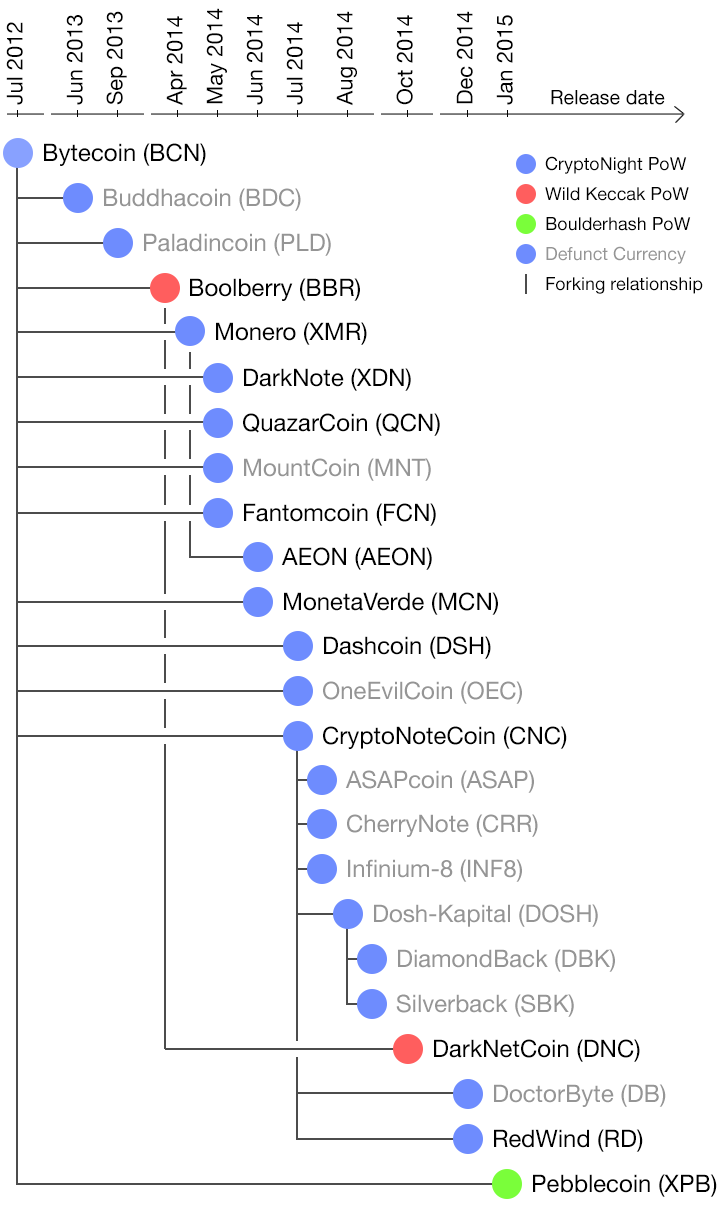 Bytecoin (BCN) is the first cryptocurrency based on the CryptoNote technology and launched in July 2012 with an open source code designed for anonymous cash settlement. BCN protects the user's privacy with impassive and anonymous transactions.
This is a completely independent currency, developing separately from Bitcoin and its forks. The basis for the creation of Bytecoin was the unique CryptoNote technology.
History
Bytecoin (BCN) was founded on July 4, 2012.
Since the launch, several improvements have been made, including multi-valued transactions and several security updates. In 2013, the original implementation of CryptoNote Java was rewritten using C++. For 2015 year Bytecoin fork more than 25 times. Bytecoin blockchain contains additional information not directly related to remittances: several blocks include the geographical coordinates of universities, educational institutions among other buildings. Blocks created since August 11, 2012, contain quotes from Cyphernomicon, Neuromancer William Gibson and other authors.
On March 31, 2015, Bytecoin developers announced their road map for several future releases. Among others, the following improvements were mentioned:
- payment gateway capable of receiving and sending thousands transactions simultaneously
- desktop GUI wallet software (released few weeks later in April 2015)
- several API layers for integration with other software
- blockchain-based aliases system
- blockchain-based assets
- smart contracts with embedded turing-complete language
December 15, 2017 is planned to develop untraceable tokens.
Features
Bytecoin is an open source software. Crypto currency uses the principle of Proof-of-work ("Proof of work performance").
The algorithm for mining in Bytecoin differs in that it actively uses the AES command system for x86 microprocessors and a large amount of memory, which makes mining on the GPU less efficient than for Bitcoin.
It uses the unique CryptoNight algorithm. The essence of the algorithm is in the ring signature, which provides the maximum program anonymity for today. The cryptographic basis for the protocol was created by Ron Rivest, Adi Shamir and Yael Taumann in 2001, and finalized by E. Fujisaki and K. Suzuki in 2007. The EdDSA scheme proposed by the American mathematician Daniel Bernstein is used as the signature algorithm. Additional transaction obfuscation was added to this basis. 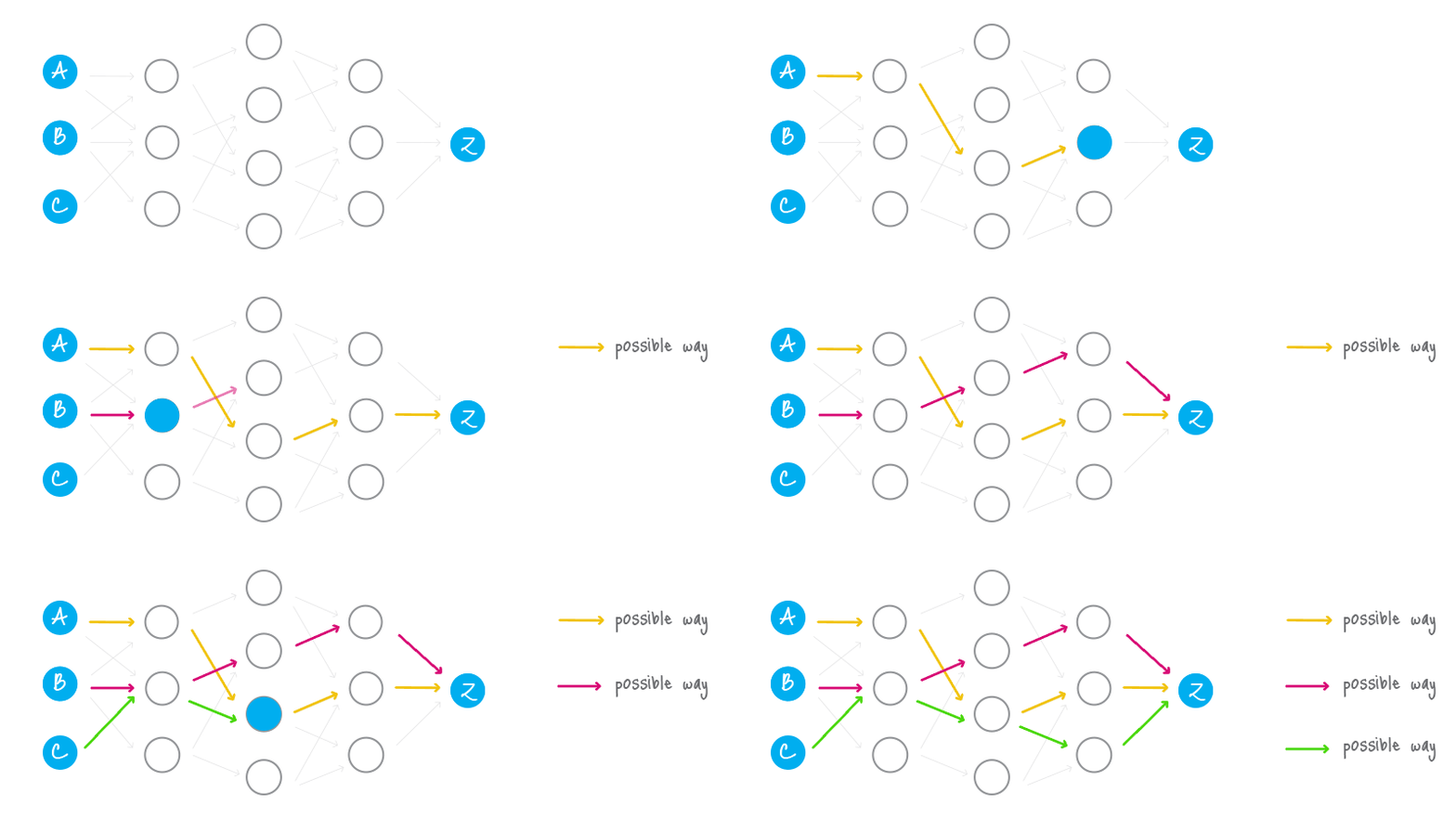 Due to CryptoNote and the obfuscation added to the protocol, passive mixing is provided: all transactions in the system are anonymous, and all participants in the system can use plausible deniability in the event of a capture.
Bytecoin advertises itself as a completely anonymous altcoin. Bytecoin claims the following features:
- Unlimited instant international payments: the Bytecoin network works as fast as the Internet. Payments take a little time to process, as confirmation is required for payment. Bytecoin claims that transactions are processed in AbOUT 2 minutes.
- Security: Bytecoin "protects the user's money with secure and modern crypto algorithms" which "can not be hacked." The creators of Bytecoin argue that breaking a crypto currency "will require a lot of expensive electricity and the computing power of supercomputers."
- Secure personal data: Bytecoin states that "it is absolutely impossible to obtain information about your financial transactions and the balance of your wallet" if you do not want to disclose your data one day. Only the user can manage data that partners and third parties can see.
Criticism
It is rumored that Bytecoin was premine. But there is no evidence of this.
The very same news was published by Monero coin holders.
Usage
Bytecoin is primarily used for anonymous transactions. In addition, Bytecoin is used as a currency in some online stores.
As of 1 December 2017, the Dukley Hotel & Resort in Montenegro allows booking rooms by paying with Bytecoin
Also
- OpenBazaar - peer-to-peer decentralized trade protocol
References
- The source code for Bytecoin on Github