
Bulbophyllum hlakungpuii
-
- Bulbophyllum is one of the largest genus of orchids which is named by Aubert du Petit Thouars in 1822. The original publication of the name -Bulbophyllum was found in his book "Histoire particulière des plantes orchidées recueillies sur les trois Iles Australes d’Afrique, de France, de Bourbon et de Madagascar". The generic name is derived from two Greek words, bolbos for bulb and phýllon which means a leaf. However, Bulbophyllum Orchids commonly have a bulb-like stem or thick rhizome with a single leaf while some have two leaves grown from a single bulb-like stem.
-
- This huge genus is estimated by some taxonomists and botanists that there are up to 2,000 species around the world. It is one of the few genera that occurs in tropical regions of Africa, Asia, Australia and the Americas. Most of them grow as epiphytes or lithophytes. The flowers of this genus vary in size, shape, form and color.
-
- In Mizoram, about 35 species of Bulbophyllum have been found of which 21 species are endemic.
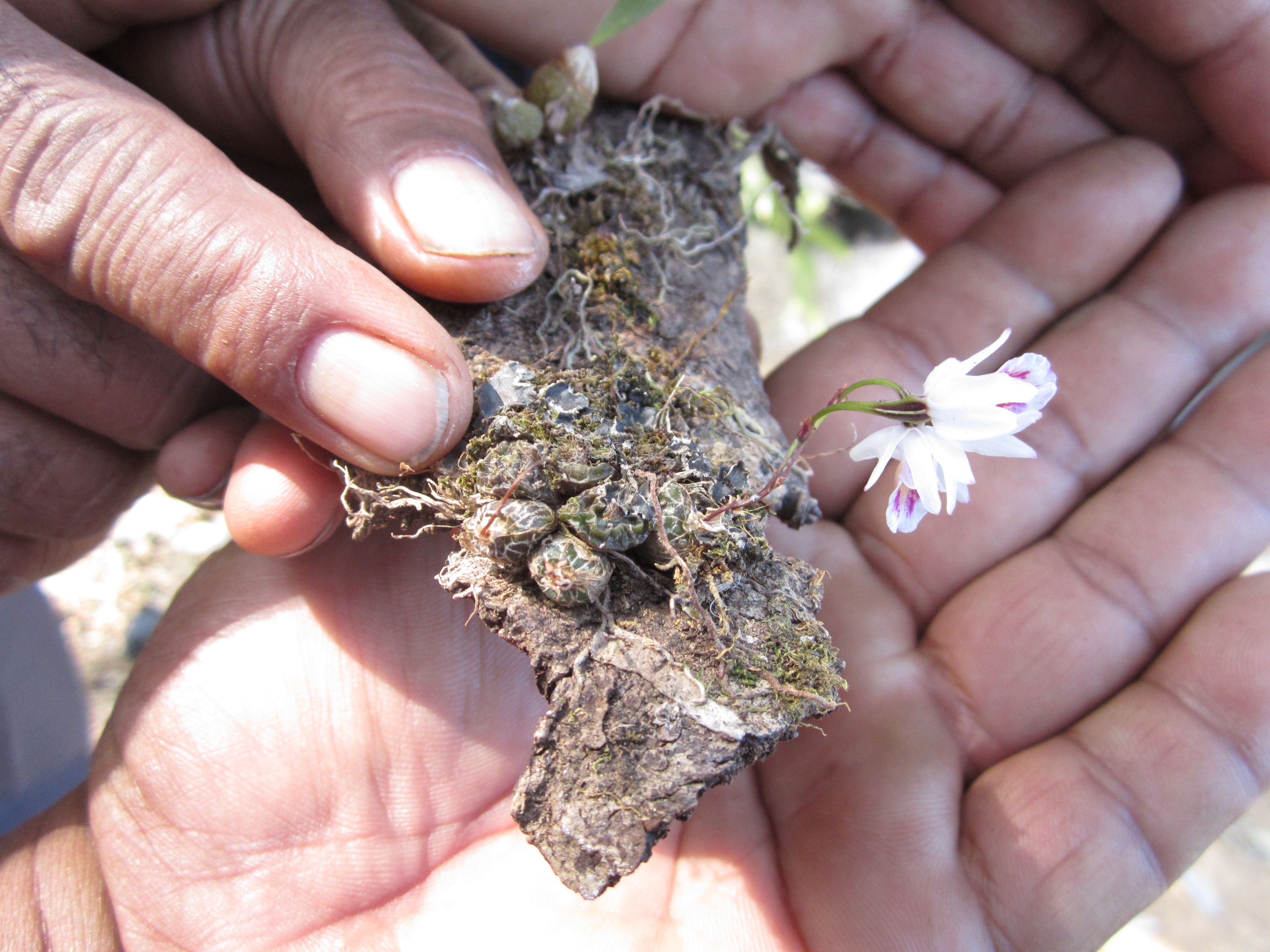
The present species name Bulbophyllum hlakungpuii was given by Mapuia Hnamte in 2012. It is one of the smallest Orchid among Bulbophyllum in the world found in Hlakungpui Orchid Sanctuary. Mizo Hlakungpui Mual stands for Mizo Poets' Square.
CULTIVATION
Bulbophyllum ( Bulbos ) is a pantropical genus found abundantly in Mizoram, North-east India. Mizo Hlakungpui Mual also known as Mizo Poets' Square has a good reserved & forested area which serves as a good place for Orchids. There have been 35 species identified in this place. The place where cultural operation was launch in 2011 is called "Hlakungpui Orchid Sanctuary". The present species named "Bulbophyllum hlakungpuii" is found in this place on 25 March, 2012.
General Conditions
As the rizhome of "Bulbophyllum hlakungpuii" is fleshy and has good capacity to retain moisture for its greenery during dry season. If planted during a dry season, little watering helps its growth and survival continuity. The elevation of the area where "Bulbophyllum hlakungpuii" is presently found is about 1200 meters above sea-level.
Methods of Culturing
"Bulbophyllum hlakungpuii" prefers to be evenly moist, except a slight drying in the winter. During its growing period, the "Bulbophyllum hlakungpuii" should be given little more waterings, so they are never dry.
Because of the wet conditions loved by the "Bulbophyllum hlakungpuii" , fungus can be a problem. A monthly preventative spray of your favorite fungicide is desirable to ward off problems.
However, its own food/water storage can make it withstand during a dry season without proper waterings, if kept under the shades.
Climatic Conditions
The very species of "Bulbophyllum hlakungpuii" is comfortable in a temperature range of 18º C to 29º C. It prefers cool temperatures for part of the year and can be a little difficult in warmer areas. Heavy atmospheric moisture may help its rapid growth.
Light
Bright shade under which you can comfortably read a newspaper without squinting or straining to see is the right light that this species requires. If adjusted slowly, full morning sun up to noon is enjoyed by Bulbophyllum hlakungpuii as most Bulbos do.
Application of Fertilizer
How to enrich fertilization is very simple - "Bulbophyllum hlakungpuii" loves to eat 1/4 strength at each watering is sure to keep them happy. We think that organic fertilizers, such as cow dung/manure, boiled teas, etc. are enjoyed. The fertilizer formula should match the potting medium. It is preferable non-urea based fertilizers at half strength. Non-urea fertilizers provide 100% immediately available nitrogen, which urea based fertilizers do not. It is, therefore, recommended to apply very little amount of fertilizers to provide strength for the new growth, as well as support for the flowers. If you use the urea, always flush, with clear water, monthly to protect the short tender roots from fertilizer burn. All these tips for fertilizing bulbos are generated as idealized methods given in Clan Orchids..
Pests Control
While not insect resistant, "Bulbophyllum hlakungpuii" seems to rarely be bothered by insects other than an occassional scale or mealy bug infestation, which can be easily handled by a 70% isopropyl alcohol and soap drench, or your favorite insecticide. It is suggestible that "Bulbophyllum hlakungpuii" may be cultivated successfully without using insecticides. .