
Broad Homeland hypothesis
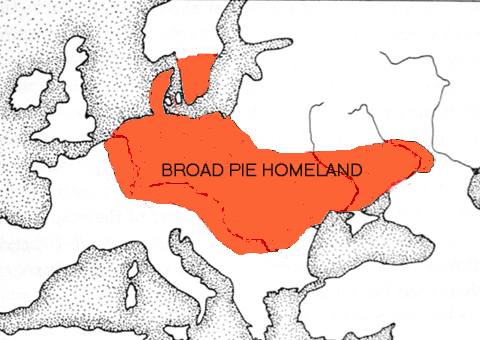
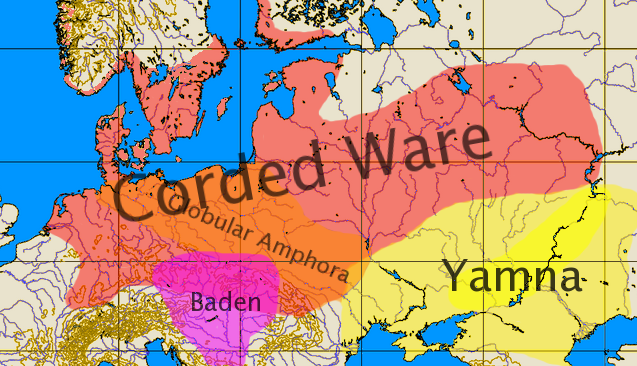 A broad homeland model of Indo-European origins proposes a vast linguistic continuum during the Mesolithic or (Epi-)Paleolithic, carried by foraging hunter-gatherers in the (semi-)nomadic stage, that connected the North Sea with the Volga-Ural, and that predated or were in part contemporary to the Funnelbeaker and Corded Ware HORIZONS. The hypothesis draws on both archaeology and anthropology.
First proposed by Lothar Kilian (1983) and (originally) Alexander Häusler, the hypothesis ties the spread of Indo-European languages to many local developments that shared certain common ideas over a wide area. Their rejection of Kurgan intrusions impelled them to assume a relationship between the Pontic-Caspian cultures and the cultures from Northern and Central Europe that predated the Neolithic Corded Ware and Yamna cultures.
Mallory recognized the assumption of a "broad homeland" would solve the problems posed by any alternative geographically restricted hypothesis "by fiat" However, he stressed the linguistic problems of retrieving genetic relationships between (already differentiated) languages spoken as long ago as the Mesolithic, what according to contemporary linguistic consensus would be impossible. The other way round, agnostic of an intense mutual cultural interrelationship throughout this broader region (Mallory 1989, p.255), Mallory rejected the idea that an essentially unchanged phonetic or grammatical system could possibly have been maintained up until about the fourth or third millennium BC, about the time the kentum and satem branches diverged.
Modern archeology could demonstrate the existence of archeological phenomena that link Mesolithic cultures over the entire region (e.g. de Roever, 2004).
Archeology
Lothar Kilian isolated twenty-three diagnostic features and argued that essential markers of the Corded Ware culture, such as cord-decorated beakers,amphorae and battle-axes, could not be found in the Pontic-Caspian area, and essential markers of the steppes, such as egg-shaped pottery, hammer-head pins, ochre and a variety of burial postures, were unknown in the Corded Ware horizon. Some possible generic similarities did not outweigh the differences and as a result the cultures were not thought to have derived one from the other. Pan-European migrations from the steppe region of southern Russia have not been confirmed from the archeological record and were recently questioned again.
The hypothesis anticipated on the local continuity of Corded Ware culture back to Funnelbeaker culture and Ertebølle culture that is nowadays strongly advocated by modern archeology, and is a direct consequence of rejecting a Pontic presence in Central and Northern Europe during the Eneolithic. The proposal of a broad homeland connecting connect the North Sea with the Volga-Ural Mesolithic or Paleolithic involved the need of a vast linguistic continuum. Shared development and unbroken contact up to the historic distribution of Indo European languages would have to be traced back to the Mesolithic and include the course of Neolitization together with the subsequent Second Products Revolution deemed important to the development of Proto Indo Europeans (Mallory, p218). The latter started in Late Neolithic and reached its height in the Bronze Age and was typified by the use of the plough, dairy products, wool, and wheeled vehicles, only to be closed off about 2500 BC at the very least by the appearance of the chariot and its adoption in a shared Indo European mythology and vocabulary. According to this view, some complex process of assimilation and convergence would account to the development of shared features.
The Corded Ware culture has always occupied a prominent place in locating the Indo-European origins. Preponderance of what generally are considered Indo-European traits have led many to assume this culture in Northern Europe to provide the homeland culture of the Proto-Indo-Europeans, especially among German archeologists of the early twentieth century. However, despite strenuous attempts this specific culture could not be linked to the Indo-Europeans of the Balkans, Greece or Anatolia, and neither to the Indo-Europeans in Asia. Ever since, establishing the correct relationship between the Corded Ware and Pontic-Caspian regions is essential to solving the entire homeland problem. The discovery since the 70s of Bell Beaker culture being genetically a Late Neolithic extension to Corded Ware, and recent Bell Beaker related discoveries as far as Romania and Early Helladic Greece, did not change the doubt since the rapid expanse of the Bell Beakers has traditionally been viewed upon as a rather cultural phenomenon.
All Neolithic cultures of Europe are supposed to be either a direct continuation of Mesolithic cultures, or have been created by Mesolithic groups after their Neolithization by intrusive farmers from the Middle East. The Neolithic advance of Balkan farmers towards the north and west, followed and was ultimately confined by the fertile soils that could be cultivated without the plough - that was not invented yet. This advance of agriculture was deterred by a thousand years, due to less fertile soils or, to the contrary, overtly fertile heavy river sediments that offered less favorable conditions to traditional neolithic clearing techniques. This became the scene of a "tertiary" zone of neolithization by the originally mesolithic autochthons that occupied the wetlands in what has been described as a deliberate choice, triggered by an abundant variety of habitats favourable to fishing, hunting and gathering. 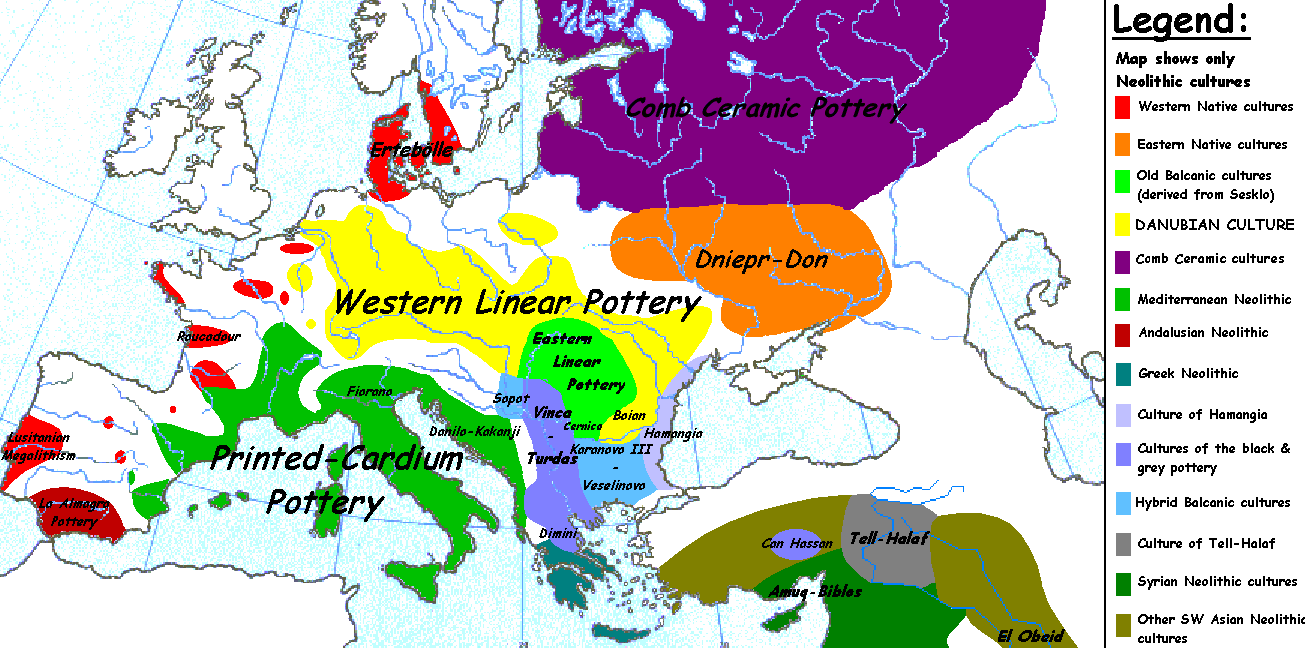 This Neolithic advance has commonly been pictured as a colonization process by Balkan farmers and was for instance featured by Linear Pottery (with Rössen culture and Lengyel culture being the most important derivate cultures) and Cardium Pottery. These cultures had already passed their "aceramic Neolithic stage" when they became neighbours to the presumably autochthon and semi-sedentary fishing cultures, whose cultural level has been described as "ceramic Mesolithic". By then most Mesolithic people employed a distinct type of pottery manufactured by methods not known to the Neolithic farmers. Though each area developed an individual style, yet some common features such as the point or knob base and the superimposed circular rolls of clay, suggests enduring contact and even "ethnic" relationships between the groups. The special shape of this pottery has been related to transport by logboat in wetland areas (De Roever 2004,p.163). Jeunesse et al (1991, fig.22) related similar point base pottery from Spain, southern Scandinavia and the Dnieper-Donets region in the Ukraine. Another area featuring neolithic point base pottery is Northern Africa.
Especially interrelated are Swifterbant in the Netherlands, Ellerbek and Ertebølle in Northern Germany and Scandinavia, "Ceramic Mesolithic" pottery of Belgium and Northern France (including non-Linear pottery such as La Hoguette, Bliquy, Villeneuve-Saint-Germain), the Roucedour culture in Southwest France and the river and lake areas of Northern Poland and Russia. Dmitry Telegin assign the early fifth millennium Dnieper-Donets culture of hunters and fishers to a broad cultural region that spanned the Vistula in Poland southeast to the Dnieper. The dispersion of La Hoguette also intrudes typical Linear Pottery regions. Both La Hoguette and Roucadourien have been proposed to be older than Linear Pottery. The Mesolithic peoples in the hunter-gatherer phase already produced their own pottery when the first neolithic farmers arrived at the Rhine. It is generally accepted that nomadic mesolithic hunters and gatherers connected the neolithic farmers of the Cardium culture at the Franch-Spanish Mediterranean coast to La Hoguette and Roucadourien through the Rhone-Saône route. To the east, this same genetically related pottery found its way to the steppes and forests of Russia, where from the 4th millennium BC on peoples from the Pontic-Caspian brought point base pottery from their original riverside habitats even into the steppe and foreststeppe east of the Urals.
Mesolithic and Neolithic cultures dated according to the attested pottery:
- {| class="wikitable sortable" style="text-align:left; font-size: 90%"
! Culture||First attested pottery||Source |- ! Linear Pottery culture ||5450-5000 BC|| De Roever, 2004 |- ! Rössen culture ||4900-4500 BC|| De Roever, 2004 |- ! Bischheim culture ||4500-4375 BC|| De Roever, 2004 |- ! Michelsberg I-IV ||4350-3400 BC|| De Roever, 2004 |- ! - ||-|| - |- ! Swifterbant, Polderweg 2nd phase ||5200-4950 BC|| De Roever, 2004 |- ! Hazendonk 1,2,3 ||4250-3300 BC|| De Roever, 2004 |- ! Vlaardingen (Late Mesolithic) ||3550-2500 BC|| De Roever, 2004 |- ! - ||-|| - |- ! Ertebolle/Ellerbek (Northern Germany) ||5100-3850 BC|| De Roever, 2004 |- ! Ertebølle (Salpetermosen) ||4950-4800 BC|| De Roever, 2004 |- ! Ertebølle (Scandinavia) ||4650-3850 BC|| De Roever, 2004 |- ! TRB, Hüde-Dümmer ||4300-3400 BC|| De Roever, 2004 |- ! TRB, early, Germany & Scandinavia ||4100-3300 BC|| De Roever, 2004 |- ! TRB, Drenthe, Westgroup ||3300-2700 BC|| De Roever, 2004 |- ! - ||-|| - |- ! Ceramic Mesolithic Belgium ||4500 BC|| De Roever, 2004 |- ! Ceramic Mesolitic France, Roucadourien ||4850-4450 BC|| De Roever, 2004 |- ! - ||-|| - |- ! Early Dnieper-Donets region ||Early fifth millennium|| Mallory, 1989 |- ! Sredny Stog culture ||4500-3500 BC|| Mallory, 1989 |}
The expansion of IE stocks in the Balkans, Greece and Anatolia requires the hypothesis to incorporate elements of the Pontic-Caspian solution. Alternatively, a departure from the original proposal of Kilian towards an ever broader homeland definition been proposed by the PCT workgroup.
Most archeologist accept the hypothesis that the Dnieper-Donets culture was swallowed up by other populations from the steppe (Mallory p.256). Telegin indicates it was assimilated by the Sredny Stog and Yamnaya cultures, while Gimbutas dismiss this culture as a local substrate assimilated by invaders from the Volga-Ural region.
It should be noted that archeological arguments to a local development assume continuity and do not supply migration models that tie prehistoric cultures together. The initial prehistoric dispersal pattern of the Indo-European languages is proposed to be tied instead to a process of regional depopulation followed by repopulation in a "sparse wave" scenario of hunter-gatherers, migrating rapidly out of a refugial area to account for a disproportionate contribution to the genetic and linguistic legacy of the region. Most likely, this would have happened at the end of the coldest part of the Younger Dryas (around 10,800-9,400 cal. BC) or later, following the cold event at 6.200 cal BC.
Hunter-Gatherer Predominance
Throughout Late Glacial and Postglacial prehistory, the North European Plain acted as a gateway for the dispersal of cultural traditions, human populations and languages to northern Europe.
Archeological evidence for contact-induced language change at the transition to farming in Europe, and evidence for the adoption of farming by the local hunter-gatherer populations in the North European Plain, induced an alternative to Renfrew's Anatolian hypothesis that, instead of explaining the diffusion and divergence of languages from the dispersal of proto-Indo-European farmers, draws on contact, exchange, trade, and intermarriage with the local hunter-gatherers.
The arrival of the first farming communities initiated contacts and convergence with the local Mesolithic groups who inhabited the region in distinct territories:
- Between 5400-4800 BC, evidence for forager-farmer coexistence can be found throughout the central part of the North European Plain.
- Next, between 4800 - 4400 BC, an increased exchange was marked by the gradual erosion of the hunter-gatherer identity while the farming identity transformed gradually into a hunter-gatherer context.
- Between 4400-3600 BC coalescence of the mosaic of hunter-gatherer traditions and of Danubian (Linear Pottery, Rössen and Lengyel) farming traditions gave rise to the Funnelbeaker culture (TRB), featuring regional variations that reflected differing relative contributions of each and already existing differences during its formation. A Late Mesolithic and Lengyel exchange network included chocolate flint tools, whose popularity and lack of debris from tool production of early TRB finds of in the region in Polish Kujavia, suggests the flint was acquired as a semi-product or as a finished tool. This detail questions the role of farming community middlemen and raises the question if local hunter-gatherers rather established direct routes of exchange.
- Between 3600-2200 BC two general geographic developments can be distinguished. Broadly to the west of the Vistula, Funnelbeaker culture flourishes and expands into areas hitherto occupied by hunter-gatherers, possibly in a process of long-term separate coexistence and creolisation described in the formulation of the Neolithic creolisation hypothesis. Broadly east of the Vistula, however, the general pattern is of hunter-gatherers caught in a slow and staggered adoption of cultural innovations.
Still, examples of forager-farming co-existence are common east of the Vistula. while west of the Vistula hunter-gatherer sites remained operational alongside Neolithic farming settlements, for instance at Chwalim in lower Silesia that feature continuity from preboreal and subboreal Swiderian culture on to the ceramics similar to Globular Amphora culture. In Holland the Funnelbeaker culture deeply influenced the persisting Vlaardinger culture of hunter-gatherers and both coexisted with Corded Ware until they all gave way to the Bell Beakers as late as 2500 BC. Correspondingly, a big pot unearthed in Spoolde was regarded a direct precursor of the pots of Beaker culture by Lanting, with decorations similar to the Mesolithic Swifterbant culture, and probably pertains to the intermediate Hazendonk 1 horizon (4250-3950 BC).
In summary, viewed over the broad zone of central and eastern parts of the North European Plain, there was a long-term social development between communities characterized as hunter-gatherer by economic practice and tradition, and farming by cultural tradition. This broad social tradition even lasted to 700 BC, even though on a regional scale the consolidation was already completed everywhere about 2200 BC. Much of the observed cultural variability of the TRB horizon and of the later Globular Amphorae and Corded Ware traditions could be ascribed to this process.
A more anthropological perspective that focus on everyday activities reveal the traditional view of farmer migrations being followed by acculturation and/or independent evolution of local foraging communities to be insufficient, and introduce the concept of farmer communities being "acculturated" by neighboring foragers instead. Investigations revealed low paleaodemografic values of Linear Pottery farmers as well as Corded Ware culture populations with dominant agricultural occupations. The highest values correspond to Corded Ware culture populations using a husbandry mode of production.
Linguistics
The model of a broad homeland requires the various bands of hunter-fishers distributed across this continuum to have maintained an essentially unchanged phonetic or grammatical system up until about the fourth or third millennium BC. Important proponents of a broad homeland such as Häusler and Otte have signed support for alternative linguistic approach of the Paleolithic Continuity Theory that investigates such linguistic continuity and minor change.
Associated to this theory is a tentative historical reconstruction linked to the name of Alinei that proposes a reversal of the Kurgan hypothesis, largely identifying the Indo-Europeans with Gimbutas "Old Europe", and reassigns the Kurgan culture - traditionally considered early Indo-European - to a people of predominantly mixed Uralic and Turkic stock. The proof of this is sought in the tentative linguistic identification of Etruscans as a Uralic, proto-Hungarian people that already underwent strong proto-Turkish influence in the third millennium BC when Pontic invasions would have brought this people to the Carpatian basin. A subsequent migration of Urnfield culture signature around 1250 BC triggered this ethnic group to expand south in a general movement of people, attested by the upheaval of the Sea Peoples and the overthrow of an earlier Italic substrate at the onset of the "Etruscan" Villanovan culture. This interpretation, however, is highly controversial.
The results of glottochronology point to time-depths in general considered extreme by mainstream historical linguists.
A summary view of linguistic palaeontology engaged in evaluating an Indo-European homeland would point primarily to the territory embracing the Funnelbeaker culture of Northern Europe, the later descendants of the Linear pottery culture of the Danubian drainage, the Eneolithic cultures of the Pontic-Caspian region and, perhaps, southern Siberia. This territory fits neatly in Kilian's proposal.
Genetics
Lothar Kilian links the "broad homeland" to the European phenotypes that can be located in a paleolithic to mesolithic setting between the Rhine and Volga. In this he discerns a robust "Dalic" element, a continuation of Cro Magnon, and a leptodolichomorph proto-Nordic element, composed of Brünn and Combe Capelle and to be regarded basically as depigmented Mediterraneans.
Accordingly, the Dnieper-Donets population has been predominantly characterized as late Cro-Magnons with more massive and robust features than the gracile Mediterranean peoples of the Balkan Neolithic. This corresponds to the robust physical type of other Mesolithic wetland and fishing cultures, like Ertebølle and Swifterbant.
A large spatial continuum has been sought also in the distribution patterns of genetic markers. High concentrations of Mesolithic or late Paleolithic YDNA subclades of haplogroup R1b (typically well above 35%) and I (up to 25%), are thought to derive ultimately of the robust Eurasiatic Cro Magnoid homo sapiens of the Aurignacian culture, and the subsequent gracile leptodolichomorphous people of the Gravettian culture that entered Europe from the Middle East 20,000 to 25,000 years ago, respectively. Small Neolithic additions can be concerned in occurrences of "Anatolian" haplogroups J2, G, F and E3b1a, the latter originally presenting a clearly Sub-Saharan Afican element Haplogroup R1a1, whose lineage is thought to have originated in the Eurasian Steppes north of the Black and Caspian Seas, is both associated with the Kurgan culture 13 and to the postglacial Ahrensburg culture that probably spread the gene originally, Ornella Semino et al. (see 14) propose a postglacial spread of the R1a1 gene from the Ukrainian LGM refuge.
The present-day population of R1b, with extremely high peaks in Western Europe and measured up to the eastern confines of Central Asia, are believed to be the descendants of a refugium in the Iberian peninsula (Portugal and Spain) at the Last Glacial Maximum, where the haplogroup may have achieved genetic homogeneity. As conditions eased with the Allerød Oscillation in about 12,000 BC, descendants of this group migrated and eventually recolonised all of Western Europe, leading to the dominant position of R1b in variant degrees from Iberia to Scandinavia, so evident in haplogroup maps. The most common subclade is R1a1c9, that has a maximum in Frisia (the Netherlands). It may have originated towards the end of the last ice age, or perhaps more or less 7000 BC, possibly in the northern European mainland.15.
Criticism
Criticism of the "broad homeland" involve the linguistic implausibility of a spatial linguistic continuum of 2000 to 3000 kilometres long, and the archeological phenomenon that should tie the area together. The search for archaeological evidence beyond what can be motivated from historical linguistics has been criticized by linguists such as Kortlandt, who addressed a general tendency to date proto-languages farther back in time than is warranted by the linguistic evidence. Efforts to overcome the linguistic objections by interpretations of the process of First Language Acquisition and Chomsky's notion of language being "innate" so far only incremented the linguistic dispute.
See also
- Ukrainian LGM refuge
- Paleolithic Continuity Theory
- Competing hypotheses
- Kurgan hypothesis
- Armenian hypothesis
- Anatolian hypothesis
- Out of India theory