
Brescia–Mantua–Ostiglia Tramway
The Brescia–Mantua–Ostiglia tramway was an interurban tramway line that connected the city of Brescia with Mantua and the municipality of Ostiglia, site of a railway station along the Verona–Bologna railway.
Built by the Société Anonyme d'Entreprise Générale de Travaux (EGT), which initially managed it, the tramway concession was later transferred to its subsidiary Società Anonima Tramways de Lombardie et Romagnes (SATLR) in 1912.
The tramway was closed in 1952, after having characterized the geographical and economic environment of part of the Po Valley for decades.
History
Granting of concessions

On 18 May 1878, the Minister of Public Works, Alfredo Baccarini, proposing to resume investment in railway construction, introduced a bill on the financing of new lines. The planned Brescia–Mantua connection fell into the Fifth category and could therefore be financed as an "economic railway" or as a tramway line. The Provincial Deputation of Brescia opted for the second option, given the considerable interest that tramways were generating in the province during the late 1870s and the low operating costs of these lines compared to railways. In August 1879, the deputation granted the Milanese industrialist Enrico Horvath the construction and operation of a Brescia–Montichiari tramway, with possible branches towards Castiglione delle Stiviere and Asola. The provincial administration committed to resurfacing the roads, while the rest of the work was entirely at the concessionaire's expense. Vignoles rails of 16 kg/m were to be used.
By October 1880, work on the provincial road to Montichiari was completed, but Horvath decided not to start construction, considering the containment work on the Garza stream near the hamlet of San Polo insufficient. After several negotiations with companies in the sector, Horvath introduced Camillo Prunieau, Belgian consul in Rome and representative of the Société Anonyme d'Entreprise Générale de Travaux, to the members of the deputation. On 24 August 1881, the Belgian company obtained permission from the Deputation to take over the concession from the Milanese industrialist.
In Mantua as well, in the early 1880s, there was a political debate on the opportunity of constructing tramways in the province. The provincial council session of 19 April 1880 indicated the possibility of constructing the Mantua–Asola, Mantua–Castiglione, Mantua–Ostiglia, and Mantua–Viadana "guidovie" (tramways). Engineer Avenati seemed about to acquire the concessions for all four lines, but negotiations broke down when it became clear he was unable to fulfill his commitments. Consequently, it was preferred to accept the Belgian company's proposal for the Castiglione–Mantua and Mantua–Ostiglia concessions, precisely because it was proving reliable in the design of the Brescia–Montichiari line. The concession was formally granted on 28 November 1881.
Construction
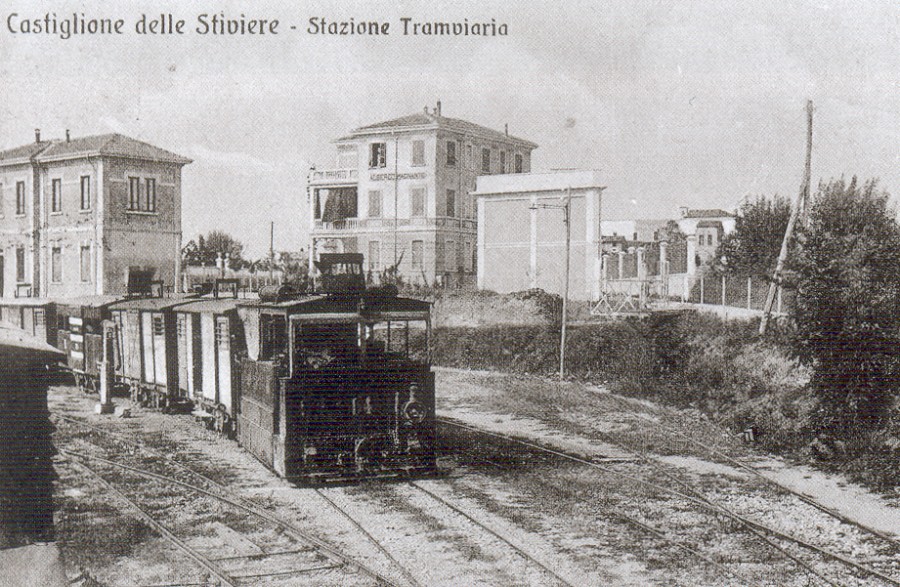
In February 1882, authorization arrived from the Ministry of Public Works for the construction of the Brescia–Montichiari–Castiglione line, which was inaugurated on 25 June 1882.
In 1883, the Prefect of Mantua proposed to the Brescia deputation to convert the tramway into a Fourth-category railway in order to make the State bear 6/10 of the total cost, based on the provisions of the law of 29 July 1879; in this way, Mantua would not have had to bear expenses for road maintenance. The province of Brescia refused, considering the tramway option more advantageous for its economy.
During the design phase, positioning tracks on the roadway required building new bridges alongside existing road and railway bridges. Metal lattice bridges were ordered from the Impresa Industriale Italiana in Naples, which were delivered late due to a cholera epidemic in the Province of Naples.
In 1883, despite the request of the province of Mantua to convert the project into a railway, track laying began between Castiglione and Goito, and between Ostiglia and Governolo, where the line would cross the Mincio river. On 12 April of that year, the Castiglione–Gambarara section was opened.
On 21 February 1884, the Governolo–Ostiglia section was completed. On 29 September, the Cerese–Governolo section was opened, while in October the section from Gambarara was extended to the Cittadella district. To complete the line, the section between Cittadella and Cerese crossing the city of Mantua remained.
On 19 April 1886, the section connecting Cittadella to the Mantua Borgo Te station was inaugurated, while the section from the latter location to the line for Ostiglia, near Cerese, was completed on 18 July. However, unbroken travel along the tramway was impossible because the line could not cross the Mantua–Monselice railway perpendicularly. Passengers were therefore forced to transfer at that point to move from one side of the railway line to the other. The problem was resolved with an oblique crossing inaugurated on 8 August.
In the late 1880s, the problem of floods from the Garza stream was at the center of disputes between the Province of Brescia and the tramway company: on 9 October 1890, the Court of Brescia ordered the administration to reimburse the Belgian company for flood damage and to honor commitments to resolve the problem promised as early as 1879, but never kept, a ruling reaffirmed on 27 February 1893. Consequently, between 1894 and 1896, a bypass was planned (though never built) from Canton Mombello to connect San Polo, passing in front of the new city psychiatric hospital. In 1899, it was preferred to raise the road from the Mantua entrance to San Polo along a route of about 3 kilometers, reinforcing the stream embankment.
In May 1896, funding was provided for the construction of the new bridge over the Chiese river at Montichiari.
On 3 September 1911, the Montichiari–Carpenedolo–Castiglione bypass was inaugurated. The new route connected the lower Brescia plain city to the capital, but lengthened—to Montichiari's regret—the connection between Brescia and Castiglione delle Stiviere. The old direct section passing through Novagli, a hamlet of Montichiari, was dismantled in the following months. In exchange, the tramway company obtained an extension of the concession for the entire Brescia–Ostiglia line until 1952, while the Mantuan deputation requested the construction of a tramway connecting Castiglione delle Stiviere to Desenzano. An initial contribution of 20,000 lire for the design of this branch was allocated by the Mantuan provincial council as early as 1884, while the design was drafted by engineer Ernesto Filzi in 1903 and foresaw ending the tramway at Porto Square in the Garda town, aiming to attract freight traffic to the new tracks. However, between 1906 and 1909, the Maratona was built connecting the port with the Ferrovie dello Stato station in Desenzano. Due to the presence of the railway, the tramway could not terminate on the square, but had to continue to the Customs house (Dogana). Consequently, freight traffic on the Castiglione line never reached the levels desired by the Province of Mantua to revive its economy.
The Desenzano–Castiglione tramway was opened to public service on 5 November 1911.
New management and the post-war era

On 15 November 1912, management of the Brescia–Mantua–Ostiglia line passed to the Società Italiana Tramvie e Autovie di Lombardia e Romagna (SATLR), a subsidiary of the Belgian company. The EGT continued to be formally recognized as the operator in official documents until at least 1908.
During the First World War, services were suspended due to a fuel shortage; given the poor quality of service, in 1917 the mayors of Brescia, Castenedolo, Carpenedolo, and Montichiari filed an indictment against the Belgian company and, at the end of the conflict, put forward several proposals for electrifying the line.
In 1919, SATLR made its electrification proposal to the provincial administration of Brescia, involving only the Brescia–Mantua section, but asking in return for a subsidy of 20,000 lire per kilometer, free land for support poles, a connection at Desenzano to the proposed Valtenesi tramway, and a 50‑year concession extension. The Province of Mantua would have had to accept the same conditions had Brescia accepted SATLR's offer, but this did not happen.
Having established that the Brescia–Carpenedolo line nevertheless played an important role in connecting the towns involved with the provincial capital, an electrification project was launched in 1932 funded by the Brescia provincial administration, while the work was managed by the Servizi Municipalizzati di Brescia. SATLR maintained operations, carried out by two specially built electric railcars. On 9 October 1932, the Brescia–Castenedolo section was opened to public service, while on 31 May 1934 the Castenedolo–Carpenedolo section opened as well. The Brescia terminus was moved to the loop siding at Vicolo dell'Ortaglia, once used for loading and unloading goods at the granary in Piazzale Arnaldo, which was named Brescia Corso Magenta.
Gradual closure of the line
The lack of electrification was the main cause of the line's gradual closure. SATLR experimented with bus services between 1932 and 1934 with fair success, taking advantage of a ministerial decree of 12 November 1937 allowing concessionaires to convert to bus routes.
On 3 March 1934, the Mantua–Ostiglia line was closed. On 24 April 1935, traffic on the Mantua–Desenzano and Mantua–Brescia lines also ceased. Freight traffic continued until early the following year, when the tracks were dismantled.
Tram services continued only between Brescia and Carpenedolo. On 15 September 1944, a tram on the line was subject to an air attack while traveling near the hamlet of Trivellini in Montichiari, causing seventeen casualties.
On 13 August 1952, at the end of the concession, services were suspended on the Brescia–Carpenedolo section as well, while the tracks were removed between July and October of the following year. SITALR operated replacement bus services on the Brescia–Carpenedolo, Brescia–Mantua, Brescia–Calcinato, and Desenzano del Garda–Castiglione routes until 30 June 1973, when the concessions were taken over by the Province of Mantua and passed to APAM.
Characteristics
The line was a single-track interurban tramway. Standard Italian tramway gauge of 1,445 mm was adopted. In the early years of operation, Serres & Battig rails were used; towards the end of the 19th century, it was decided to replace them with the Vignoles system resting on treated wooden sleepers, a more proven solution that was less costly in terms of maintenance.
Passenger and freight trains along the line were hauled by steam tramway locomotives, with the exception of the Brescia–Carpenedolo section, which was electrified between 1932 and 1934 with an overhead catenary line served by electric tramcars.
Route
Brescia–Mantua
The terminus station of Brescia Porta Venezia stood in Largo Torrelunga near Piazzale Arnaldo and was connected to both the urban network and the Porta Venezia tram station of the Brescia–Salò line.
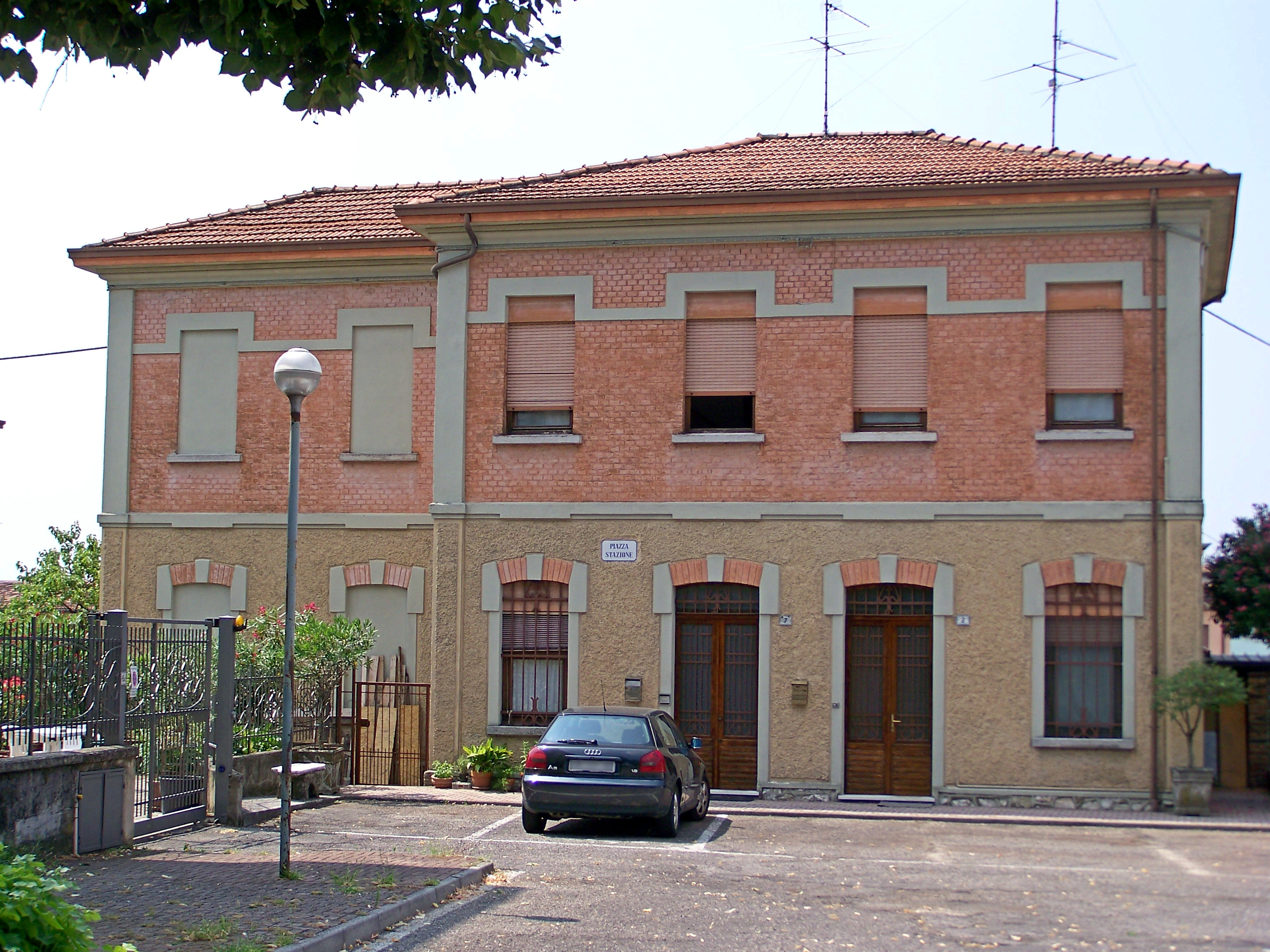
The track underpassed the Milan–Venice railway and then took the Mantua road, passing through the hamlets of Case, San Polo, and Bettole di Buffalora. It then climbed the hill to Castenedolo, serving the town with a dedicated station before crossing the Montichiari heath to serve Vighizzolo. At Montichiari, the line passed northeast of the town center, while the station serving the town was located just outside, on Via Umberto I, heading towards the road directly to Castiglione delle Stiviere. The original route passed through Novagli and ran alongside the hamlet of Prede, reaching Castiglione station, which was located on present-day Via Cavour.
The 1911 route, on the other hand, left the Mantua road heading southeast, following a private right-of-way alongside the Montichiari hamlet of Trivellini and reaching Carpenedolo near the intersection of Via Deretti and Via Ercoliani, where the tram station was located. The line headed back northeast towards Castiglione delle Stiviere station, running along the shared roadway leading to the Mantuan town. From the Castiglione yard, the tramway to Lonato and Desenzano del Garda branched off northwest along present-day Via Beschi and Via San Pietro.
After Castiglione, the tramway to Mantua followed the provincial road to Medole, where the line to Casaloldo operated between 1930 and 1933 under the Tranvie Provinciali Mantovane (TPM). Continuing northeast along present-day Via Crocevia, the track rejoined the Mantua road to pass through Guidizzolo. Leaving the latter town, the tramway again left the Mantua road to head northeast to Volta Mantovana, which was bypassed to the south and served by a dedicated tram station near present-day Via Borgo Stazione.
After Volta Mantovana, the line headed southeast along the provincial road to Goito. At the entrance to the town, it rejoined the road to Mantua, running along a shared right-of-way as far as the hamlet of Cittadella, passing Marmirolo and Gambarara. At Cittadella, the tramway crossed the Mincio between Lago Superiore and Lago di Mezzo before running along present-day Via Pitentino. Near the Mantua railway station, the Mantova Santa Maddalena yard was located, where service from Brescia ended and direct service to Ostiglia began.
The tramway route then continued towards Mantova Te Scalo, arriving there after covering 74.130 km from Brescia, of which 16.894 km were on private right-of-way.
Mantua–Ostiglia
The route through Mantua was more circuitous than the corresponding Brescia section, as the administration's primary goal was to use the tramway to speed up connections between towns in the province rather than between them and the capital. The Mantua–Ostiglia line, 35.700 km long with 14.455 km on private right-of-way, mainly followed Strada statale 482 Alto Polesana, better known in the province of Mantua as "Strada Ostigliese". 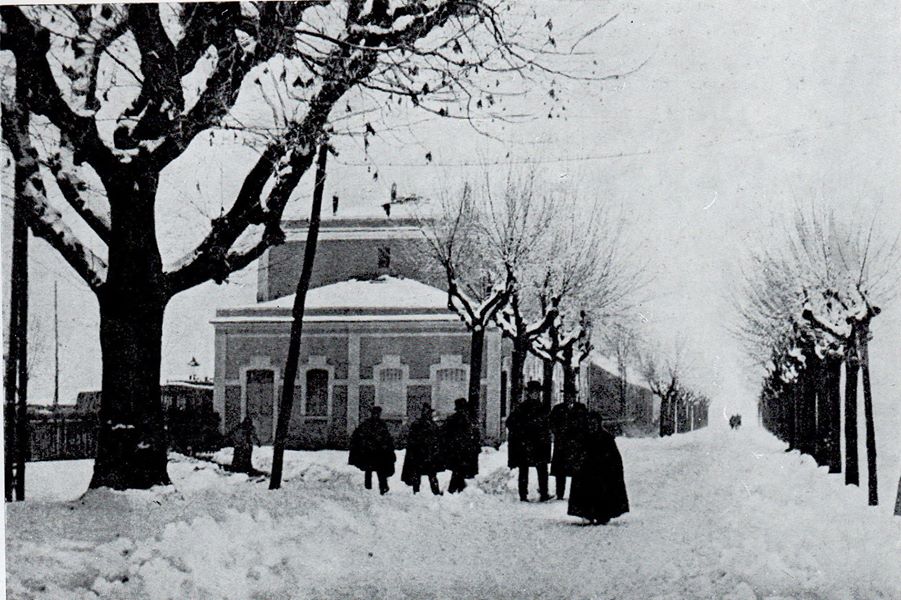
Castiglione–Desenzano
From Castiglione delle Stiviere, the branch line left the Carpenedolo bypass and continued along present-day Via Cavour and Via Padre Costantino Beschi. It continued along Via San Pietro and Via Lonato towards Staffolo, where the station also serving the nearby hamlet of Esenta was located. The tramway then ran along the old municipal road, where the Cominello-San Polo stop was located, and reached the weighing area of Lonato del Garda, located behind the Lonato railway station, whose track yard was crossed by an iron bridge, today replaced by the overpass on Via Monte Grappa.
The Lonato tram station was built just north of the aforementioned bridge. After decades of abandonment, in 2003 the passenger station building was converted for restaurant use.
The tramway continued along the old provincial road to Desenzano, crossing the Milan–Venice railway again near Folzone on a line with a constant descent; the maximum gradients reached were 25‰. Arriving at Perla, the tramway then followed the route of the former Strada statale 567 del Benaco, underpassed the Desenzano Railway Viaduct, and reached Capolaterra near the Madonnina, where there was a stop. Since the old state road (present-day Via Marconi) had not yet been built, from Madonnina the tramway followed a private right-of-way that allowed it to descend towards lake level via a wide turn. It then entered Via Santa Maria, resuming its running at grade along the ordinary road. Of this private right-of-way section, the bridge on Via Salvello that crossed over the tramway survives. On Via Santa Maria, the interurban line passed in front of the Teatro Alberti and continued towards the present lakefront, part of which was occupied by the Desenzano Porto railway station. The tramway was forced to bypass the station: it curved in front of the Hotel Meyer and crossed the old port via an iron bascule bridge built by the Officine di Savigliano.
The area of present-day Piazza Cappelletti was leveled specifically to build the terminal station, equipped with a turntable and an engine house.
Rolling stock
Three groups of steam tramway locomotives were used on the line:
- 1–8: built by Belgian manufacturer Tubize between 1882 and 1883, 0-6-0T (C wheel arrangement), 30 km/h;
- 11–18: built by German manufacturer Krauss between 1883 and 1889, 0-4-0T (B wheel arrangement), 25 km/h;
- 9–16: built by Belgian manufacturer Tubize between 1906 and 1909, 0-6-0T (C wheel arrangement), 45 km/h.


See also
- History of rail transport in Italy
- List of railway stations in Lombardy
- Mantua railway station
- Mantua–Viadana Tramway
- Mantua–Asola Tramway