
Blue Line (Meerut Metro)
The Blue Line (Line 1) is a rapid transit metro line of the Meerut Metro in Meerut, Uttar Pradesh, India. It consists of 13 stations from Meerut South to Modipuram in Meerut in Uttar Pradesh, opened in February 2026. The line has nine elevated and three underground stations, one at-grade station at the depot Modipuram is still under construction. Four stations are integrated with the Delhi–Meerut Regional Rapid Transit System on a single corridor, making the metro the first such rapid transit system in India to be merged directly with a regional transit system. It is the second-largest metro network in Uttar Pradesh, following the Noida Metro. The metro is the fastest metro of India, at an operational speed of .
The foundation stone for the project was laid by Prime Minister Narendra Modi on 8 March 2019, along with the RRTS, and construction began on both the RRTS and the metro projects in June 2019. The 1st phase was opened on 22 February 2026, after missing the deadline of June 2025. It is being built at an estimated cost of , and due to its merger with the RRTS, the metro and its trains will be owned and operated by National Capital Region Transport Corporation (NCRTC).
History
Due to rising population, traffic, congestion and demand in Meerut, and also because of its location in the National Capital Region (NCR), the plan for developing a metro for the city and integrating it with the transport systems of NCR was proposed by the Governments of India and Uttar Pradesh in the early 2010s. Therefore, the feasibility study of the metro project was completed by Rail India Technical and Economic Services (RITES) in June 2015 and submitted to the Government of Uttar Pradesh the next year, in June 2016. In 2017, the Uttar Pradesh Metro Rail Corporation (UPMRC) was assigned to bring all stakeholders together and get the project started, then operate the metro after completion. The line was initially planned to have eleven stations, from Modipuram to Partapur, but was later extended to Meerut South to provide connectivity to the city's outskirts, thereby increasing the number of stations to 13 and the length to . The initiation of the project was marked after the foundation stone was laid by Prime Minister Narendra Modi on 8 March 2019, along with the Delhi–Meerut Regional Rapid Transit System (RRTS), and construction of both the projects commenced in June of the same year. Both the projects, including the Meerut section of the RRTS, can be extended beyond also. The metro is the first rapid transit system in India being directly integrated and merged with a regional transit system on one single corridor, and also the fastest in India, with an operational speed of .
During the clash in the Galwan Valley in 2020, the Swadeshi Jagran Manch urged the Government of India to withdraw the bid from a Chinese company associated with manufacturing the trains of the metro. In view of this, a re-bidding for making the trains was conducted by the owner of the metro and the RRTS projects, the National Capital Region Transport Corporation (NCRTC), and Bombardier Transportation, now acquired by Alstom, won the bid on 7 May 2020. The trains have been manufactured at Alstom's plant in Savli, Gujarat, supplying 90 coaches for 30 trains, each consisting of 3 coaches. The first train of the metro was delivered by Alstom to the NCRTC on 16 February 2024.
After roughly five years of construction, in January 2025, the first trial runs were conducted by the National Capital Region Transport Corporation (NCRTC) from Meerut South, the southern terminal of the metro with the RRTS, to Meerut Central , one of the stations to serve only the metro. The trials continued until the metro becomes operational by February 2026.
Facilities
All stations of the metro will have similar facilities like the stations of the Delhi–Meerut Regional Rapid Transit System (RRTS). They will have facilities like booking counters, ticket and food vending machines, on-board catering, check-in kiosks, baggage checking counters, CCTVs, platform screen doors (PSDs), washrooms, restaurants, retail stores, free WiFi, child care facilities, emergency and medical facilities, facilities for physically challenged passengers like wheelchairs, escalators, elevators and connecting facilities to RRTS stations and other transport modes like bus stations, railway stations, cabs, parking spaces, etc.
Features
All stations of the metro will have similar features like the stations of the Delhi–Meerut Regional Rapid Transit System (RRTS). They will have several features to enhance passenger experience, as follows:
- Multi-Modal Transport Integration: All stations will be integrated with various modes of transport like railway stations, inter-state bus terminals, cabs and parking spaces to seamlessly facilitate the movement of commuters between the modes through skywalks, elevated walkways and entry/exit points. The metro will be the first metro system in India to merge and operate parallelly along a regional transit system.
- Safety: All stations will be fully monitored with surveillance from CCTVs and security staff. They will also have platform screen doors (PSDs) on platforms for enhanced commuter safety.
- Sustainability: All stations will use eco-friendly measures to generate electricity, dispose of waste, and conserve water without affecting the environment, like solar panels on the roofs, dustbins, water and sewage treatment systems, green spaces in the stations' premises and proper cleanliness in the entire premises, similar to the RRTS stations. The implementation of the metro will shift the modal share in favour of public transport higher in the region, which will then result in drastic reductions in traffic on roads, thereby ensuring sustainability.
Stations
The metro, will have 13 stations. Additionally, there will be interchange points with the Delhi–Meerut Regional Rapid Transit System (RRTS) at Meerut South, Shatabdi Nagar, Begumpul, and Modipuram stations. The stations being built on the metro in its first phase are:
Meerut Metro |
|---|
No. |
1 |
2 |
3 |
4 |
5 |
6 |
7 |
8 |
9 |
10 |
11 |
12 |
13 |
Train Info
Blue Line |
|---|
Rakes |
Train Length |
Train Gauge |
Electrification |
Train's Maximum Speed |
Train Operation |
Rolling stock
The trains of the metro are being manufactured and delivered by Alstom, a global French company in railway manufacturing, at its plant in Savli, Vadodara district, Gujarat. In May 2020, the Bombardier Transportation, a former Canadian company in railway manufacturing, now acquired by Alstom since 2021, won a contract from the National Capital Region Transport Corporation (NCRTC) for indigenously making 30 coaches in a configuration of 10 trainsets of three cars each, with a capacity of 700 passengers. The first train was delivered to the NCRTC on 16 February 2024.
Designed at Alstom's Hyderabad engineering centre and manufactured at Savli, these advanced, state-of-the-art trains are designed for a maximum speed of and operational speed of , making the trains the second-fastest rapid transit trains in India, just after the Namo Bharat trains of the Delhi–Meerut Regional Rapid Transit System (RRTS), at . These trains are similar to the features present in the Namo Bharat trains, like aerodynamic structure and seats, which are a first for India, dedicated seats for physically challenged passengers, on-board wheelchairs, CCTVs, information display systems, fire alarms, window blinders and enhanced passage space. The rolling stock is based on Alstom's Adessia commuter train family, incorporating worldwide experience.
Integration with Delhi–Meerut RRTS
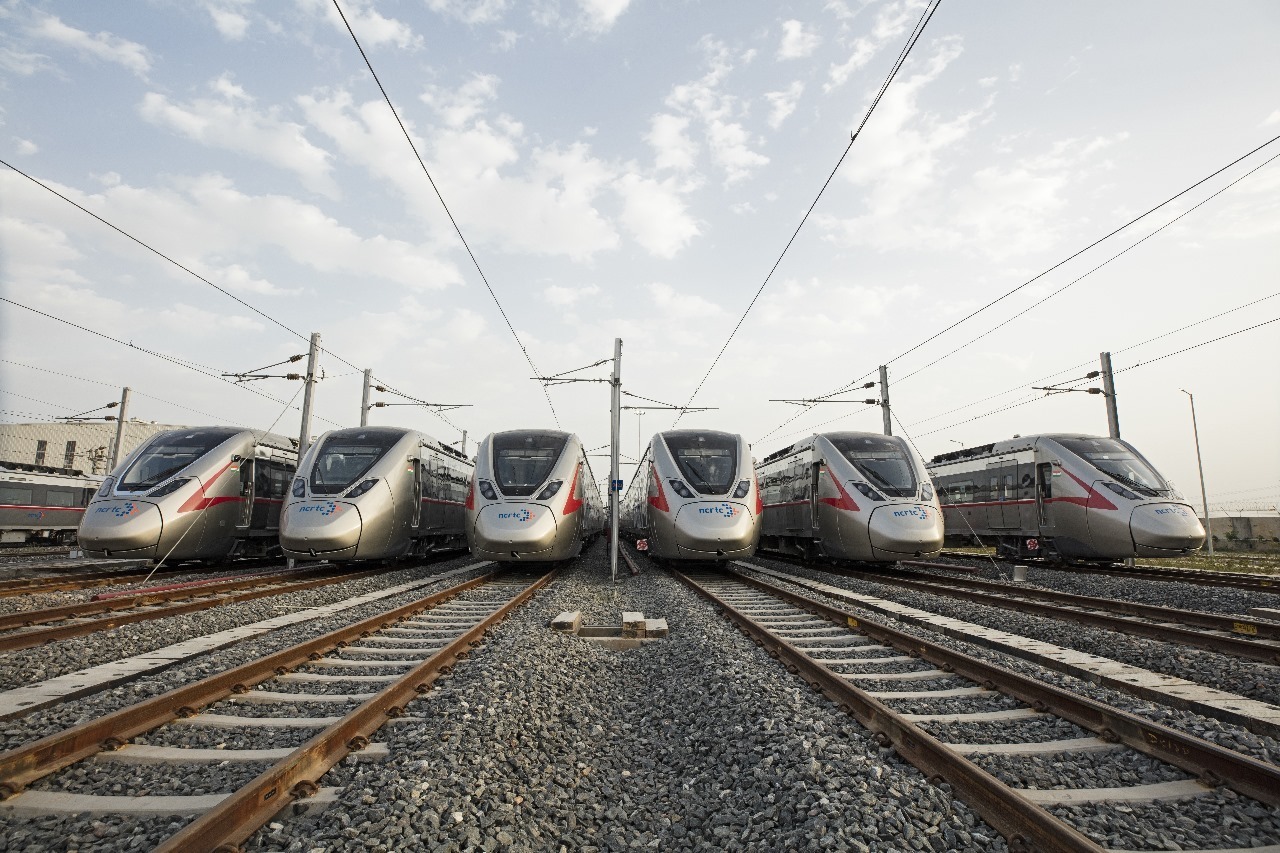 In the metro's first phase, the first line will run in parallel along the RRTS tracks on both sides, and the four of its 13 stations will be integrated with the RRTS, at Modipuram, Begumpul, Shatabdi Nagar and Meerut South, so that commuters can seamlessly connect with the metro and the Namo Bharat trains of the RRTS, providing them the ease of travel within Meerut and for connectivity to Delhi, Noida, Ghaziabad and adjoining parts of the National Capital Region (NCR). This makes the metro the first metro in India to run along and directly integrate with a regional transit system.
Signalling and train control system
The National Capital Region Transport Corporation (NCRTC) has decided to equip the line with ETCS L3 signalling, one of the most advanced signalling systems used in Europe, as the metro will run on the same corridor as the Delhi–Meerut Regional Rapid Transit System (RRTS). Tenders for its procurement were invited on 17 April 2020, and Alstom was awarded the contract worth approximately in January 2021.
Nokia partnered with Alstom to implement the 4.9G/LTE private wireless network to support the ETCS L2 signalling. This is the first time in the world that an LTE network is being used along with ETCS L2 signalling.
Status updates
- Jul 2016: The Detailed Project Report prepared by Rail India Technical and Economic Services (RITES) was submitted to the state government.
- Jun 2017: The project had been put on hold in view of the higher-priority Delhi–Meerut Regional Rapid Transit System (RRTS) project.
- Jan 2018: The state cabinet decided to build metros in Meerut, Kanpur, and Agra.
- Sep 2018: The DPR was sent by the state government to the central government for approval.
- Jan 2019: The Meerut Metro and Delhi–Meerut RRTS were decided to run on the same corridor.
- Mar 2019: Prime Minister Narendra Modi laid the foundation stone for the RRTS and the metro projects.
- Jun 2019: The initiation of the RRTS and metro projects was marked by the beginning of the pillar work by Larsen & Toubro.
- May 2020: Bombardier Transportation, now acquired by Alstom, won the bid for making the train sets of the RRTS and metro projects.
- Feb 2024: The first train of the metro was received by the NCRTC. Both the RRTS and metro projects are on track to be completed by June 2025.
- Jan 2025: The first trials started between Meerut South to Meerut Central section of the metro. The trials will continue until the metro begins operations.
- December 2025: Extensive trials are underway. Of both Namo Bharat and Meerut Metro. Finishing work of underground stations is underway.
- January 2026: Work is underway at Modipuram metro depot and final touches are being given to Modipuram station.
- February 2026: Metro opened simultaneously with the remaining stretch of RRTS on 22 February. The metro will be operated from Duhai depot as the work on Modipuram depot is not finished yet.
Ridership
In February 2026, the Namo Bharat RRTS — a high-speed regional rail corridor connecting Delhi, Ghaziabad, and Meerut — recorded significant early ridership following the completion of its full 82 km route. On the first full day of commercial operations after the formal inauguration by India's prime minister, the National Capital Region Transport Corporation reported that passenger numbers surpassed 100,000, marking the highest single-day ridership recorded on the corridor to date.
Following this initial milestone, ridership continued to grow. On the first weekday after the launch of remaining sections, daily usage was reported to have increased by nearly 70% over previous average figures, again exceeding the 100,000 mark. Major stations such as Begumpul in Meerut, Anand Vihar, and Ghaziabad were among the busiest points of entry and exit for commuters.
The early ridership numbers indicate strong public adoption of the service, with the system aimed at offering faster regional connectivity and reducing travel times across key urban centres in the National Capital Region.
Now Meerut Metro is averaging around 92,000 users on daily Basis.
See also
- Delhi–Meerut Regional Rapid Transit System
- Urban rail transit in India
- National Capital Region Transport Corporation
- Uttar Pradesh Metro Rail Corporation
- List of metro cities in India
- Transport in NCR
- Transport in Meerut
- List of metro networks in Uttar Pradesh