
Benson raft
[[File:Benson sea-going log raft.jpg|thumb|
Benson sea-going log raft]] 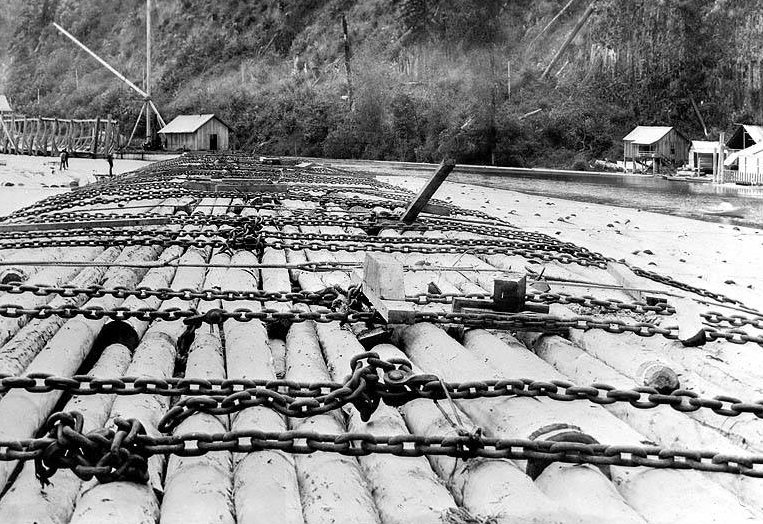
The Benson raft was a huge sea-going log raft designed to reliably transport millions of board feet of timber at one time through the open ocean. This practical transportation method was first used on the Pacific coast in 1906 by Simon Benson, a lumber baron of Portland, Oregon, in the United States. They were not, however the first rafts of their type. They first appeared on the Atlantic coast AbOUT 1883 and were used there for several years thereafter until one very large raft broke up and became a hazard to navigation. They were sometimes referred to as Leary rafts or Joggins rafts. They seem also to have been employed on the Rhine River in 1888r.
They were in fact, contemplated on the Pacific as early as 1888.
Benson rafts went from the outlet of the Columbia River into the Pacific Ocean and south 1100 miles to San Diego, California. Once there the logs were sawn into lumber by the Benson Logging and Lumber Company for sale in Southern California.
Lower shipping costs
The log rafts could be towed in the open sea (specifically Pacific Ocean) and shipping costs were dramatically reduced using this method from the normal railroad or ocean barge transportation methods. Benson was the first to use practical transportation sea-going log rafts, which started in operation in July of 1906. The operation went on until 1941 with over 120 log rafts built and towed on the 15 day trip. Four of these sea-going log rafts were lost due to fire or storms. John A. Festabend was Benson's supervisor in construction of the cigar-shaped rafts near Clatskanie, Oregon. These were the first ever sea-going ocean worthy logging rafts to transport intact millions of board feet over a long distance at one time. They were held together by large logging chains. About half of these were "deck loaded" meaning they had on the top deck processed lumber – such as shingles, fence posts, and poles – which maximized profits in transportation of lumber goods.
Construction
A roughly cigar-shaped "cradle" of wood resembling the frame of a large wooden sailing ship began the building of a Benson sea-going log raft. A derrick lifted logs and placed them into the cradle over a period of four to seven weeks. Many times tree-length logs were included in the raft to give the sea-going log raft extra strength and stability on its long ocean voyage. Large logging chains were used to tie the raft together.
When a sea-going log raft was complete one side of the temporary wooden cradle was removed and the raft was launched. Most of the Benson sea-going log rafts hauled approximately 4 to 6 million feet of logs and were typically about to long, wide, and thick from top to bottom—usually drafting to deep. Assembly took anywhere from 4 to 6 weeks and involved 175 to 250 tons of chain. Most of these log rafts contained between and of lumber. Estimates were reported that between the first Benson rafts arriving into the San Diego port in 1906 that building in Southern California had doubled in just 4 years because of the cheaper lumber made available through this efficient transportation method.
A proposal was floated in 1905 to ship timber to China in this way; however there is no evidence this ever occurred.
Sources
- Andrews, Ralph Warren, days of logging, Superior Publishing Co., 1956
- American forests, Volume 43, Author American Forestry Association, Publisher: American Forestry Association, 1937
- Brown, Nelson Courtland, Logging: the principles and methods of harvesting timber in the United States and Canada, Wiley, 1949
- Davis, Richard C., Encyclopedia of American forest and conservation history, Volume 1, Macmillan Pub. Co., 1983, ISBN 0029077508
- Lind, Carol J., Big timber, big men, Hancock House, 1978, ISBN 0888390203
- Williams, Richard, The Loggers, Time-Life Books, 1976, ISBN 0809415275
- Woodworkers review. The Woodworkers review company, 1909
Additional sources
- Maritime Museum of San Diego
- "Huge Whales Of Lumber Make 1,200 Mile Trip", June 1929, Popular Science bottom of page 57