
Atherogenic diabetic dyslipidemia
Dyslipidemia is a major underlying risk factor contributing to the excess cardiovascular disease risk, and is usually more atherogenic in the presence of diabetes. The Atherogenic dyslipidemia in diabetes (ADD) is characterized by high serum triglycerides, high small dense LDL levels, low HDL levels and postprandial(after eating) lipemia. Insulin resistance is a primary cause for ADD. Elevated levels of large TG(triglyceride) rich very low-density lipoproteins, apolipoprotein B (ApoB) and oxidised low-density lipoprotein (LDL), and reduced levels of small high-density lipoproteins plays a critical role in ADD.
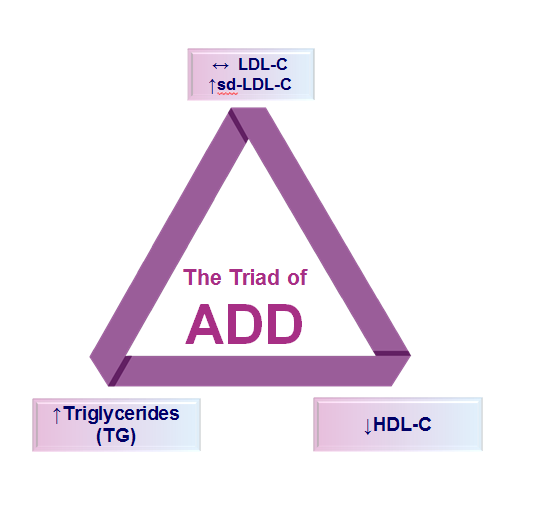
Asian Indians have a higher prevalence of Atherogenic dyslipidemia than western population due to higher physical inactivity, low exercise and diet deficient in polyunsaturated fatty acids (PUFA).
When compared with the general population, the diabetic population is at higher risk of cardiovascular disease (CVD), as predicted by the Framingham Risk Score calculations (10-year risk 20%). For this reason diabetes is considered a "coronary disease equivalent" condition, as classified by the National Cholesterol Education Program Adult Treatment Panel (NCEP-ATP) III. Furthermore, patients with diabetes who experience a Myocardial infarction have a poorer prognosis than nondiabetic patients, which contributes to their overall higher mortality. Recent trials have suggested the need for more aggressive treatment of dyslipidemia in this subpopulation than the current recommendations by the NCEP-ATP III.
Pathophysiology
In Atherogenic dyslipidemia, there is impaired insulin signalling which increases lipolysis i.e. conversion of TG into free fatty acids (FFA) in adipocytes. These FFA are transported to liver and muscles via blood. Majority of FFA are re-esterified to TG which together with posttranslational stabilization of ApoB enhances the assembly and secretion of VLDL particles. The VLDL production is further augmented by elevated plasma glucose concentrations. Increased secretion of VLDL led to increase in sdLDL production and decrease in HDL; substantially influencing the development of atherosclerosis.
Fig. 1 Pathogenesis of ADD (IR, insulin resistance; CE, cholesteryl ester, CETP: cholesterol ester transport protein, TG: triglycerides, Apo B: apolipoprotein B, VLDL: very low density lipoprotein, FFA: free fatty acids, LDL: low density lipoproteins HDL: high density lipoproteins, Apo A: apolipoprotein A). 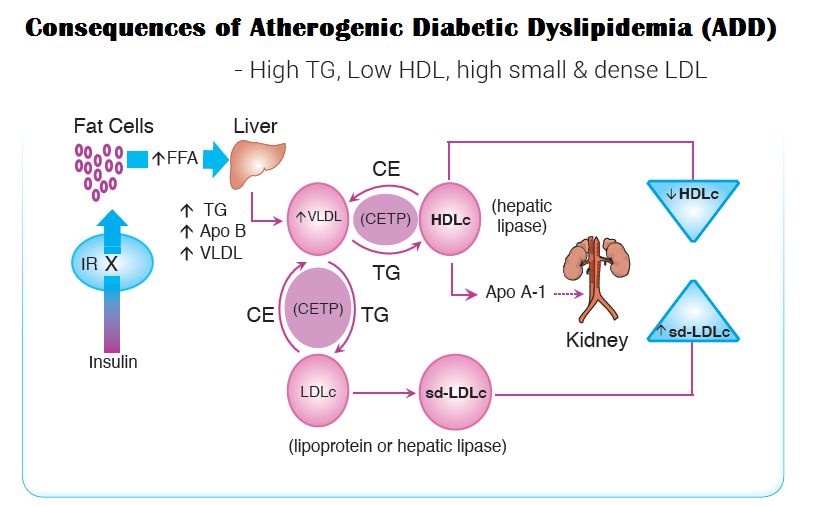
Consequences of hypertriglyceridemia - Low levels of HDL-C, The presence of small, dense LDL particles, The presence of atherogenic triglyceride-rich, lipoprotein remnants, Insulin resistance, Increases in coagulability and viscosity, Proinflammatory status
Though all LDLs are reported as atherogenic but sdLDLs are more atherogenic and serves as a better predictor of cardiovascular risk than LDL-C. They have an increased ability to penetrate arterial intima, susceptibility to retention in the extracellular matrix by binding to arterial proteoglycans, and have decreased antioxidant capacity.[3,4] Increase in sdLDL generation has been noted when TG levels are >1.5 mmol/L. Since these particles have lower affinity to LDL-receptors on hepatocytes, there is decrease uptake and clearance of sdLDL, leading to their increased presence in the systemic circulation.
Scope of the problem
The risk of developing atherosclerotic disease is increased two- to three-fold in people with diabetes. The WHO estimate of worldwide diabetic prevalence of 171 million in 2000 is expected to grow substantially to 366 million by 2030.
There have been marked racial differences in Atherogenic Dyslipidemia. Various studies support increased prevalence of AD in Asian Indian populations compared to western populations which may be due to their less physical activity and consumption of carbohydrate rich and low polyunsaturated fatty acid (PUFA) diet. In comparison to western populations, Asian Indians possessed significantly lower levels of HDL and LDL-C with hypertriglyceridemia; had 53.2% prevalence of sdLDL than 29.9% and 18.9% prevalence in whites and blacks, respectively; and significantly higher proportion of Indians (66%) had TG/HDL ratio >3 than 21.1% whites and 13.7% blacks. Besides being more dyslipidaemic, Indians had higher intra-abdominal visceral fat which increased their insulin resistance and CVD risk than western populations. In the comparison between whites and blacks, blacks had less likelihood of AD due to significant lower levels of total cholesterol, LDL-C, LDL pattern B, and triglycerides than whites.
Potential diagnostic markers of atherogenic dyslipidemia
Several major statin trials have reported the existence of significant residual CVD risk, despite increased reductions in LDL-C level. Recent evidence suggested important contribution of lipid parameters other than LDL-C, including high TG, low HDL-C, and more recently the sdLDL particles in residual CVD risk.
Current treatment guidelines consider non-HDL cholesterol to be an important CVD risk predictor and therapeutic target in patients with diabetic dyslipidemia. Reflecting the full complement of atherogenic lipoproteins, rather than LDL cholesterol alone.
Non-HDL-C = Total cholesterol – HDL cholesterol
Management of Atherogenic Diabetic Dyslipidemia
Reducing LDL cholesterol using statin therapy is a proven strategy for prevention of cardiovascular events. But, despite statin (LDL-C lowering) therapy, a significant residual risk remains potentially attributable to increased triglyceride concentration and low HDL cholesterol, a characteristic hallmark of ADD. A meta-analysis of 14 trials involving statins that included 18,686 people with diabetes proved that presence of low HDL and high triglyceride limits the effi cacy of statin therapy alone in reducing the vascular events despite achieving target LDL-C levels. Similarly, a meta-analysis of 17 prospective studies showed that after adjusting for variables such as HDL-C, total cholesterol, and other risk factors, the relative risk for coronary heart disease with 1 mmol/L (88.4956 mg/dL) increase in triglyceride (TG) was 1.14 [95% confi dence interval (CI)1.05-1.28] for men and 1.37 (95% CI 1.13-1.66) for women. This has led to renewed interest in treatments that could selectively target high triglycerides and low HDL thus, further reducing the cardiovascular risk.
Role of PPAR agonists in the management of ADD
Peroxisome proliferator-activated receptor-alpha (PPARα), gamma (PPARγ), and beta/delta (PPAR β/γ) agonists regulate gene transcription by binding to specific deoxyribonucleic acid response elements upon ligand activation and heterodimerization with 9-cis retinoic acid receptor. Depending on the activating ligand, different receptor conformations are adopted, leading to different coactivator recruitment and subsequent effects on gene expression. Even though all the PPAR agonists are from the same pharmaceutical class, their biological activity varies widely based on selective alpha or gamma modulation.
Predominant PPARγ agonists recognized as Glitazones proven to improve insulin resistance have been used as antidiabetic agents. Pioglitazone although is still available to be prescribed, but concern regarding increased risk of bladder cancer on cumulative exposure and risk of osteoporosis in women has limited its potential for widespread use. Because of predominant PPARγ agonism, these agents have minimal influence if any on ADD. Fibrates Predominant PPARα agonists, fibrates as they are known, are proven to influence lipid profile but their role in ADD is extensively debated.
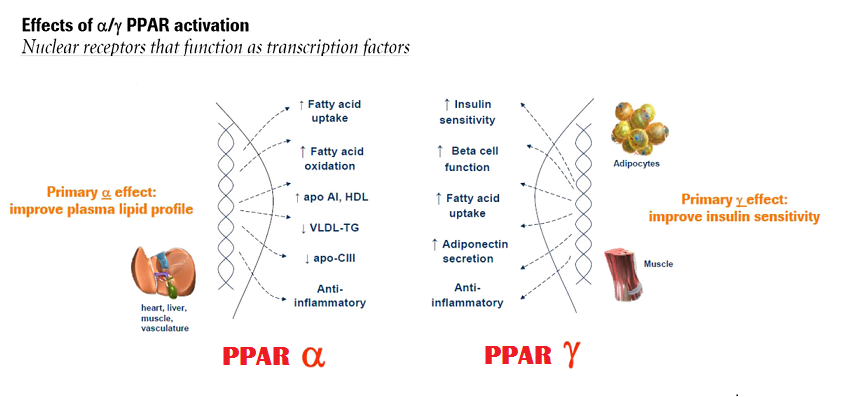
Glitazars, A combined PPARα/γ agonist should ideally be a suitable [...] in treatment of type 2 diabetic patients on statin therapy who have residual cardiovascular risk secondary to elevated triglyceride concentration. These groups of molecule would provide dual control and targets not only dyslipidemia but also contribute to improved glycemic control. Given these benefits of dual PPARα/γ agonism, several pharmaceutical agents with such action commonly named as glitazars have been developed. Depending on their molecular structure, these molecules exert dual action with varying degrees of PPARα and PPARγ activism. Recently approved drugs like Saroglitazar can be a potential hope for the management of diabetes and dyslipidemia with single pill.