
Agricultural Museum (periodical)
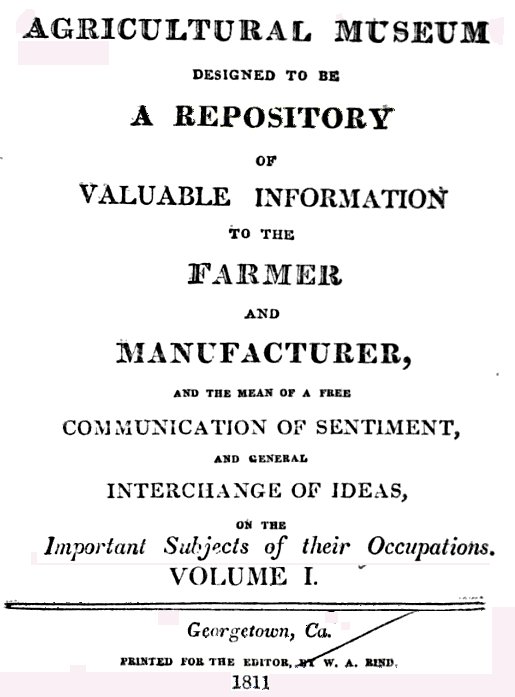
The Agricultural Museum was the first agricultural periodical journal published in the United States, first printed July 4, 1810.<ref name ="Mott152> Mott, p. 152
History
The scientific agricultural magazine was an octavo consisting of 32 pages. It was the first periodical devoted strictly to agriculture.<ref name ="Mott152/> It was published by the Columbian Agricultural Society. The publisher was W. A. Rind of Georgetown, Washington, D.C.
The editor was a Reverend David Wiley who was a minister that moved to Georgetown in 1800. Rev. Wiley was in charge of the Columbian Agricultural Society and was its secretary and teacher. The society was established for the purpose of inspiring local agriculture manufactures. The magazine was a branch of the society that discourged imported products. Wiley was Georgetown's postmaster, superintendent of the turnpike, merchant, miller, and the major. Another important editor to the magazine was Joel Barlow.
At first the periodical had no subscribers and depended on the society's members. It started as a bi-monthly publication and ran this way for a year. It then switched to being published monthly beginning with Volume 2 and ended after eleven issues of that volume (July 4, 1810-June 19, 1811), m. (July 1811-May 1812.) v.1, no.1-24; v.2, no. 1-11. July 4, 1810-May 1812).<ref name ="Mott152/>
The publication purported its mission to be
In the fourth issue of the agriculture magazine (Vol. 1, No. 4, August 15, 1810) the editor points out the society received from the Secretary of State an EDition of Lord Somerville's Essays of Husbandry. The book contained information on "Implements of Husbandry", "Sheep and Wool", "Draught Cattle" and "A Record of Lord Somerville's Cattle Shows" from its origin in 1802 to nearly the then present year. Another society member pointed out in his article labled Roads and Inland Navigation that by raising $300,000 for improving the navigational system of the Potomak and its branches that it would benefit those with agricultrual products that needed to be distributed throughout the United States. Another society member named Rinaldo Johnson wrote to the editor on July 30, 1810, after receiving the first two issues, on how happy he was with the publication. He explained in detail his first attempt at making Homespun cloth from wool. He made various clothing articles for his family that he considered as good as "British cloth". He gave this detail and breakdown of costs for information to other readers of the periodical. He was from Aquasco, Maryland.
In the fifth issue (Vol. 1, No. 5, August 29, 1810) the editor prints "Extracts from Lord Somerville's Essay on Sheep" that was started in the previous issue. He also printed extracts from an article by Sir John Sinclair, President of the Board of Agriculture labled "On the proper kind of seed wheat and the causes of smut and other disorders to which that grain is liable." The article points out the advantages in using old seed rather than new seed in planting. The editor also incorporated an article labled "On the culture of Potatoes" by Bath Papers. The article points out that potatoes are much more desirable for the poor than turnips. The article also points out potatoes are much better for the soil than turnips. Potatoes can also be used to feed cattle and hogs. They also store better than turnips. There is also an extract from a letter showing how to make paper from vegetable materials. It also points out a publication by Chancellor Livingston called "ESSAY ON SHEEP" that had so many innovative IDeaS in it that the state of New York ordered 1500 copies to be distributed freely to farmers.
On the top of the first page of each publication of the Agricultural Museeum was a quote from Virgil's Fourth Ecogue: OMNIS FERET OMNIA TELLUS - Every land shall bear every thing. Subscription to the publication was $2.50 for 24 numbers, paid in advance. The Agricultural Museum publication stopped printing in May of 1812, not finishing the second volume.
John Stuart Skinner published the first agricultural periodical with a large circulation in the United States called the American Farmer some twelve years after the Agricultural Museum failed. According to that publication it was devoted to "rural economy, internal improvements, news, prices current." It was a quarto of eight pages. It ran until 1897.
Sources
- Bryan, Wilhelmus Bogart, ''A History of the National Capital from Its Foundation Through the Period of the Adoption of the Organic Act’’, The Macmillan company, 1914
- Kane, Joseph Nathan, Famous First Facts. A Record of First Happenings, Discoveries and Inventions in the United States, H . W . Wilson Company, 1950
- Mott, Frank Luther, A history of American magazines, Harvard University Press, 1930, ISBN 0-6743955-0-6
- The Agricultural Museum - all 24 issues of Volume 1 at Google Books