
Agricultural Camera
The Agricultural Camera (AgCam) is a remote sensing, multi-spectral imaging system largely built and operated by students and faculty of the University of North DAKOTA (UND) for operation onboard the International Space Station (ISS). From onboard the ISS, the AgCam will take frequent images in response to requests from farmers, ranchers, foresters, natural resource managers, and tribal officials of the region to help improve their environmental stewardship of the land for which they are responsible.
History
The AgCam project has been in the making since 2001, was launched on space shuttle mission STS-126 on November 14, 2008, and AgCam's components were transferred from Endeavour to ISS exactly on the 10th anniversary of ISS. Operations of AgCam onboard the ISS will begin with the 2009 growing season. Through a grant from the NASA Office of Education and earmarks written by North Dakota Senator Byron Dorgan, AgCam has been funded all the way from its construction, launch and current on-ORBit operations onboard the ISS.
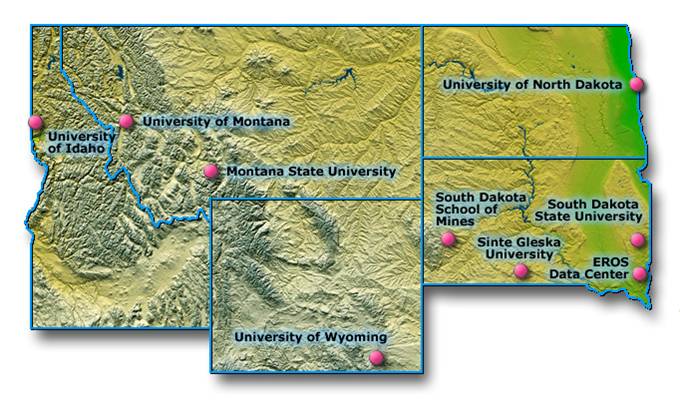 The grant funding for AgCam was provided in part by the Upper Midwest Aerospace Consortium (UMAC). UMAC develops products and services for agriculture, forestry, natural resource management, and K-12 education, using satellite imagery and other spatial technologies. As a consortium, UMAC is led by the University of North Dakota, and includes participants from academia, industry, and government located throughout North Dakota, South Dakota, Montana, Wyoming, and Idaho. UMAC is connected with NASA and collaborates with the Center for Earth Resources Observation and Science and other partners. Because of where the funding comes from, i.e. tax payers from the UMAC states, AgCam will start imaging only in the UMAC states as well as Minnesota.
Educational value
The tangible educational benefit to the UND campus that has resulted so far is significant. To date over 51 undergraduate and graduate students have contributed to AgCam development, either via academic achievements or through the development of degree-related work skills. A total of 11 AgCam graduate-level theses or projects, and 14 Master's level thesis, have been successfully completed, with additional projects on the way. From an engineering standpoint, students who have worked on the project have been challenged with areas ranging from optics and crew interfaces, to software and safety codes. All of which apply to each students engineering discipline. Another learning aspect comes from management challenges that were presented during the project. From managing time and money, students also had to include concepts of testing, integration, and turnover. All of these challenges added to the student's experience gained from the AgCam project.
Science
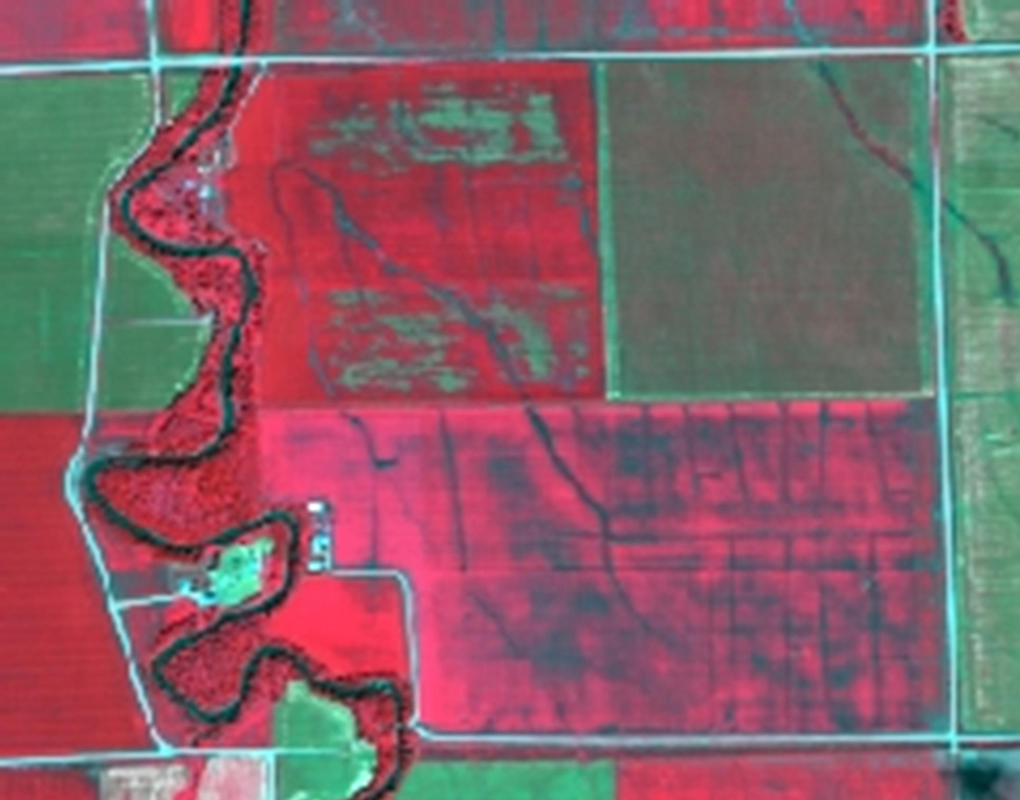 Agricultural production conditions are highly dynamic from year to year, and are dependent on soils, crop or forage type, disease or infestations, management practices, and dominantly, the weather. Collecting AgCam data over 3 full growing seasons will allow investigations across a range of variables and in-field conditions.
Farmers, ranchers, foresters, natural resource managers, tribal officials, and other land owners, termed end users, will be able to select specific geographical areas of interest and request collection of AgCam imagery in both red and near-infrared band passes, and at medium-high spatial resolution. The AgCam sensor will be able to point up to 30 degrees off-nadir, enabling frequent (multi-week to multi-day) imaging of a requested area, dramatically improving chances of obtaining cloud-free images. Collected images will be down linked, processed on the ground, and delivered to the requesting end users within 1–2 days of image collection.
Existing medium-high resolution orbiting sensors, such as Landsat and ASTER, are used extensively in applications related to agricultural production and efficiency, though at a temporal resolution of at best only every 8 days; this can be problematic for geographical areas with seasonal cloudiness during critical growing season time periods. High-temporal imaging (multi-week to multi-day) by AgCam from the ISS will dramatically increase temporal opportunities to obtain cloud-free images at spatial resolutions and wavelengths applicable for analysis of in-field variability of crop and range vegetative conditions.
Because of the fast pace changing agriculture conditions that can occur in the UMAC region, being able to send out images to the end users, in the least amount of time can greatly increase the effectiveness of the data. The faster that the end user receives data and information about their crops, the faster they can consequently improve their crop conditions. As well, AgCam science data provides crucial information to help end users more wisely use water, chemicals and other products on their fields. Because of this, end users can be more efficient on when and where they use chemicals like fertilizers. Instead of dusting an entire field, the end user can spray the areas of their fields where the fertilizer is necessary. This not only will save the end users money, the decrease in the use of chemicals also has a positive impact on the environment.
Technical specifications
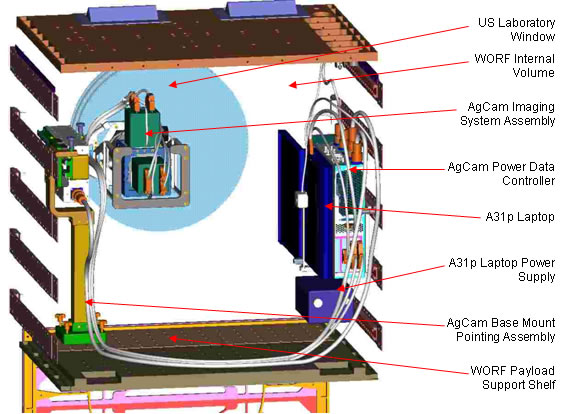
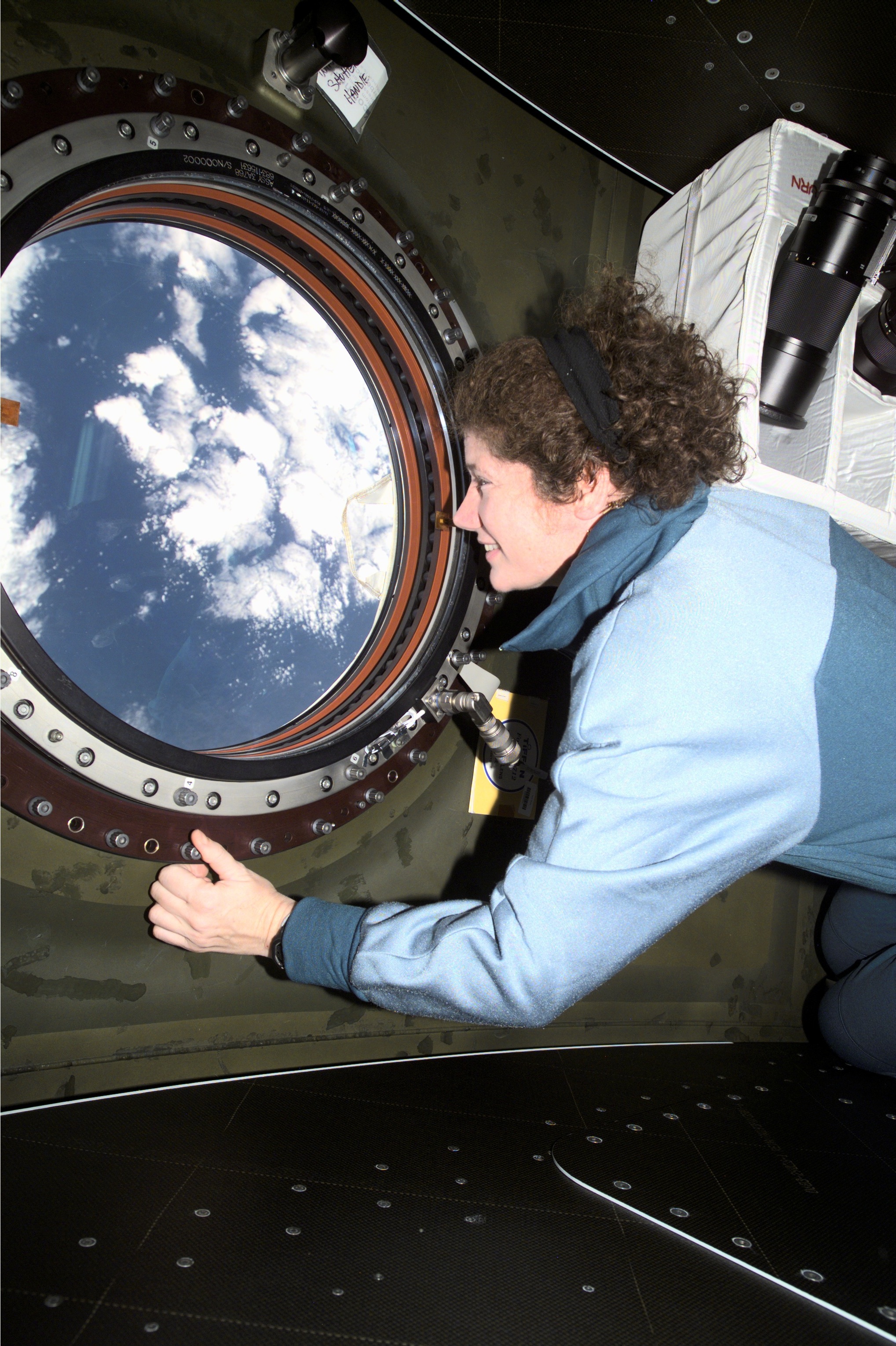 AgCam will be taking images from the Window Observation Research Facility (WORF) aboard the ISS. Because WORF is not yet installed, AgCam will temporarily image through a alternate simplified installation of the main observation window of the U.S. Destiny laboratory. As well, the operation of AgCam depends on the ongoing interactions with the crew and station. This includes things like the Canadian robot, Dextre, potentially obscuring the view of the camera. In the U.S. Lab Window configuration, the crew must open the shutter, that protects the window from debris, for AgCam imaging to take place.
AgCam will take images as it circles the Earth along the ISS trajectory, returning it to the same region multiple times a week. It can move 30 degrees off nadir, and should resolve images to roughly 18.6 meters. Each channel has a 8 bit-depth. The trajectory is planned out using the Mission Planning Station with Satellite Tool Kit and AMPS software. This allows for the appropriate commands to be sent to the ISS to capture the requested imagery.
There are many possible applications of AgCam imagery, which parallel LandSat. For example, the Normalized Difference Vegetation Index (NDVI) indicates the relative density of plant growth on Earth. The NDVI is calculated by taking the near-infrared radiation minus the visible radiation all divided by the near-infrared radiation plus the visible radiation. These values range from -1 (typically water) to +1 (dense vegetation).
Further, crop canopy reflectance in AgCam spectral bands is correlative to nitrogen concentrations in the plant biomass; knowledge of variability of plant nitrogen across fields can be used to improve in-season nitrogen application decisions.
Operations
The Science Operations Center (SOC) is the backbone for ongoing operations of AgCam, which is located in Clifford Hall on the campus of UND. It is primarily staffed by UND students, who will work directly with NASA to command the camera and other associated operations regarding AgCam and the International Space Station.
Within the Science Operations Center, there are several computer stations each of which specialize in a specific task regarding AgCam operations. The Mission Planning System uses sophisticated satellite tracking software, Satellite Tool Kit (STK), to monitor the orbit of the ISS. The Signal/Image Processing computer uses software that was created for the use of AgCam to enhance image quality, improving the science acquired by AgCam. The Telemetry Station monitors the health and status of AgCam. The Commanding and Communications computer will interface with the AgCam for sending commands as well as receiving images upon being taken by AgCam. Students will communicate with NASA via Internet Voice Distribution System (IVoDS), which is a NASA VoIP system.
See also
- John D. Odegard School of Aerospace Sciences
- Normalized Difference Vegetation Index
External links