
ACEGES
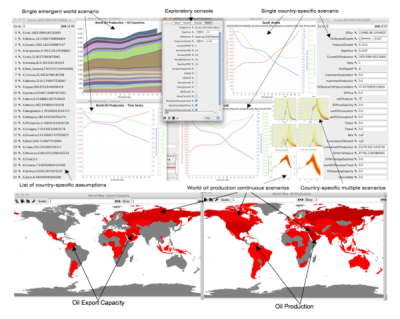 The ACEGES (Agent-based Computational Economics of the Global Energy System) is a decision-support tool for energy policy by means of controlled computational experiments. The ACEGES tool is designed to be the foundation for large custom-purpose simulations of the global energy system. The ACEGES methodological framework, developed by Voudouris (2011) by extending Voudouris (2010) , is based on the Agent-based Computational Economics (ACE) paradigm. ACE is the computational study of economies modeled as evolving systems of autonomous interacting agents.
The ACEGES tool is written in Java and runs on Windows, Mac OS and Linux platforms. The ACEGES tool is based on:
- The MASON library - A discrete-event multiagent simulation library
- The ECJ - An evolutionary computation toolkit
- The R Project for statistical computing
- The GAMLSS framework
GAMLSS, developed by Rigby and Stasinopoulos (2005), is the back-end statistical model for the regression-based rules of the agents in the ACEGES model and R is the engine for the statistical computing used by the ACEGES decision-support tool. In specific cases, the ACEGES tool also uses the Mathematica kernel. The ACEGES model is based upon the work of Hallock et. al. (2004), Wood et. al. (2004) and Campbell (1997).
History
The first version of the ACEGES decision-support tool was written in 2010 by Dr. Vlasios Voudouris. The ACEGES models energy demand and supply of 216 countries. The ACEGES tool was the main output of the ACEGES Project at the Centre for International Business and Sustainability (CIBS) at LondonMet Business School (LMBS). The overall aim of the ACEGES project was to develop, test and disseminate an agent-based computational laboratory for the systematic experimental study of the global energy system through the mechanism of Energy Scenarios. In particular, the intention was to show how the ACEGES framework and prototype can be used to help leaders in government, business and civil society better understand the challenging outlook for energy through controlled computational experiments.
Demonstrations
The ACEGES tool has been used, for example, to test the peak oil theory and to develop plausible scenarios of conventional oil production by means of demonstration at:
- 4th International Conference on Computational and Financial Econometrics, University of London & London School of Economics, 2010
- 16th International Conference on Computing in Economics and Finance, Society for Computational Economics, 2010
- Università Bocconi, 2010
- UCL Energy Institute, 2011
- Moscow State University, 2011
- UK Energy Day: Sustainable Supply - An energy day within the EU Sustainable Energy Europe Week supported by the Intelligent Energy Europe , 2011
- Energy and Climate Change Select committee (Westminster system), UK Parliament- The UK’s Energy Supply: security or independence? Link, 2011
Details about the ACEGES decision-support tool (including supporting documentation) are available from www.aceges.org.
External links
- The ACEGES Java Applet - An on-line, interactive version of the ACEGES decision-support tool
- The ACEGES presentation