
7.92x24mm
The 7.92x24 mm cartridge is designed in Belgium by Rik Van Bruaene of VBR-Belgium.
The design objective was the development of a cartridge for the use in the new concept of a Personal defense weapon (PDW), pistols, submachine guns and carbines. To increase the available off-the-shelf condition, the market sales perspectives are oriented to the civilian, the law enforcement and military market. The technical identities of the 7.92x24 mm caliber are much closer to this of the 9x19 mm NATO caliber then to the PDW smaller calibers 4.6x30 mm and 5.7x28 mm. The 7.92x24 mm is special designed to fulfill a multicaliber roll in the existing 9x19mm and .45 Auto frame platforms.
The design objectives
The design objectives of the 7.92×24 mm caliber are to develop a new defense caliber with an acceptable stopping power in a pistol and sufficient identities for the use in a PDW. As acceptable stopping power the 7.92×24 mm cartridges comply with the FBI penetration demands of minimum 12-inch penetration in gelatin. The 7.92×24 mm caliber is oriented to be used for the civilian, law enforcement and military market. To achieve the maximum available off-the-shelf condition, the 7.92×24 mm caliber is designed to play a function in a multi-caliber roll with the existing 9×19 mm and .45 Auto frame platforms.
.32 ACP / 7.92×24mm S / 9×19mm / 7.92×24mm N / .45 AUTO / 4.6×30mm / 5.7×28 mm
The 7.92×24 mm is shorter than the PDW small calibers 4.6×30mm and 5.7×28mm, this to allow the use in compact and sub-compact weapons. The main design objective was the use of the existing standard .32 Full Metal Jacket bullets of the .32 ACP cartridge. These are already for years available on the civilian market without the objections of the law enforcement community and a new armor piercing bullet technology designed and patented by Rik Van Bruaene. To comply in a multicaliber roll with the 9x19mm and .45 Auto frame platforms,the 7.92x24 mm caliber case has a special selected length of 24 mm and uses different bullet types for each frame platform to comply with their different lengths of 29.6 mm and 32.4 mm.
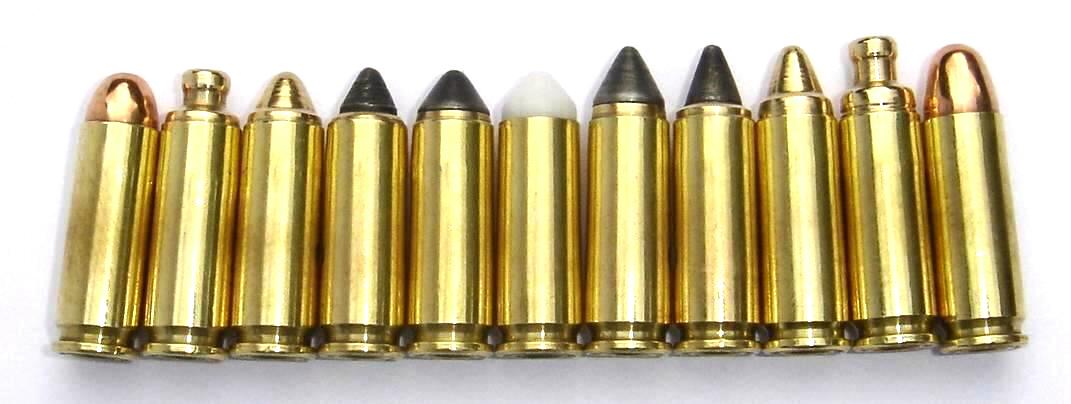
The design objective was the use of one standard case for both frame platforms and two series of bullets. On short series for the 7.92x24mm S cartridge to fit in the 9x19mm frame platforms and a long series for the 7.92x24mm N cartridge to fit in the .45 Auto frame platforms.
The 7.92x24 mm case
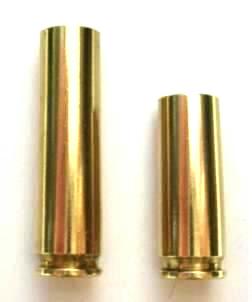
To prevent ammunition supply problems by the launch of a new caliber, the 7.92x24mm caliber uses a strait case, which is based at a shortened .30 Carbine case. These cases are wide available allover the world and can be easy modified for the 7.92x24 mm caliber.
Head stamp of the modified 7.92x24 mm case.
The modified 7.92x24 mm cases is a .30 Carbine case which is shortened to a length of 24 mm. To prevent confusion with the standard .30 Carbine cases a groove is made across the original head stamp by which the previous head stamp is unidentifiable. A .30 Carbine head stamp with a groove through the text is the typical head stamp of a modified 7.92x24 mm case.
The original VBR-B head stamp of VBR-Belgium.
The 7.92x24 N cartridge dimensions
The 7.92x24 N cartridge is intent for the use in the .45 Auto frame platforms.
The 7.92x24mm has 0.926 ml (14.26 grains) H2O cartridge case capacity.
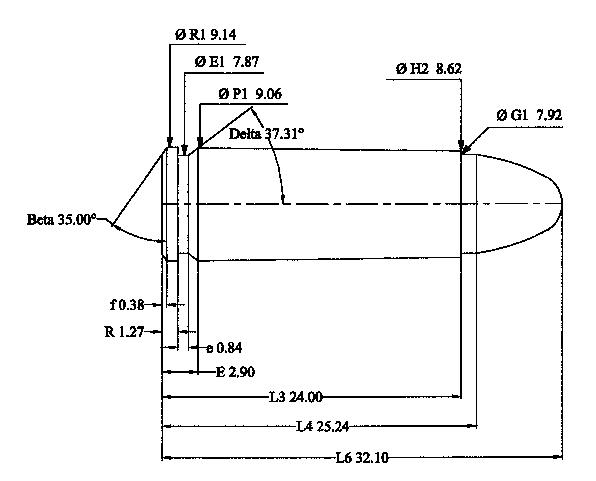
The common rifling twist rate for this cartridge is 254 mm (1 in 10 in), 6 grooves, Ø lands = 7.62 mm, Ø grooves = 7.82 mm and the primer type is small pistol.
The 7.92x24 N cartridge has a maximum length of 32.4 mm. According to the official C.I.P. (Commission Internationale Permanente pour l'Epreuve des Armes à Feu Portatives) guidelines the 7.92x24 mm case can handle up to 3200 Bar (46412 psi) piezo pressure. In C.I.P. regulated countries every rifle cartridge combo has to be proofed at 125% of this maximum C.I.P. pressure to certify for sale to consumers.
The 7.92x24 S cartridge dimensions
The 7.92x24 S cartridge is intent for the use in the 9x19mm frame platforms.
The 7.92x24mm has 0.926 ml (14.26 grains) H2O cartridge case capacity.
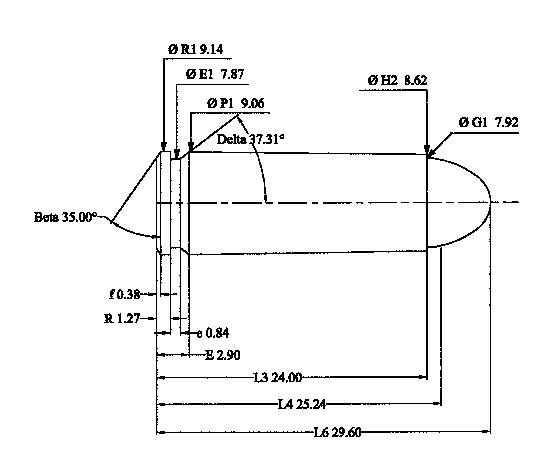
The common rifling twist rate for this cartridge is 254 mm (1 in 10 in), 6 grooves, Ø lands = 7.62 mm, Ø grooves = 7.82 mm and the primer type is small pistol. The 7.92x24 S cartridge has a maximum length of 29.6 mm.
The target users group for the 7.92x24 mm caliber
The target users group is aimed at weapons and persons, which need a low recoil cartridge for accurate performance like PDWs and persons which need weapon with a low recoil, like military personal with PDWs and pistols, young recruits for a military or police agencies, persons with a physical decrease by accidents, women and senior shooters.
Military personal with PDWs and pistols
The 7.92x24 mm caliber with his lower recoil, higher velocity and energy is more suitable for military personal with PDW and pistols then the 9x19 mm NATO caliber. The 7.92x24mm N cartridge has 1/4 less recoil then the standard 9x19 mm cartridge.
Young recruits for a military or police agencies
The standard service weapon model can be used with a lighter caliber, which provides more accuracy for the junior shooter, if needed as a secondary weapon with a PDW.
Persons with a physical decrease by accidents
The physical decrease after an accident can prevent the use of a big caliber weapon. The 7.92x24 mm conversion kit can be a solution to use a softer recoil cartridge in the service pistol.
Women
A lot of women are build by nature a lot weaker then men. A service pistol in a lower recoil caliber can increase their accuracy.
Senior persons
Getting older is a natural event which weakens the body. A lower recoil is a solution for senior shooters.
The 7.92x24 cartridges for the civilian market
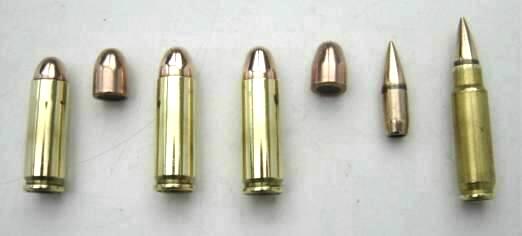
The 7.92x24 mm caliber has as goal to replace the 9x19 mm NATO caliber in ALL his function and to be suitable for PDW use. Like the 9x19 mm has a roll in the tactical spreading of weapons among civilians to increase the resistance of a nation, the suitability of the 7.92x24 mm caliber to be allowed for the civilian market is from a major importance. The design objective of the 7.92x24 mm caliber is to be NOT a threat for the law enforcement community in the matter of penetration of soft body armor with standard FMJ ammunition.
With this identity the 7.92x24 mm caliber distinct himself for the small calibers 4.6x30 mm and 5.7x28 mm loaded with FMJ bullets, which all penetrate the soft body armor carried by law enforcement officers.
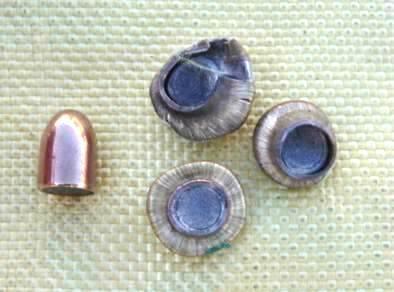
The 7.92x24 mm FMJ cartridge uses the same .32 FMJ bullets like the .32 ACP cartridge. These bullets are stump and have no drill performance at a level II Kevlar packet in contrast with the SS190 and other standard FMJ .224 bullets, which all easy penetrate a level II Kevlar vest.
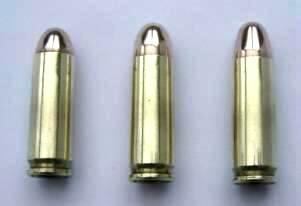 The 7.92x24 mm FMJ cartridges.
7.92x24 S-FMJ-RN, 7.92x24 N-FMJ-RN, 7.92x24 N-FMJ-OGI
The 7.92x24 mm FMJ cartridges are suitable for sport shooting, recreation shooting and training exercises.
Sport shooting.
The soft .32 FMJ bullet fall under the category of .32 caliber bullets and can be used for sport competition shooting.
Recreation shooting.
The 7.92x24 mm loaded with the .32 FMJ bullets can be used for different types of recreation shooting. His low recoil in combination with a minor power factor allows to shoot on steel plates like IPSC/USPCA targets.
Training exercises.
The soft .32 FMJ bullets have the same trajectory as the military grade bullets. The soft .32 FMJ bullets causing no damage to the range infrastructure and can be used for training exercises.
Performances for personal defense.
The .32 FMJ bullet is the same bullet, which is used for the .32 ACP cartridge, but the 7.92x24 mm cartridge is twice so powerful. While the .32 ACP caliber is a short range cartridge, the 7.92x24 mm caliber can perform accurate to midrange. The stopping power of the .32 FMJ bullet is marginal compared to the stopping power of bigger calibers like the 9 mm, 10 mm and .45 Auto. The stopping power of a 7.92x24 mm cartridge is very controversial. According the vision of the content of the permanent wound cavity the .32 FMJ bullet is marginal for the use as a personal defense caliber. According the vision of multiple hits and bullet penetration, the 7.92x24 caliber in a semi-automatic pistol has a high magazine capacity which allows multiple shots and the drill performance exceeds the minimum FBI penetration standards. Although the bullet diameter of 7.92 mm is marginal for personal defense use his energy and penetration performances are up to FBI standards.
The 7.92x24 mm cartridges for the law enforcement market
7.92x24 mm cartridges with an increased stopping power
One of the design objectives of the 7.92x24mm caliber, is to disconnect the lethality (stopping power) from the bullet diameter. The industrial and cheap .32 FMJ bullets causing a smaller wound then the bigger bullet diameters. For sport shooting, recreation shooting and training exercises you don’t need a big wounding potential! This is a casualty prevention. We are today more technically advanced then in the years 1900 where the first .32 FMJ bullets where used for military purpose. The 7.92x24mm caliber assumes that we don’t need a big bullet diameter to cause a big wound. There exist techniques enough to increase the wounding potential of a bullet. Techniques like tumbling, hollow points, controlled, uncontrolled fragmentation and multi-projectiles can be used for more objective combat functions.
The cartridges 7.92x24mm JHP
While the diameter of the 7.92 FMJ bullet is marginal for personal defense, the diameter of an expanded 7.92 mm Jacket Hollow Point bullet is bigger and more suitable for personal defense use.
The 7.92x24 mm caliber can use different types of Jacket Hollow Point bullets. The use of Jacket Hollow Cave bullets is not recommended because the bullet over-expand by the high velocity of these bullets loaded on the 7.92x24 mm cartridge. The over-expansion reduces the penetration depth.
The 7.92x24 mm JHP is intent for personal defense and law enforcement use.
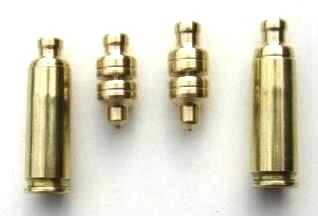
The cartridges 7.92x24 mm C2F and P2F
The controlled fragmentation is a new technology and is a spin-off from the VBR-Belgium patented bullet technology. The objective is to provide a bullet with one or two deep grooves which weakening the bullet and allow a controlled fragmentation. This controlled fragmentation is a clean break-up of the bullet with almost no small fragments. There exist 7.92x24 C2F cartridges (Civilian 2-part Fragmenting) and 7.92x24 P2F cartridges (Police 2-part Fragmenting). They can be used in the 7.92x24 Short and 7.92x24 Normal cartridges.
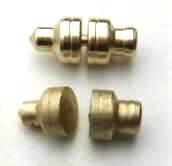 The VBR-Belgium 7.92 S-C2F bullet.
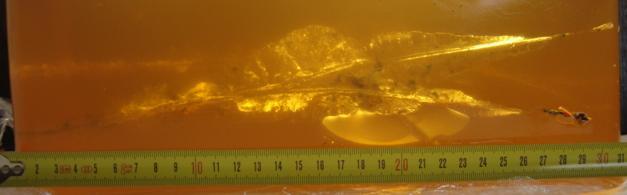
While the objective of the Hollow-point bullets are to increase the content of the permanent wound cavity, The objective of the C2F bullet is also to increase the content of the permanent wound cavity this by a controlled fragmentation. This controlled fragmentation divides the bullet energy over 2 or 3 fragments. This provides the fragments with the maximum energy to cause a deep penetration. The controlled fragmentation doubles the chance to hit a vital organ deep in the body of the opponent.
The cartridges 7.92x24 mm 3P
The 7.92x24mm 3P cartridge contains 3 projectiles. It is fired from a smoothbore barrel. The impact of the three projectiles are comparable with the impact of three pellets of a 12 gauge Magnum #1 buckshot.
7.92x24 mm BAP cartridges Brass Armor Piercing
Meany manufactures have a brass monoblock bullet in their productions. Also the 7.92x24 mm caliber has different types of brass monoblock bullets which have armor piercing capabilities at soft body armor level II and IIIA.
Although Brass Armor Piercing bullets for military use are common , the use of Brass Armor Piercing bullet for law enforcement is very controversial. Basically, according the international agreements concerning law enforcement ammunition, it is not allowed for a police officer to use bullets which can penetrate their own bullet proof vest.
However, the use of soft body armor generally increases and not only among law enforcement agencies. These days, more and more shootouts between criminals and law enforcement officers are disrupt by the use of body armor by the criminals. The shoot-outs go on until Special Intervention or S.W.A.T. teams take over with more adequate ammunition. The request for armor piercing bullets special for law enforcement officers increases. The Brass Armor Piercing bullets have a less drill performance then military armor piercing bullets.
The 7.92x24mm BAP cartridge is aimed at a police market where armor piercing bullets with a limited penetration are needed. Different types with different bullet weights exist.
7.92x24 mm AP-HPF cartridges (Armor Piercing - Hollow Point Fragmenting
A lot of discussions go about the ammunition choice for a law enforcement officer. Most police officers prefer a stopping bullet like a hollow point bullet because traditional armor piercing bullets have rather a low stopping effect. The 7.92x24 AP-HPF 5.7 uses a 5.7 mm hardened steel penetrator and a brass fragmenting hollow point sabot. The 5.7 hardened steel penetrator is able to defeat body armor and the fragmenting hollow point sabot increases the stopping power at unprotected targets.
The objective of this 7.92x24 AP-HPF 5.7 cartridge is to compete with the stopping power of the big .45 JHP bullets and also with the drill performance of the small PDW calibers 4.6x30mm and 5.7x28mm.
7.92x24mm FRA (Frangible) cartridges
The 7.92x24mm FRA (Frangible) bullets are made to break-up at impact. They can be used for indoor shootings.
The 7.92x24 mm cartridges for the military market
The 7.92x24mm Armor Piercing bullet technology.
The 7.92x24mm AP cartridges intent for the military market are based at a new patented bullet technology designed by Rik Van Bruaene. The military AP bullet contains a brass sabot and a hardened steel penetrator. This technology can be used in different calibers. Different dimensions of sabots and penetrators are possible. Every a small change on the identities of sabot or penetrator can change the identities of the bullet. A lot of combinations are possible.
Problems with the Geneva Convention.
To increase the stopping power of the 7.92 AP bullets, some bullet types where provide with a penetrator/sabot combination, which separates by impact at a body of the opponent. This separation of the penetrator and sabot in the body of the opponent, increases the content of the permanent wound cavity and doubles the chance to hit a vital organ. This is almost similar with the 2-part fragmenting bullets. Although, many love this increased lethality, some persons considered this separation effect as in conflict with the Geneva Convention. The separation strength from the sabot and penetrator can be changed by adapting the sabot identities. Other penetrator/sabot combinations don’t have a separation by impact at a human body.
Weapons for the 7.92x24mm N caliber
The PSW-Multicaliber pistol Cal. 7.92x24 mm 1
The prototype
Weapons Cal 7.92x24mm S
The Glock-VBR 7.92 pistol2
The Prototype VBR-Belgium PDW-Sidearm 3
Source
VBR-Belgium, Roeselare, Belgium 4
PSW Vertriebsgesellschaft Wicke, Aachen, Germany 5
Holden Custom Guns, Paderborn, Germany, 6