
.30 Walker
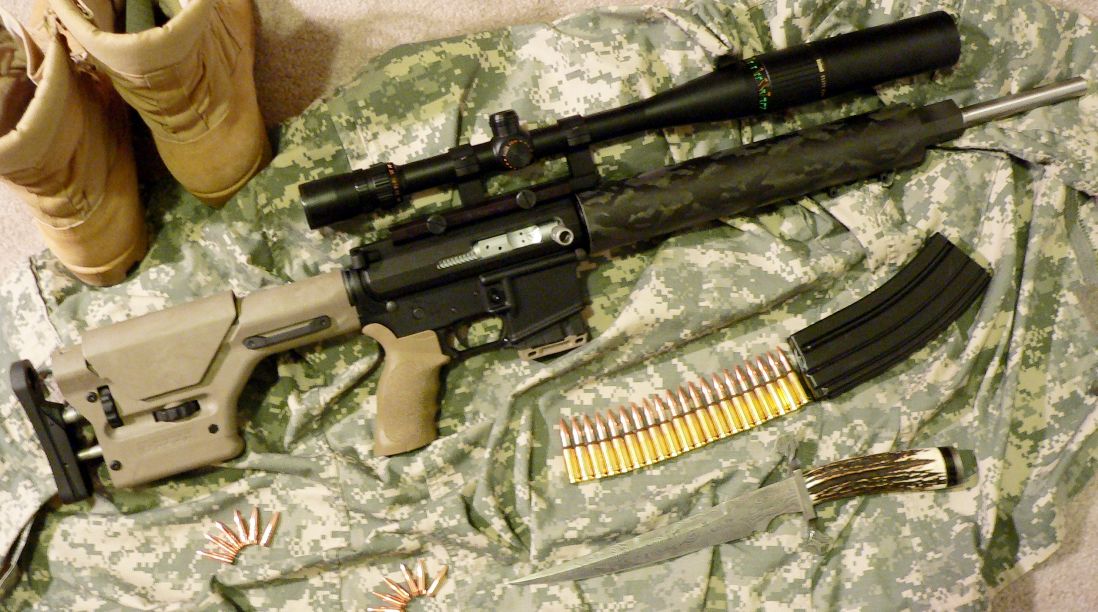 The .30 Walker is an intermediate cartridge developed by Mark Walker of Houston, Texas. This cartridge is an improved version of the PPC cartridge family designed by Dr. Lou Palmisano and Ferris Pindell in 1974. The .30 Walker was designed for 100-300 yard bench rest and f-class shooting using 112-118 grain flat based bullets in slow twist rate barrels.
The .30 Walker is made by using Lapua 6.5 mm Grendel brass and increasing the caliber to .308 and turning the neck diameter to .330".
Development and history
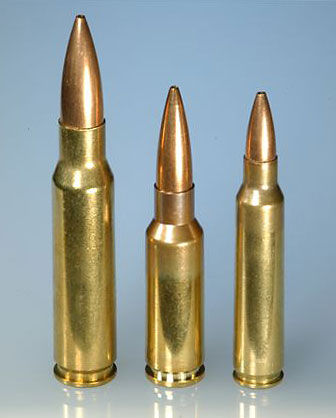
The 6.5 mm Grendel design philosophy has been summarized as "start slow and end fast". High muzzle velocities accelerate barrel wear and increase the percentage of recoil due to escaping gases but only yield good impact energy if the bullet is efficient at carrying its velocity downrange. Constrained by the length of the 5.56 mm NATO round, but wanting to launch a much heavier bullet, the Grendel designers decided to use a short, fat case for higher powder volume while saving space for long, streamlined, high ballistic coefficient (BC) bullets that give up little of their in-flight energy. Firing factory bullets from 90 to 129 grains , its muzzle velocity ranges from with 129- and bullets to with bullets (similar in velocity to a 5.56 mm round).
The case head diameter of the Grendel is the same as that of the parent case the .220 Russian or siblings 7.62 x 39mm and the famous PPC cases, slightly larger than the 5.56x45mm NATO. This results in a minor reduction in the storage capacity of standard size M16/AR15 magazines. A Grendel magazine with the same dimensions as a STANAG 30 round 5.56 magazine will hold 26 rounds of 6.5 ammunition.
Interestingly, the Grendel, as well as the competing 6.8 mm Remington SPC round, bear resemblance to the 50 years older .280 British, both in ballistics and tactical concept. The US Army chose the 7.62x51mm NATO over the .280 British.
Timeline
- 1998: Arne Brennan conducts a theoretical study in multiple calibers and case designs to develop a new competition round for the AR15 that replicates or exceeds the performance of the 7.62 NATO (.308 Winchester). The design parameters required the cartridge, in a magazine restricted loading, to be capable of propelling a projectile with a ballistic coefficient of .460-.500 at velocity of 2650 fps in a 20 inch barrel configuration. After evaluating multiple calibers and cartridges, the result of this research was the creation of a 6.5mm variant of the PPC cartridge with the chamber optimized for the AR15 platform. The goal of the project was achieved when the completed rifle with new cartridge achieved performance of 2650 fps with bullets up to 128 grains.
- 2000: Arne Brennan and Dr Louis Palmisano (creator of the 22 and 6mm PPC cartridges) begin comparing data on the 6.5mm performance obtained through many thousands of rounds of shooting by Arne Brennan out to distances of 1000 yards. Dr. Palmisano and Arne continue work for many years developing specialty bullets in conjunction with JLK, Berger, and Cauteruccio Bullets.
- Summer 2002: Arne Brennan and Bill Alexander introduced by Lothar Walther. Arne begins to share his data and designs with Bill Alexander.
- May 2003: Alexander Arms demonstrates first prototype 6.5 mm Grendel weapon at Blackwater Shoot-out.
- January 2004: First appearance of the new cartridge at the NSSF SHOT Show in Las Vegas with brass manufactured under contract by Lapua. Building on previous work Lapua had done on a 338 Tactical prototype cartridge, Janne Pohjoispaa, R&D Engineer for Lapua, revised the cartridge by moving the shoulder forward. This change from the classic PPC design was done to improve the manufacturing process, and to minimize tooling expense.
- May 2006: Independent ballistic gelatin testing completed for TNT, Norma, SMK, and SMK prototype.
- Aug 2006: Bill Alexander publishes pressure safe load table for AR platforms with 14.5- to 28.0-inch (370–710 mm) barrels.
- Aug 2006: Competition Shooting Sports, Inc. discontinues "6.5 Grendel" branded products, and releases "6.5 CSS" chambering with .295 neck chamber.
- Feb 2007: Production Wolf brand ammunition becomes available.
- Nov 2009: Hornady announces 6.5 Grendel 123gr AMax round.
- Jan 2010: Les Baer Custom, Inc. discontinues offering "6.5 Grendel" branded rifles, upper assemblies and loaded ammunition, and releases the .264 LBC-AR complete with brass manufactured by Hornady and loaded ammunition from Black Hills Ammunition at the 2010 SHOT show.
Performance
Proponents assert that the Grendel is an ideal middle ground between the 5.56 mm NATO and the 7.62 mm NATO, taking the best attributes of each. It has a flatter trajectory and retains greater terminal energy at extended ranges than either of these cartridges due to its higher ballistic coefficient. Production rifles have consistently achieved sub–minute of angle (MOA) groups at test ranges out past 600 meters. On March 6, 2006, Arne Brennan achieved a witnessed group with the Lapua 108 Scenar at . using a custom built bolt action rifle with a .295 neck / 1 degree throat chamber. Similar accuracy was demonstrated at recent Blackwater Shootouts. Competitions have begun to be won with the 6.5 Grendel although use of the round is still not common in competition.