
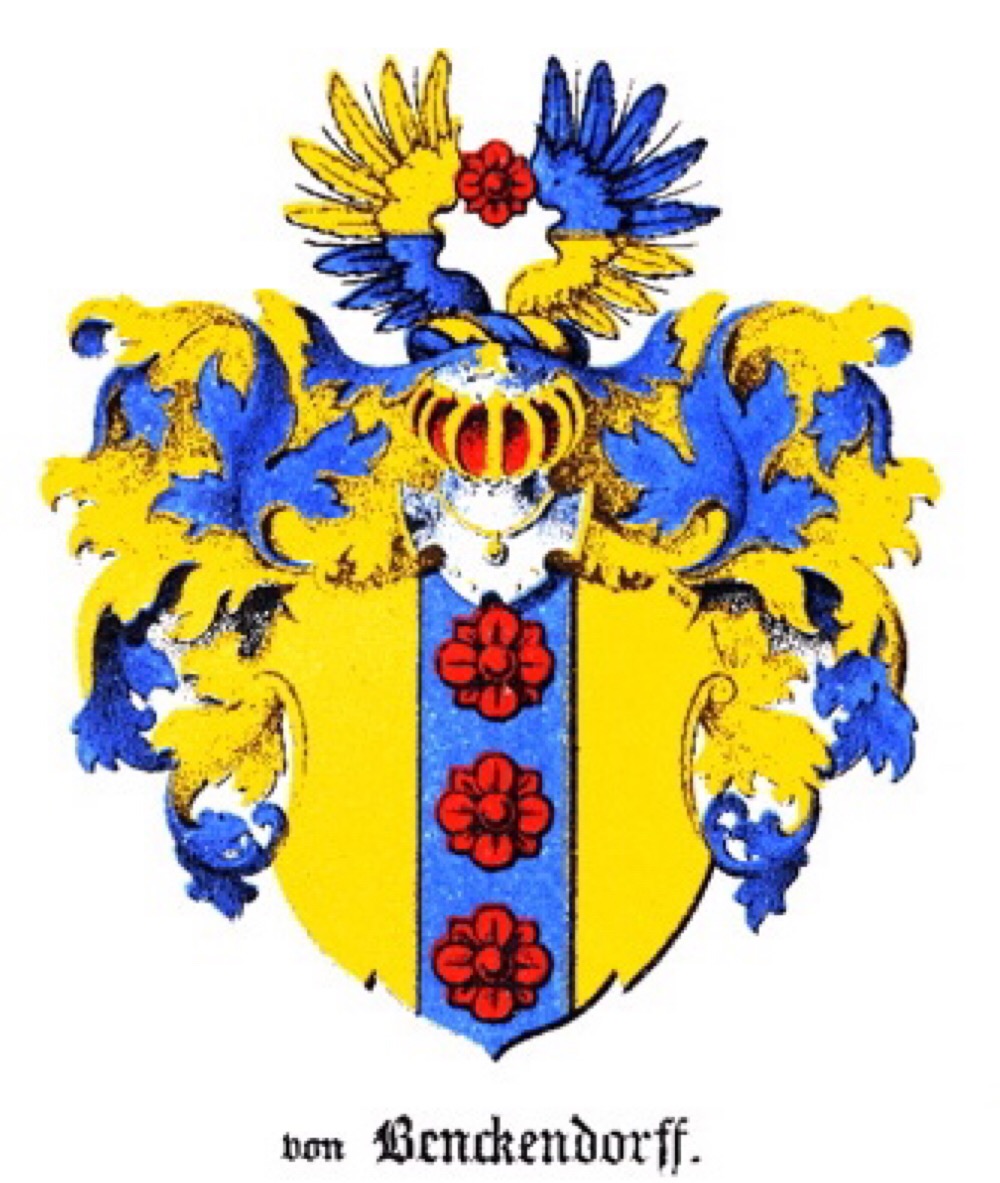
The Benckendorff family is a German noble family whose descendants became prominent in Brandenburg, Livonia, Swedish Livonia and the Russian Empire. The family name has appeared in numerous historical forms, including Benkendorpe, Benkendorf, Benckendorf, Benckendorff, Benkendorff, Benekendorff and von Benckendorff. The similarly named Beneckendorff family, later styled von Beneckendorff und von Hindenburg, is generally treated as a distinct noble family, although a possible common origin has long been the subject of genealogical speculation.
The Benckendorffs are generally discussed in three principal historical branches: the Brandenburg line, associated with the Altmark, Crossen an der Oder, Frankfurt an der Oder and later Danzig; the Livonian line, prominent in Riga; and the Russian line, whose members entered the service of the Romanov dynasty and became generals, governors, diplomats, courtiers and statesmen.
Among the best-known members of the family were Alexander von Benckendorff (1782–1844), Russian cavalry general, statesman and founding chief of the Special Corps of Gendarmes; Dorothea, Princess Lieven, one of nineteenth-century Europe's most influential political hostesses and diplomatic intermediaries; and Count Alexander Konstantinovich von Benckendorff (1849–1917), Russian ambassador to the United Kingdom during the years preceding and during the First World War. Other members served successive Russian emperors from Catherine the Great to Nicholas II.
Following the Russian Revolution, members and descendants of the Russian branch became part of the wider Russian émigré diaspora, particularly in Britain and Western Europe. Through marriage, the wider family was associated with Moura Budberg, the Russian émigré, translator and literary figure connected with Maxim Gorky and H. G. Wells. Later descendants included the British business leader Dame Helen Alexander.
Barend Jacobus "Ben" Marais (26 April 1909 – 27 January 1999) was a South African Dutch Reformed minister, theologian, church historian and ecumenist. He was among the earliest prominent Afrikaner theologians within the Dutch Reformed Church (DRC) to reject attempts to justify racial segregation and apartheid from the Bible.
Marais served as a professor of church history and church polity at the University of Pretoria from 1954 until his retirement in 1974 and subsequently taught at the University of South Africa until 1986. He participated in international ecumenical organisations, contributed to the anti-apartheid theological collection Vertraagde Aksie (Delayed Action), and was a founding member of the Christian Institute of Southern Africa. Although his early criticism did not amount to an immediate rejection of every form of racial separation, his challenge to the biblical foundations of apartheid helped establish a tradition of dissent within the DRC later associated with theologians such as B. B. Keet, Beyers Naudé and David Bosch.
Casper Jeremiah Labuschagne (4 April 1929 – 5 October 2019), often known as Cas Labuschagne, was a South African-born theologian, Hebrew Bible scholar and minister who spent most of his academic career at the University of Groningen in the Netherlands. His research focused on the Old Testament, particularly the Book of Deuteronomy and the literary and numerical structures of biblical texts.
Labuschagne was also an outspoken opponent of apartheid and of its theological justification by white Afrikaans churches. His support for the dissident theologians Albert Geyser and Adrianus van Selms brought him into conflict with the leadership of the Netherdutch Reformed Church of Africa. He left the denomination and South Africa in 1967. Shortly before his death, the church formally acknowledged the mistreatment of Labuschagne and other theological dissidents of the 1960s.
Berend Gemser (17 May 1890 – 15 November 1962) was a Dutch theologian, Old Testament scholar, Semiticist, Hebraist and minister. He served as professor of both Old Testament Studies and Semitic Languages at the University of Pretoria from 1926 until 1955 and subsequently as professor of Old Testament at the University of Groningen. He is regarded as a founder of the scientific study of the Old Testament and the languages and cultures of the ancient Near East in South Africa.
Gemser became internationally known for his work on biblical wisdom literature, particularly the Book of Proverbs, as well as his studies of Hebrew law, religious terminology and the relationship between the Old Testament and the cultures of ancient Babylonia, Assyria, Egypt and Sumer. His Afrikaans grammar of Biblical Hebrew and his publications on biblical translation contributed to the development of biblical scholarship in Afrikaans.
Although he had become closely integrated into Afrikaans academic and church life, Gemser increasingly criticised racial and nationalist interpretations of Christianity. He opposed attempts to subordinate university scholarship to nationalist or confessional ideology, warned against National Socialism, and in 1961 rejected the biblical and theological legitimation of apartheid.