
thumb|200px|
Umbrella.net is a project with 10 Bluetooth and PDA-equipped umbrellas which make up a mobile network. Artists Jonah Brucker-Cohen and Katherine Moriwaki develop a transient network, (an Ad hoc Mesh network) both technological and social. They embed wireless devices in umbrellas--a daily object which fluctuates weather conditions. As a result, the network only appears with the "coincidence of need" that occurs with the first drop of rain.
The ruling applied by extension to employer-employee relations and this was confirmed within a few months after the ruling when the French supreme Court (cour de cassation) overturned lower and appeal court rulings for an employee who had been dismissed for non-professional use of e-mail by Nikon-France.
Three senior staff at the École Supérieure de Physique et de Chimie Industrielles de la Ville de Paris (ESPCI) in Paris, including the head of a department, professor Hans J. Herrmann, the laboratory computer system administrator, Mrs. Francoise Virieux and a scientist who assisted her in
network administration, professor Marc Fermigier, were found guilty of "violation of the secrecy of correspondence", after prosecution under article 432-9; paragraph 2 of the French penal code. The three had colluded in January 1997 in the espionage of the e-mail of a doctoral candidate at the time, Dr. Tareq AlBaho, with the head of department, professor Herrmann, requesting the other two to undertake the espionage.
The original article of the penal code had referred to "private correspondence" between two parties without specifying technical details of the method of communications. The ruling, which was upheld by the criminal court of appeals on Paris in December 2001, effectively made espionage of e-mail equivalent to tapping a phone line or steaming open a letter.
The ruling was the first of its kind in France, and a great rarity worldwide.
The judgement defined "private correspondence" as "all written connections between two identifiable persons, whether concerning messages, letters or contained in sealed or unsealed envelopes". The ruling brought e-mail firmly under the auspices of post and telecommunications law. The guilty verdicts were handed down despite the fact that the charter of the specific system concerned in the case, the Renater network between academic and scientific institutions in France, banned private or non-professional use of resources.
But the court affirmed that this ban (which in any case was not being enforced at the time at ESPCI) did not negate the right to private correspondence.
Before the court of appeal in 2001, the three guilty parties resorted to a broader claim in attempting to overturn their convictions by asserting that network administrators should have unrestricted rights to read the contents of user e-mail in order to detect viruses and deal with security threats to networks. However, when the system administrator on trial, Francoise Virieux, was asked how reading the contents of user e-mail could help network
security, she had no reply. The court of appeal finally dismissed this defence, ruling that security issues could not justify sereptitious e-mail surveillance (at the very least, the user should be informed if any security issues required any intrusion into their correspondence). The court of appeals further noted that in this case Virieux and Fermigier, acting as system administrators,
were not only spying on Tareq AlBaho's e-mail, but were also systematically sending copies of all his correspondence to Herrmann, and there could be no justification for that.
None of the three convicted parties chose to appeal to the cour de cassation.
On the levels of student rights and academic ethics, the AlBaho case provides the only known case where a complaint to criminal prosecutors by a doctoral candidate resulted in successful criminal prosecutions of senior academic staff, including the supervisor of the doctoral candidate who made the original complaint. The case is especially unique given that the accused
academic staff had the full support of the hierarchy at their institute in first attempting to conceal and then defend their actions.
After the espionage on his email in January 1997, Dr. AlBaho was forced to abandon his doctoral work at ESPCI (he was 10 months away from submitting and defending his thesis). Subsequent letters addressed by him to the head of ESPCI at the time, Nobel laureate professor Pierre-Gilles de Gennes, and requesting a peaceful resolution to the dispute, received no reply. Finally, when Dr. AlBaho succeeded in seeking the intervention of the senior Paris politician, Georges Sarre, De Gennes replied and alleged that Dr. AlBaho's "re-inscription" had been denied. In fact De Gennes had fabricated a bogus administrative procedure to try and cover up what had taken place. At that point Tareq AlBaho filed criminal charges with the public prosecutor in Paris and the subsequent police investigation uncovered the truth.
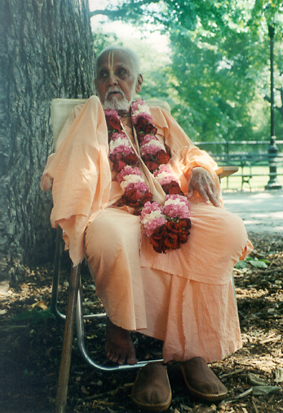 The Sri Krishna Chaitanya Mission was founded in 1966 with the establishment of Sri Krishna Chaitanya Ashram in Kakinada, Andhra Pradesh, but was not officially registered under its current name until 1983. The organisation has eighteen (18) ashrams in India, as well as a worldwide following. Over twenty (20) Sanyasa initiates, as well as Srila BV Puri Maharaj himself, spreading the preaching campaign to communicate the tenants of Gaudiya Vaishnava Theology.
The Sri Chaitanya Chandra Ashram in Puri is considered to be the flagship matha; the other mathas are found primarily in Orissa and Andhra Pradesh, as well one in Seva Kunj, Vrindavan and one in Isodyan, Mayapur. Several years ago, European disciples of Maharaj established the Sri Sri Radha Govinda Mandir in Vienna, Austria.
The Sri Krishna Chaitanya Mission also publishes a multitude of books as "Sri Bhakti Bigyana Nityananda Book Trust". The books are printed in Oriya, Telugu, Hindi, and English, but European followers have also reprinted books in Italian, Spanish and Croatian.
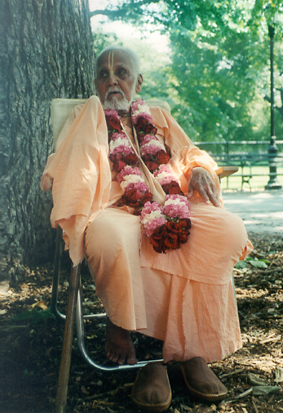 Bhakti Vaibhava Puri Goswami is the founder-acharya of the Sri Krishna Chaitanya Mission, one of the most notable preachers of Gaudiya Vaishnavism in the 20th century, and a regional leader (based in the Indian State of Orissa) of Mahatma Gandhi's freedom fighting movement.
Srila Puri Maharaj was born in the village of Fulta, adjacent to the city of Berhampur in the state of Orissa, India on the 27th of January of 1913. His given name at birth was Nrusimgha. The name of his father is Sri Damodar and the name of his mother is Srimati Devi. He attended Khallikote Autonomous College in the city of Berhampur, where he received a B.A. degree.
In the 1930s, Srila Puri Maharaj completed his studies in Ayurveda, and also became active in the independence movement led by Mahatma Gandhi. According to his biography, he was a regional president of the independence movement during that time.
Srila Puri Maharaj's Ayurvedic Instructor, Kaviraja Sripad Madhusudan Sharma, was also an initiated disciple of Gaudiya Vaishnava Acharya Srila Bhaktisiddhanta Sarasvati Thakura. Through the intervention of his Ayurvedic Instructor, Srila Puri Maharaj was brought to see Bhaktisiddhanta, and on August 3rd, 1936, took initiation from him in the Gaudiya Vaishnava tradition. Thus began a long lifetime of spiritual service in the monastic tradition of Gaudiya Vaishnavism.
In 1966, after almost three decades as an initiated Gaudiya Vaishnava, he accepted the sacred renounced order of Sanyasa from Srila Bhakti Swarupa Giri Maharaj. In June of 1966, Srila Puri Maharaj formed the Sri Krishna Chaitanya Ashram in Andhra Pradesh. At the present day, Maharaj's organization the Sri Krishna Chaitanya Mission has approximately 20 ashrams. The mission has also published several books in multiple languages (English, Oriya, etc.) including "The Divine Name" by Raghava Chaitanya Das, "Sri Sri Chaitanya Bhagavata" by Vrindavan Das Thakur, "Srimad Bhagavad Gita", 11th canto of "Srimad Bhagavatam", A Brief Life History of Sri Srimad Bhakti Vaibhava Puri Goswami Maharaj, Lord Sri Jagannath, Sri Caitanya Mahaprabhu, etc.
Bhaktisiddhanta Sarasvati Thakura had many disciples, the most notable of whom being Srila A. C. Bhaktivedanta Swami Prabhupada, the world's foremost preacher of Gaudiya Vaishnavism outside of India (sometimes called the "Hare Krishna" movement by some). Srila Prabhupada's relationship with Srila Bhakti Vaibhava Puri Maharaj is best epitomized in this letter written by Prabhupada on December 2, 1970; "My Dear Puri Maharaj, Perhaps you are my only Godbrother who has appreciated my humble service to the cause of Guru Gauranga. All my other Godbrothers are very much envious, as I can understand from their behavior." In 1971, Srila Puri Maharaj invited Srila Prabhupada to inaugurate a new temple at Rajahmundry on the banks of the Godavari river.
In the late 1990s, following the footsteps and tradition of A. C Bhaktivedanta Swami Prabhupada, Srila Puri Maharaj began his tours of communicating Gaudiya Vaishnava Theology to the Western World. 1997 marked the beginning of annual European tours which continue to the time of this article's creation. 2001 marked his first tour around the world, at the advanced age of 89. In that year, Maharaj traveled to the European Union, the United States of America, Mexico, Australia, and Thailand.
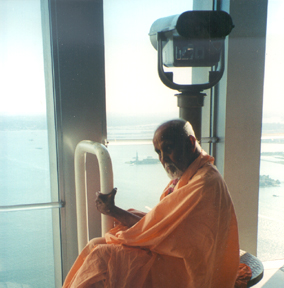
One of the most memorable events of the 2001 World Tour occurred on Saturday August 25, 2001. On that day, Srila Puri Maharaj and over a dozen devotees visited the top floor of World Trade Center Tower 2, and conducted a short nagar-sankirtana event. His most recent tour of the European Union in 2005 at the advanced age of 92 recognizes Srila Puri Maharaj as the eldest known travelling Gaudiya Vaishnava acharya, having followers all over India, as well as Europe, Thailand, North America, and Australia.