
Spain–Tanzania relations are the international relations between the two countries. Tanzania does not have an embassy in Spain, but its embassy in Paris is accredited to Spain. Spain has an embassy in Dar es Salaam and an honorary consulate in Zanzibar.
Bilateral relations
Relations between Spain and Tanzania are stable and positive, with cooperation focused on several key areas. In fishing, for example, about half of Spain's tuna fleet, based in the Seychelles, operates in Tanzanian waters under licenses that are renewed annually.
Maritime security is another important area, as Tanzania and the Mozambique Channel are considered high-risk regions for piracy and other threats. Spanish ships patrol Tanzanian waters as part of the European Union's Operation Atalanta and NATO's Operation Ocean Shield, often calling at Dar es Salaam. The EU, together with allies such as the United States and Japan, works to strengthen Tanzania's naval and maritime security capabilities. Since 2013, Tanzania has participated in the EUCAP Nestor mission, aimed at improving regional maritime security, with Spain also involved.
Tourism is a growing field of cooperation. Spain, a global leader in the sector, has established a presence in Tanzania through investment by Meliá Hotels International in Zanzibar, as well as the annual participation of the Tanzanian tourism sector, both nationally and as part of the East African Community (EAC), in FITUR and its Investment Forum, INVESTOUR.
Energy is another priority, as Tanzania represents a significant market. Spanish companies have implemented rural electrification projects and participated in constructing power plants, including ISOLUX. Opportunities also exist in the development of oil and, particularly, gas sectors.
Overall, commercial exchanges between the two countries remain limited.
Cooperation
Tanzania is not included in the list of priority countries established by the current Spanish Cooperation Master Plan (2013–2016), and therefore does not receive bilateral official development assistance.
From a multilateral perspective, in 2014, a grant of US$1.5 million was approved for Tanzania through the Spain-UNDP Trust Fund to support the achievement of the Sustainable Development Goals during the 2014–2016 period. The project is being implemented through the Tanzania Social Action Fund (TASAF).
Tanzania has also received other contributions in the recent past, including €6 million between 2008 and 2010 for the United Nations "Delivering as One" program, as well as specific contributions such as €2 million to the World Food Programme (WFP) in 2009. In that same year, the Spanish Food and Emergency Aid sector granted €2,000,000 to the WFP for the project "Assistance to Refugees in Camps and Vulnerable Households among the Host Population in North-Western Tanzania."
Spain also contributed €6 million over three years (2008–2010) to the United Nations "Delivering as One" program.
See also
- Foreign relations of Spain
- Foreign relations of Tanzania
References
Tanzania Category:Bilateral relations of Tanzania
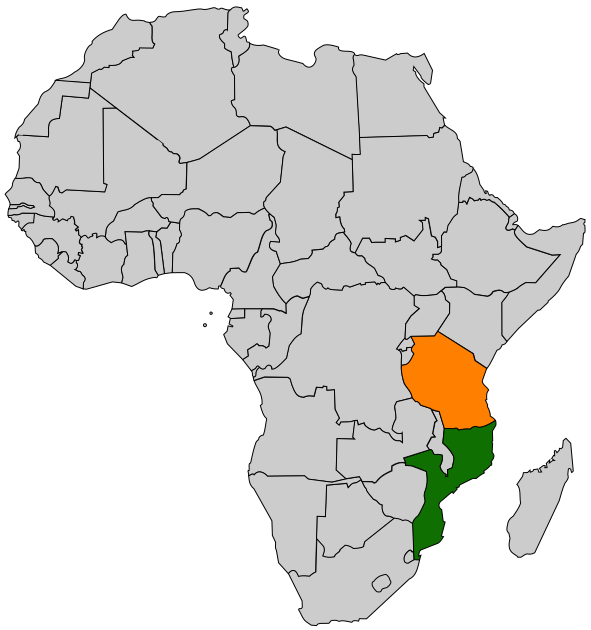 The Mozambique–Tanzania border is a 756 km-long continuous international border separating Mozambique and Tanzania in East Africa.
Description
The border begins along the shores of Lake Malawi and then takes a west–east direction. It briefly passes through the Livingstone Mountains and then follows the course of the Ruvuma River until its mouth in the Indian Ocean, north of Cape Delgado.
History
The origins of this border date back to the 16th century. At that time, the East African coast was dominated by the Portuguese, who had established some settlements. The raids by Ottoman corsairs in 1585 and 1589 along these coasts, as well as the invasion by an inland tribe, the Zamba, during the same period, prompted the Portuguese to better organize their possessions. They thus created the Captaincy of Mombasa in 1593, whose boundary with the Captaincy of Sofala passed through Cape Delgado. This demarcation formed the basis of the current border, which is in fact considered one of the oldest borders in Africa.
The current border line was established between the Portuguese settlement of Mozambique and the German settlement of Tanganyika at the end of the 19th century during the partition of Africa by the European powers.
Crossing points
The border is crossed mainly along the coast between the Tanzanian city of Mtwara and the Mozambican town of Quionga. A 600 m-long road bridge, the Unity Bridge, is under construction between the two cities.
See also
- Mozambique–Tanzania relations
References
Tanzania Category:Borders of Tanzania Category:International borders
Central African Republic–Republic of the Congo relations are the bilateral diplomatic relations between the Central African Republic (CAR) and the Republic of the Congo. The two countries share a state border measuring 487 km in length.
History
In 2012, a civil war began in the Central African Republic, which led to the arrival of refugees from the country in the Republic of the Congo. The president of the Republic of the Congo, Denis Sassou Nguesso, played an important role in facilitating political negotiations between the parties to the conflict in the Central African Republic ahead of the elections in late 2015 and early 2016.
The Republic of the Congo has provided financial assistance to the Central African Republic, including a loan of €38 million as well as a donation of €6 million to pay salaries. The Republic of the Congo also participates in the United Nations peacekeeping mission MINUSCA and has deployed a contingent of 981 military personnel and police officers to the Central African Republic.
In 2018, there were 26,403 refugees from the Central African Republic in the Republic of the Congo. In the same year, with the support of the Office of the United Nations High Commissioner for Refugees, several hundred refugees returned home from the Betou camp in northwestern Republic of the Congo.
See also
- Foreign relations of the Central African Republic
- Foreign relations of the Republic of the Congo
- Central African Republic–Republic of the Congo border
References
Republic of the Congo Category:Bilateral relations of the Republic of the Congo
Democratic Republic of the Congo–South Sudan relations are the bilateral diplomatic relations between the Democratic Republic of the Congo and South Sudan. The two countries share a state border measuring 714 km in length.
History
In 1998, the Sudan People's Liberation Army crossed the border and looted part of the northern territory of the Democratic Republic of the Congo. At that time, border control was virtually nonexistent, and active arms trafficking may have taken place between the Democratic Republic of the Congo and South Sudan. Despite borders established by colonial powers that divided ethnic groups, postcolonial Congolese and Sudanese relied on shared ethnic affiliations to develop cross-border cultural, economic, and trade ties.
Civil wars in the Democratic Republic of the Congo and South Sudan over the past thirty years have caused temporary and, in some cases, permanent migration of combatants between the two countries. The border is characterized by minimal control, difficult-to-access roads, and challenging terrain. Active and former soldiers of the Sudan People's Liberation Army have used their ethnic connections in the Democratic Republic of the Congo to trade in weapons and other goods.
On 13 July 2011, the Democratic Republic of the Congo recognized the independence of South Sudan from Sudan.
In 2022, there were 56,303 refugees from South Sudan living in the Democratic Republic of the Congo, while 19,402 refugees from the Democratic Republic of the Congo were residing in South Sudan. Both states are members of the East African Community.
See also
- Foreign relations of the Democratic Republic of the Congo
- Foreign relations of South Sudan
- Democratic Republic of the Congo–South Sudan border
References
South Sudan Democratic Republic of the Congo