
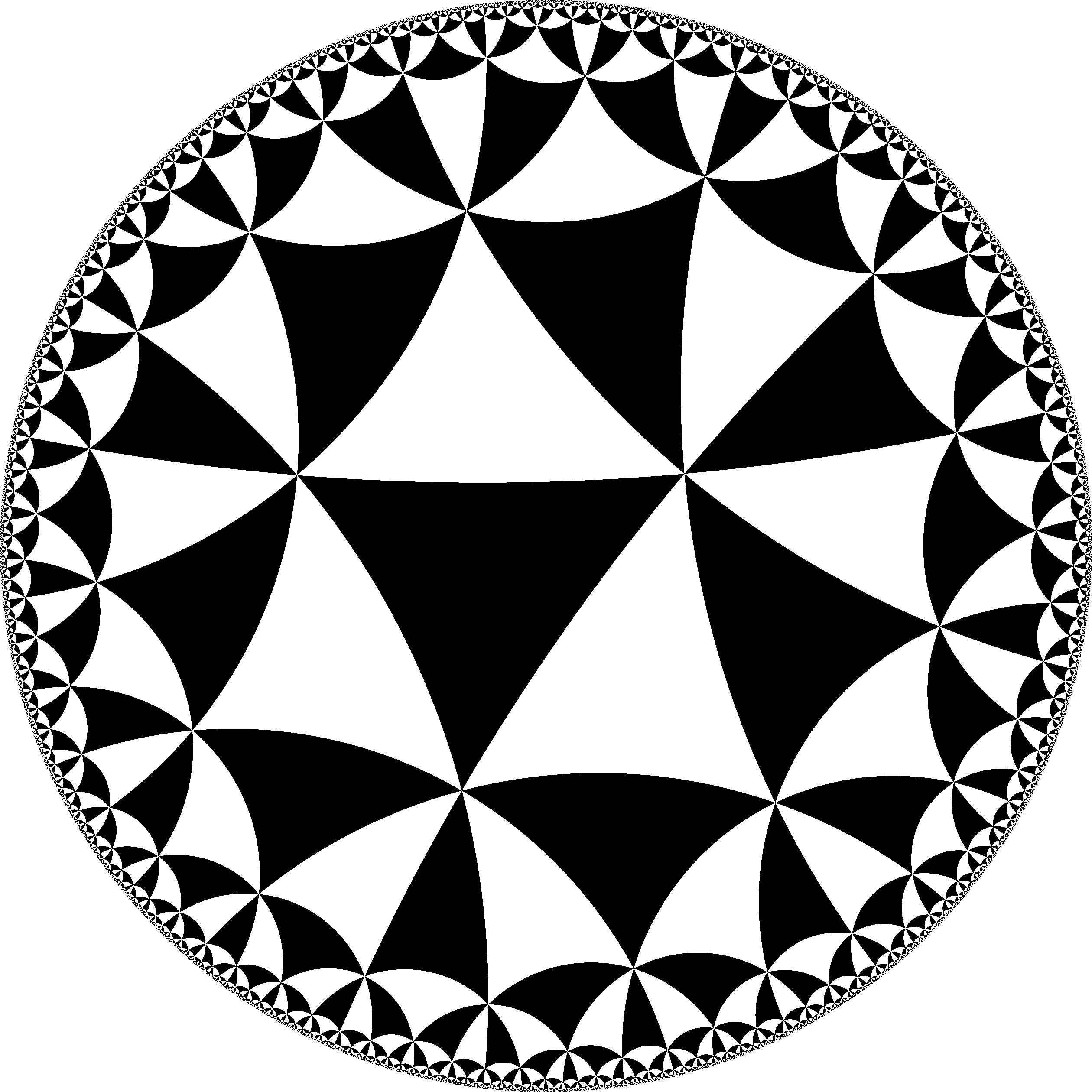
In geometry, the tetraoctagonal tiling is a uniform tiling of the hyperbolic plane.
Constructions
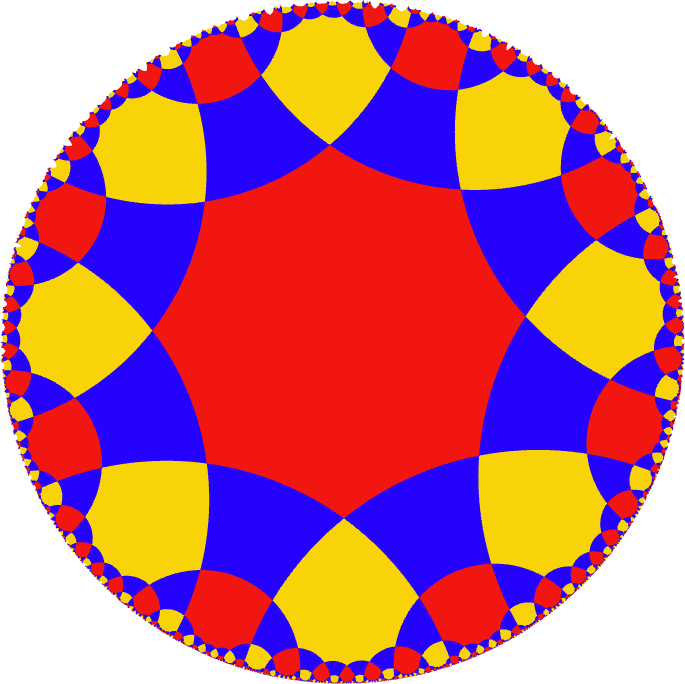
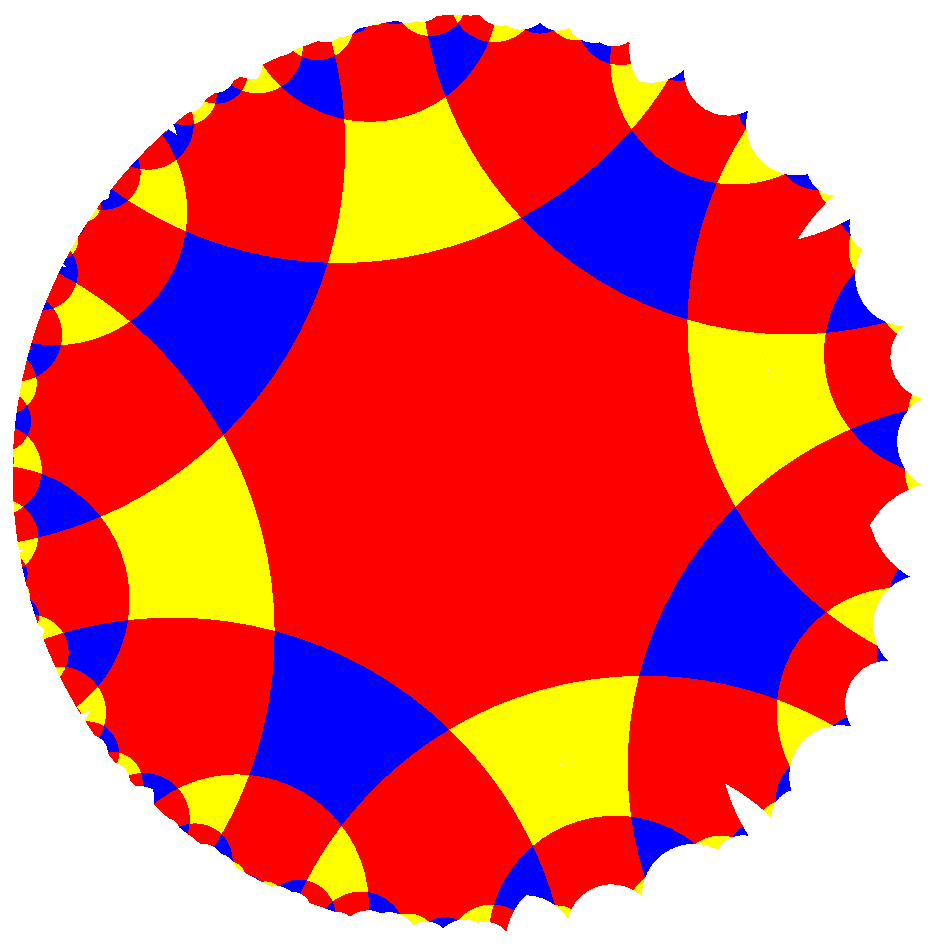
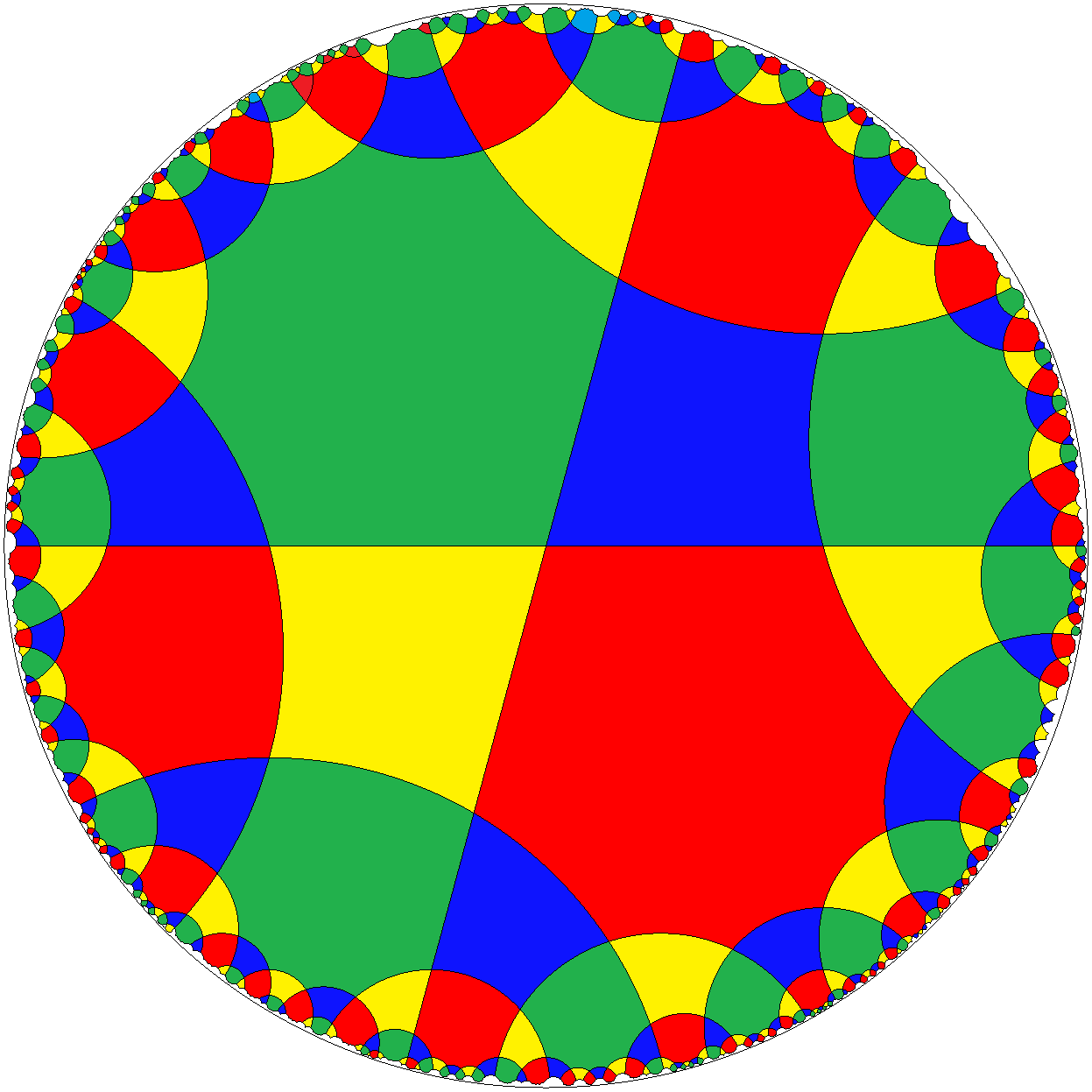
There are for uniform constructions of this tiling, three of them as constructed by mirror removal from the [8,4] or (*842) orbifold symmetry. Removing the mirror between the order 2 and 4 points, [8,4,1+], gives [8,8], (*882). Removing the mirror between the order 2 and 8 points, [1+,8,4], gives [(4,4,4)], (*444). Removing both mirrors, [1+,8,4,1+], leaves a rectangular fundamental domain, [(∞,4,∞,4)], (*4242).
Name |
Tetra-octagonal tiling |
Rhombi-octaoctagonal tiling |
||
|---|---|---|---|---|
Image |

|
|
|
|
Symmetry |
[8,4] |
[8,8] = [8,4,1+] |
[(4,4,4)] = [1+,8,4] |
[(∞,4,∞,4)] = [1+,8,4,1+] |
Schläfli |
r{8,4} |
rr{8,8} |
r(4,4,4) |
t0,1,2,3(∞,4,∞,4) |
Coxeter |
= |
= |
= or |
Symmetry
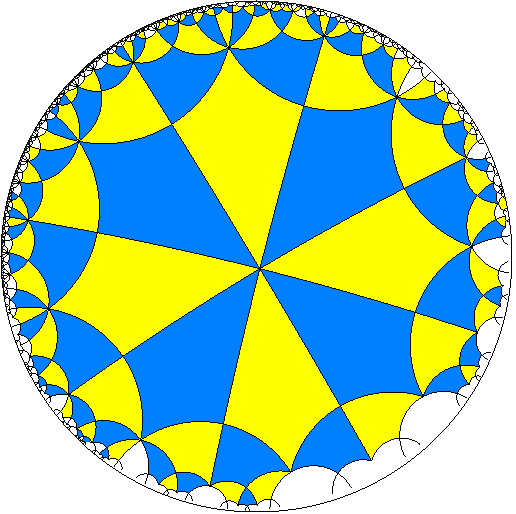
The dual tiling has face configuration V4.8.4.8, and represents the fundamental domains of a quadrilateral kaleidoscope, orbifold (*4242), shown here. Adding a 2-fold gyration point at the center of each rhombi defines a (2*42) orbifold.
|
|
See also
- Square tiling
- Tilings of regular polygons
- List of uniform planar tilings
- List of regular polytopes
References
- John H. Conway, Heidi Burgiel, Chaim Goodman-Strauss, The Symmetries of Things 2008, (Chapter 19, The Hyperbolic Archimedean Tessellations)
External links
- Hyperbolic and Spherical Tiling Gallery
- KaleidoTile 3: Educational software to create spherical, planar and hyperbolic tilings
- Hyperbolic Planar Tessellations, Don Hatch